Immigration News: Bronx Teen’s Mother Gets Visa Help
Meta description: New York City Mayor Zohran Mamdani says President Trump agreed to grant an immediate visa to the mother of Javits Frimpong, the 15-year-old shot dead in the Bronx.
In immigration news that has cut across the usual lines of American politics, New York City Mayor Zohran Mamdani announced on Saturday, October 31, 2026, that President Donald Trump had agreed to grant an immediate visa to the mother of a 15-year-old boy who was shot dead while walking to school in the Bronx. The boy, Javits Frimpong, a Ghanaian immigrant and a tenth-grade student, was killed on Thursday morning, October 29, in the Claremont neighbourhood of the borough. His mother, Doris Adu Gyamfi, lives in Kumasi, Ghana, thousands of miles from the place where her son died. According to Mamdani, a telephone conversation with the president on Saturday cleared the way for her to travel to New York to say goodbye to her son in person and to take part in his funeral arrangements. The announcement, made in a post on the social media platform X, was quickly picked up by Ghanaian news outlets and by community publications in New York, and it was followed within hours by a promise from the government of Ghana to pay the full cost of the mother’s journey.
The development is striking not only because of the grief at its centre, but because of who made it happen. Mamdani, the city’s mayor, and Trump, the president, are political opponents on almost every major question, and immigration policy is among the sharpest dividing lines between them. Yet in this case, according to Mamdani’s account, a direct phone call produced an immediate agreement on a humanitarian visa for a bereaved mother. That account has not yet been independently confirmed by the White House in the reporting reviewed for this article. Mamdani’s office did not specify what kind of visa would be issued or how the processing would be handled, and one outlet reported that the White House had not responded to a request for comment. Until the visa is actually in the mother’s hands, therefore, the arrangement remains, in the careful wording of one report, a promise rather than a completed journey. What is not in doubt is that the mayor made the announcement publicly, that Ghana’s government has acted on it, and that a family divided by an ocean is now waiting to be reunited for a funeral.
Trump News: What the Mayor Announced on Saturday
Mamdani’s announcement was short, direct, and framed entirely around the mother’s loss. In his post on Saturday, he said that the killing of a child was a pain no parent should have to bear, and that bearing it from thousands of miles away made it crueller still. He said that Javits Frimpong’s mother deserved the chance to say goodbye to her son face to face, and he reported that he had just spoken by telephone with President Trump, who had agreed to grant her visa immediately. He added that all of New York City was mourning the tragedy. The post did not go into administrative detail. It did not name a visa category, it did not give a date for the mother’s arrival, and it did not describe any conditions attached to the travel. Those gaps matter, because the difference between an agreement in principle and a visa issued in practice can be considerable, especially when the applicant is in West Africa and the funeral cannot wait indefinitely. But the mayor’s decision to announce the agreement publicly, in his own name, gave the family and the Ghanaian authorities something concrete to work with, and the Ghanaian government moved the same day.
The timing of the announcement also matters. Javits Frimpong was killed on Thursday, and by Saturday the story had already spread through the Bronx and through Ghanaian communities in New York and abroad. Vigils had been held, tributes had poured in from neighbours and from well-known figures in music, and the question of whether his mother would be able to attend his funeral had become part of the public conversation about the killing. A mother unable to bury her child because she lacks a visa is a particular kind of cruelty, and it is one that immigration systems are sometimes accused of producing without ever intending to. Mamdani’s intervention was aimed squarely at preventing that outcome. Whether the visa is processed through an expedited channel, through a humanitarian provision, or through some other route was not explained, and this article does not speculate about the mechanism. What the reporting establishes is the sequence: a phone call on Saturday, a public announcement by the mayor, and a response from Ghana’s government within hours.
Immigration News: A Boy Killed on His Way to School
Javits Frimpong was 15 years old, a tenth-grade student at DreamYard Preparatory School, and he had come to the United States from Ghana to live with his father. His father, Thomas Frimpong, works as a taxi driver in New York and told reporters that he had moved from Ghana to the city in 2000. His son followed much later, arriving in 2025 to join him, according to the accounts published since the killing. On the morning of Thursday, October 29, Javits left home for school and never arrived. Shortly before half past nine in the morning, he was shot once in the abdomen near East 171st Street and Crotona Place, in the Claremont section of the Bronx, not far from his school. Officers who reached the scene found him wounded and rushed him to St. Barnabas Hospital, where he later died from his injuries. The shooting happened in broad daylight, on a weekday morning, on a route that schoolchildren use every day, and that ordinariness is part of why the killing has shaken the neighbourhood so deeply.
The police investigation was still in its early stages on Saturday. The New York Police Department said it was searching for up to three male suspects believed to be teenagers, described in some reports as aged between 16 and 18. No arrests had been announced as of Saturday, October 31. Investigators had not publicly established a motive for the shooting, and they had not confirmed any connection between the killing and events at the boy’s school. That uncertainty has not stopped speculation, and it has placed the family in the painful position of grieving in public while the facts of the crime remain incomplete. The father’s account has added one element to the public record, but it remains, for now, an account rather than a police finding, and it should be read that way.
Bronx Shooting: The Bullying Account and What Police Have Said
Thomas Frimpong has told reporters that he believes bullying at school may have contributed to his son’s death. According to his account, Javits had complained about being bullied by fellow students, and the school principal had told him that two students who had bullied his son were suspended for a week, three days before the shooting. That sequence, if accurate, raises obvious questions about what the school knew, what it did, and whether anything more could have been done. But the reporting is careful on this point, and so is this article: the police have not established a motive, and they have not confirmed any link between the school incidents and the killing. A father’s belief, expressed in grief, is not the same as an investigative conclusion, and the distinction matters both for fairness to the students named in the account and for the integrity of the investigation itself. What can be said is that the bullying claim is now part of the story, that it has been widely reported, and that it will inevitably be examined as investigators reconstruct the days before the shooting.
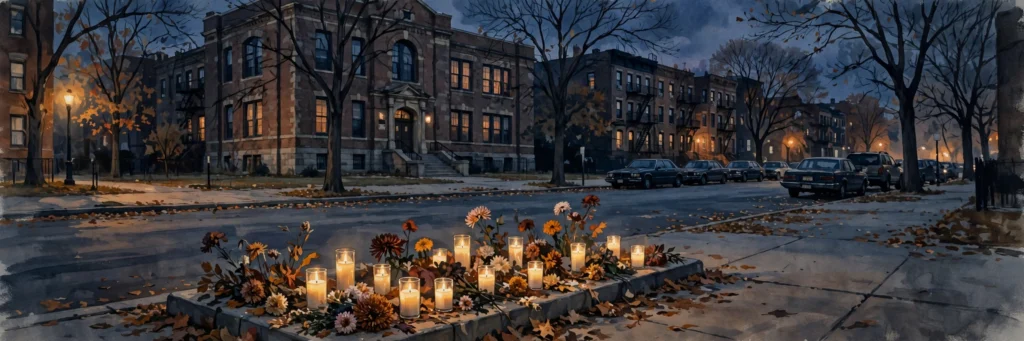
The wider community response has reflected both the shock of the killing and the particular circumstances of the victim. Javits was a newcomer, a teenager who had crossed an ocean to join his father and to attend school in a new country, and his death has been felt as a failure of protection as much as a crime. Neighbours gathered for vigils, including one attended by the mother of another young victim of violence in the borough, and tributes came from residents and from performers with ties to the Bronx. The borough has long prided itself on a sense of solidarity, on neighbours looking out for one another, and the killing of a child on his way to school tests that self-image in the most direct way possible. The visa announcement entered that atmosphere not as a political story, but as a human one: a mother, far away, learning that her son would not come home, and a city trying to make sure she could at least be present to mourn him.
White House News: Why the Visa Agreement Matters Beyond One Family
The agreement, if it is carried through as announced, matters beyond this one family because it touches a recurring tension in American immigration policy. The United States routinely grants visas for family emergencies, and bereaved parents seeking to attend a child’s funeral are among the most sympathetic cases any system encounters. At the same time, the system is slow, bureaucratic, and often opaque, and applicants from West Africa face particular hurdles, including long waits for appointments and high refusal rates for visitor visas. An intervention at the level of a mayor calling a president is not how the system is supposed to work, and it is not a route available to most families. That is why the case has drawn attention: it shows both that the system can move quickly when political will is applied, and that it usually does not move quickly at all. For advocates of a more humane immigration process, the case is evidence that expedition is possible. For critics of ad hoc interventions, it is evidence that the ordinary process is failing the people it should serve most readily.
There is also a political dimension that cannot be ignored, even though the family at the centre of the story has asked for nothing except to grieve. Mamdani and Trump have clashed repeatedly over immigration enforcement, over the treatment of immigrant communities in New York, and over the federal government’s role in the city. A phone call in which the president agrees to a request from the mayor is therefore newsworthy in itself, as a rare instance of cooperation between two figures who are usually in open conflict. It does not resolve any of those larger disputes, and it should not be read as a change in policy. It is, at most, a single humanitarian decision in a single case. But single cases have a way of becoming symbols, and this one, involving a murdered child and a mother an ocean away, is likely to be cited in future arguments about how the visa system treats grieving families, whether by those who want the system reformed or by those who want its discretion preserved.
Ghana Responds: Travel Costs and Funeral Support
Ghana’s government responded to Mamdani’s announcement with unusual speed and generosity. On Saturday, Foreign Affairs Minister Samuel Okudzeto Ablakwa announced that the government would cover the full travel costs of Madam Doris Adu Gyamfi, enabling her to travel to New York to pay her final respects to her son. Ablakwa said he had spoken with the mother on Friday, that he had assigned officials from the Ministry of Foreign Affairs to assist her with the visa application process, and that he had conveyed the condolences of President John Mahama. Officials from Ghana’s Permanent Mission in New York had already visited the family, according to the reporting. A separate Ghanaian report added that the government had also pledged to cover the funeral expenses, giving the family one less burden at a moment when every practical question feels overwhelming. Ablakwa framed the decision as a duty the country owed to one of its own, and he thanked Mamdani for his intervention, describing the mayor in warm terms that reflected the pride many Ghanaians feel in a figure of Ghanaian heritage holding high office in New York.
The Ghanaian response also clarifies the practical shape of what happens next. The mother is in Kumasi, Ghana’s second city, and she will need not only a visa but also flights, documentation, and support on arrival. The government’s commitment to fund the journey removes the financial barrier, which for many families would be decisive on its own. What remains is the administrative barrier: the visa itself, and the speed with which it can be issued. Mamdani’s announcement said the visa would be granted immediately, but immediacy in a public statement and immediacy in a consular process are not always the same thing. The involvement of Ghana’s foreign ministry, with officials assigned to assist the application, should help, but the reporting reviewed for this article does not describe a timeline for the mother’s departure, and this article does not invent one. She is expected to travel to New York in the coming days, according to the Ghanaian coverage, and the funeral arrangements will follow her arrival.
What Happens Next: A Funeral, an Investigation, and a Visa to Deliver
Three separate tracks now run in parallel, and each will resolve on its own timetable. The first is the most urgent for the family: the visa and the journey. If the agreement announced on Saturday is honoured promptly, Doris Adu Gyamfi will be able to travel to New York, to see her son, and to be present for his funeral. If there are delays, the family will face the painful choice of waiting or proceeding without her, and the public attention on the case will make any delay conspicuous. The second track is the police investigation. Three teenage suspects remain at large, no arrests have been announced, and no motive has been established. The investigation will determine whether the bullying account has any bearing on the crime, whether the suspects are identified and apprehended, and whether charges follow. The third track is the school’s own reckoning with what it knew and what it did in the days before the shooting, a question that will matter to parents across the borough regardless of what the criminal investigation finds.
For the wider city, the case will also linger as a test of how institutions respond when a child is killed. The Bronx has endured more than its share of youth violence, and each killing renews the same questions about safety on the walk to school, about the protection of newcomers, and about the resources available to schools dealing with bullying and conflict. Javits Frimpong’s death will not answer those questions, but it has already changed one thing: a mother who might have been kept away by distance and bureaucracy may now be able to stand beside her son’s grave. That is a small mercy in a story that otherwise offers very little comfort. It was achieved, according to the mayor, by a phone call between two political adversaries, and it will be completed, if it is completed, by the quiet work of consular officers, foreign ministry officials, and a family holding itself together across an ocean. The city, and Ghana, will be watching to see that it happens.
For now, the facts are these. On Thursday, October 29, 2026, 15-year-old Javits Frimpong, a tenth-grade student at DreamYard Preparatory School who had moved from Ghana to live with his father in 2025, was shot in the abdomen near East 171st Street and Crotona Place in the Bronx while walking to school, and he died at St. Barnabas Hospital. His father believes bullying may have played a part, but police have not established a motive or confirmed any link to school incidents, and no arrests had been announced as of Saturday, October 31. On that Saturday, Mayor Zohran Mamdani announced that President Donald Trump had agreed, after a telephone conversation, to grant the boy’s mother, Doris Adu Gyamfi of Kumasi, a visa immediately so she could travel to New York for her son’s funeral. Ghana’s government has promised to pay her full travel costs and to assist with the visa application. The type of visa was not specified, and the White House had not responded to a request for comment in the reporting reviewed. What happens next depends on whether that promise becomes a visa, and then a flight, in time for a mother to say goodbye to her son in person.
Source: MyJoyOnline