ICE Raids in Kansas Sparked a Voter Backlash
The ICE raids that swept through southwest Kansas in late September were supposed to be one more enforcement operation in a long deportation campaign. Six weeks later, they had become one of the defining stories of the 2026 midterm elections. Federal immigration agents moved into this rural corner of Kansas in the final days of September and detained 104 people, according to the local United States Attorney. The communities hit hardest were Hispanic neighbourhoods in Dodge City, Garden City and Liberal, three towns dominated by meatpacking plants staffed largely by immigrant workers. On November 3, Election Day, the three counties most affected by the raids swung toward the Democratic Senate candidate by more than 20 points on average compared with President Donald Trump’s vote share in 2024, according to results compiled by Reuters and USA Today. Democrat Adam Hamilton defeated the incumbent Republican senator, Roger Marshall, and will take office in January as the first Democratic senator to represent Kansas since 1932.
The result stunned political observers because Kansas is one of the most conservative states in the country, and because the shift was driven not by a national campaign but by something that happened on the streets of three small towns. The raids disrupted economic life in the region known as the Golden Triangle of Beef, left local officials complaining that they had been kept in the dark, and turned people who had never voted into determined voters. The backlash was so sharp that even Marshall, a longtime supporter of Trump’s immigration policies, publicly criticised the operation. Democrats won back control of Congress in the midterms, and Trump has since sent mixed signals about the future of his deportation campaign, telling the television programme 60 Minutes that it may have been too tough, while promoting Stephen Miller, the architect of his immigration strategy, to be his next White House chief of staff.
What the ICE Raids Looked Like in Dodge City
The operation began on September 22. Carlos Rivera was working at the National Beef packing plant in Dodge City that day when he heard from truck drivers that immigration agents had been spotted around town. During the next shift change, some departing employees were detained by agents waiting on the street outside the plant. As word spread, others fled back inside, and many spent hours in the plant cafeteria until the agents left. Over the following days, company switchboards were tied up with workers calling out, and regional cattle and livestock groups reported workforce disruptions at feedyards, dairies and meat processors that cost millions of dollars.
The scenes described by residents were stark. Masked officers in tactical gear knocked on doors before dawn. They stopped cars in the middle of intersections. Businesses shuttered. Families were afraid to leave their houses. Children stopped going to school. Some people livestreamed themselves being detained. Oscar Soto, who works at a family-owned grocery store in Dodge City, delivered food to people who were afraid to leave home. He later called that period “the black week,” comparing it to a pestilence that arrived suddenly. “It seemed unreal,” he said. “It was stuff that’s never been seen here, and it was day after day after day.”
Local officials were caught just as unprepared as residents. City Commissioner Rick Sowers was out on an early-morning walk when he noticed flashing lights on several vehicles outside a neighbour’s house and masked agents banging on the doors. “I just don’t perceive that as an appropriate measure for a document case,” he said, referring to immigration documents. Dodge City’s city manager, Nick Hernandez, the first Hispanic person to hold the job, said city officials learned about the operation from social media. They began calling state and federal legislators for information, and only 48 hours later did Republican Senators Jerry Moran and Roger Marshall pass along word from the Department of Homeland Security that the agents were leaving. “Never during the operation did we find out who was actually in charge,” Hernandez told a public meeting. The Department of Homeland Security said in a statement that ICE had advised cooperative local agencies ahead of its operation in southwest Kansas, but it did not say which agencies those were.
At a commission meeting in early October, about two weeks after the raids, community organiser Amy Soberanes stood before the five commissioners and pressed them with the questions residents had been asking for days: what had officials known, why had the area been targeted, and how would the city respond if it happened again. “Our community is looking for reassurance and direction,” said Soberanes, a 25-year-old Mexican American business owner. There were few answers to be had that night. The Trump administration issued statements naming five people it described as serious criminals and said they had been arrested in the operation. But the Wichita Eagle examined that claim and found that none of those five people had actually been apprehended during the surge: four had been deported months before, and the fifth was already in prison.
Immigration News: A Town That Thought It Was Untouchable
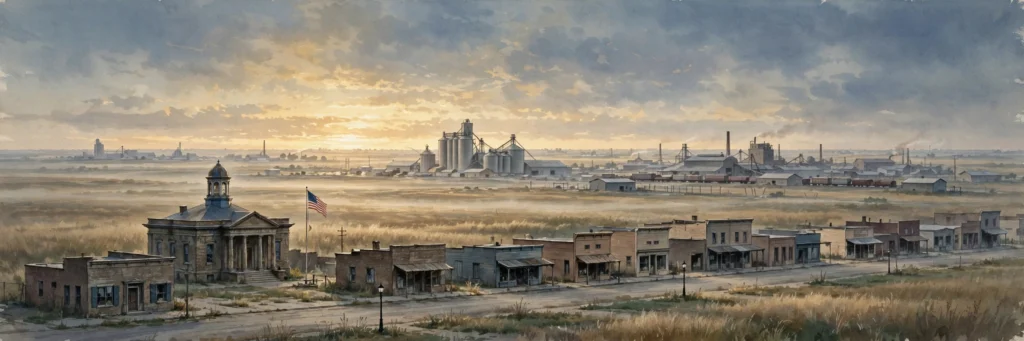
To understand why the raids hit Dodge City so hard, it helps to understand what the town has become. Dodge City gained national prominence in the 1800s as a stop for pioneers heading west, and cattle feedlots eventually spread across the open plains around it. In the 1980s, meatpacking companies began building massive plants, first employing Vietnamese and Laotian refugees and later migrants from Mexico and Central America. Today Dodge City is 67 percent Hispanic, according to the United States Census. The area formed by Dodge City, Garden City and Liberal is known as the Golden Triangle of Meatpacking, and it is responsible for about a quarter of the beef supply in the United States.
Many people in the region believed that their importance to the nation’s food supply might spare them from the administration’s deportation campaigns. “We thought we were untouchable,” Soberanes said, because of the area’s meatpacking plants and their dependence on immigrant workers. She said she had never seen people so politically energised. For years, she and other organisers had tried to get people, particularly their young Latino neighbours, engaged in politics. But from rural Kansas, immigration raids in places like Minneapolis and Chicago felt abstract. Then residents saw their own streets in videos on social media, and the abstract became personal.
Jose Del Real’s story captures that change. Del Real is an Army veteran who served two tours in Iraq, and he had not voted in a decade. He thought it would not matter in a deeply Republican corner of Kansas. But in the weeks after the raids, he stood on a stage in a park before hundreds of his neighbours carrying furious signs, his daughters crying in the front row, and told the crowd that none of it mattered if they did not vote. He draped an American flag over his shoulders, put on his Iraq veteran cap, and ended his speech with a simple message: “None of this matters if you do not vote. Let’s go vote.” Del Real later said he regretted not voting in 2024, when Trump returned to office pledging mass deportations. “We had to see it in front of us,” he said. “I had to see it in the flesh.”
The organising that followed was fast and practical. Soberanes said she worried the daily protests could get out of hand, so organisers told people not to damage property and to save their anger for Election Day. “We’ll see them at the ballot box,” she recalls repeating. In the three weeks after the immigration agents arrived, between September 22 and October 13, a total of 293 people registered to vote in the area, nearly as many as the 306 who had registered during the previous nine months. New Frontiers, a local nonprofit, delivered hundreds of meals to affected families and helped register residents to vote. Soberanes put the change bluntly: “If ICE hadn’t come, we would still be red, 100 percent. And so I thank Donald Trump for sending immigration here.”
Deportation News: The Cost to Families and the Local Economy
Behind the political numbers are families whose lives were upended in a matter of hours. Karla Flores and her husband Alfredo Arrieta went shopping at Walmart on the day the operation started, planning to stay home afterwards. Arrieta had crossed into the United States without authorisation in 2022 and found work as a mechanic in Dodge City. Flores had overstayed a tourist visa and worked as a cleaner. They were pulled over by immigration agents shortly after leaving the store. Before she was handcuffed, Flores called her brother, who arranged for their three children to be picked up from school and taken to a relative’s house. She and her husband were deported to Mexico after five weeks in immigration custody. Their two youngest children have joined them there, while their eldest, aged 17, is living with Flores’ brother. “They’re still dealing with the aftermath,” Arrieta said of his children. “We got up, we took them to school and then a few hours later they’re told your mom and dad aren’t here anymore.”
In his victory speech, Hamilton recalled a story from a woman in Dodge City who told him some parents were too afraid to pick their children up from elementary school. “This was not OK,” he said. The economic damage spread quickly beyond the families directly affected. Workers stayed home, plants ran short of staff, and the disruption rippled through feedyards, dairies and meat processors across the region. Scott Fischer, the local Republican chairman, describes himself as a supporter of strong borders, but he was surprised by the intensity of the operation. “There was a little showmanship,” he said. “I don’t know why it was like that.” Fischer said most Latino immigrants in the area are hard-working, family-oriented and faithful people, a good fit for conservative Kansas values. “In general terms, mass deportation is not practical,” Fischer said. “When we say send them all home, what does that mean? Who is them?” To many people in Dodge City, he added, “them” this time meant relatives and friends, and in a small town where nearly everybody is connected to everybody else, people did what they could to help.
Election Results: The Battle for the Senate Turns on Kansas
When the votes were counted on November 3, the scale of the shift became clear. Kansas elected a Democrat to the United States Senate for the first time in nearly a century. Adam Hamilton ousted the incumbent Republican Roger Marshall, and he will be the first Democratic senator to represent the state since 1932 when he takes office in January. The three counties most affected by the ICE raids swung toward Hamilton by more than 20 points on average from Trump’s 2024 vote share, according to results compiled by Reuters and USA Today. The shift represented a striking backlash to Trump’s immigration crackdown in one of the country’s most conservative states.
Hamilton had made the raids a central part of his campaign, calling them a “disaster” and saying Kansans were fed up with Marshall being a “mouthpiece for the president.” Marshall, for his part, had broken with the administration over the operation, saying in a statement that police “were not given advance notice or the level of cooperation we would expect,” causing “mass disruptions to local communities and businesses.” It was not enough. The anger in the southwest of the state was not limited to Democrats or to the Latino population, which has grown to about two-thirds of Dodge City. Dr. Russell Arben Fox, a political science professor at Friends University in Wichita, said swings as dramatic as this one could not have happened without some white, moderate Republicans changing their minds.
The governor’s race told a similar story, though with a twist that showed the limits of the shift. The Associated Press called the race on Thursday for Democrat Cindy Holscher over Republican Ty Masterson. But Fischer noted that Ford County, home to Dodge City, still voted narrowly for Masterson, the Republican candidate for governor, and he said he still considers the county red. The pattern suggests that voters were punishing a specific policy and a specific incumbent rather than changing their party identity wholesale. The polling data backs up that reading: more than half of Kansas voters in the Senate race disapproved of how ICE is handling its job, according to the AP Voter Poll, a survey of more than 100,000 midterm voters. That figure is consistent with the 61 percent of voters who said the same thing nationally.
Midterm Elections 2026: What the Kansas Swing Means
The Kansas result is one piece of a much larger midterm picture, and it helps explain why the election turned out the way it did. Democrats won back control of Congress in what was widely described as a decisive rebuke to Republicans, and the immigration raids in Kansas became a symbol of the overreach that many voters said they were rejecting. The story travelled because it was so concrete: a town that feeds the country, families separated in a parking lot, local officials learning about a federal operation from social media, and then a ballot-box response that nobody in either party had predicted.
For Democrats, the lesson is that immigration enforcement can be a mobilising issue when it is experienced at first hand, and that organising in communities that are usually written off can pay off quickly. The registration numbers in southwest Kansas show how fast that can happen: nearly as many people registered in three weeks after the raids as in the previous nine months combined. For Republicans, the lesson is more uncomfortable. Fischer’s observation that mass deportation is not practical in a region whose economy runs on immigrant labour is now backed by an election result. The party’s own local chairman was surprised by the showmanship of the operation, and its own incumbent senator felt compelled to criticise it publicly, yet the party still lost the seat.
The Kansas swing also fits into a wider pattern in the midterm elections of 2026, in which Latino voters shifted toward Democrats in several states. The same movement, driven by a specific local event rather than by national messaging, shows up in the Kansas numbers. That distinction matters because it suggests the shift was not simply a reaction to Washington but a response to something voters saw in their own streets, and that kind of shift is harder for a campaign to reverse. There is also a caution in the Kansas numbers for anyone tempted to overread them. Ford County still voted for the Republican candidate for governor, and Fischer still calls the county red. The Senate result was driven by a combination of energised new voters, Latino voters who had previously stayed home, and moderate white Republicans who changed their minds. That coalition came together around a single event, and whether it holds together in the next election will depend on what happens next, both in Kansas and in Washington.
What Happens Next for Kansas and Immigration Policy
The immediate future belongs to the people who won. Hamilton will take his seat in January, and his victory speech made clear that the raids will shape how he talks about immigration in the Senate. Holscher, the governor-elect, will take office in a state where the politics of immigration have suddenly become more complicated for Republicans, and where local officials are still waiting for answers about who was detained and why. For the residents of southwest Kansas, the questions are more direct. Soberanes said the community wants people to be held responsible for what happened, and the commission meetings in Dodge City are still the place where those demands are being made. New Frontiers and other local groups are still delivering meals and helping families, and the organising that began in the days after the raids has not stopped.
For the Trump administration, the Kansas result creates a visible tension. Trump told 60 Minutes that his deportation campaign may have been too tough, a striking admission from a president who returned to office pledging mass deportations. At the same time, he promoted Stephen Miller, the architect of that strategy, to be his next White House chief of staff, a move that signals no retreat from the policy itself. The Department of Homeland Security said it will continue to enforce the nation’s laws and remove people in the country without authorisation from American communities, and White House spokesperson Lauren Bis said Trump’s immigration agenda has delivered the most secure border in history. Both parties will be recalibrating their approach to immigration ahead of the next presidential campaign, and Kansas will be one of the places they study.
The deeper question is whether the Kansas backlash was a one-off or a sign of something larger. The AP Voter Poll suggests it was not isolated: a majority of voters nationally now disapprove of how ICE is handling its job. If that disapproval holds, the politics of immigration enforcement could look very different in the next presidential campaign than they did in 2024, when Trump won on a promise of mass deportations. What happened in Dodge City, Garden City and Liberal shows that when enforcement arrives without warning in a community that depends on the people being detained, the political price can be steep, and it can be paid in places nobody expected. The voters of southwest Kansas have made themselves heard, and the rest of the country is now listening.
Source: Reuters and Associated Press