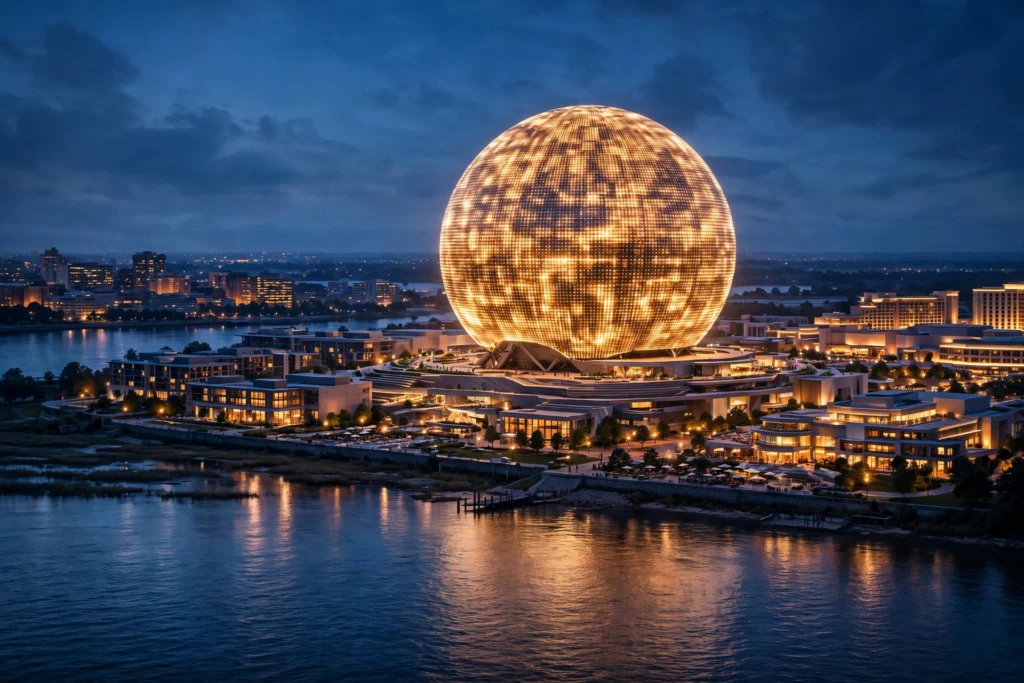
Entertainment News: Sphere National Harbor Approved
In the biggest entertainment news to reach the Washington region in years, Prince George’s County Council voted on Tuesday to approve the financing for a $1.4 billion Sphere at National Harbor, clearing the way for a smaller version of the glowing Las Vegas arena to rise on the banks of the Potomac River. The council voted 8 to 0, with three of its 11 members absent, to authorize up to $215 million in special obligation bonds for the project, a decision taken on the last day of the council’s legislative session. The venue, a 6,000-seat theater wrapped inside and out in high-resolution LED screens, would become only the second Sphere in the United States. Construction is expected to begin in 2027, with a planned opening in 2030.
The vote ends months of negotiation over how much public money the county should put behind a project owned by one of the richest entertainment companies in the country, and it arrives at a moment when Prince George’s County is looking for a win. The county has absorbed a run of economic blows, including the closure of Six Flags America and the Washington Commanders’ planned return to the District of Columbia, and its leaders framed the Sphere as the answer: a year-round attraction that would draw more than two million visitors a year and generate tens of millions of dollars in new tax revenue.
Entertainment News: The Vote and the Financing
The financing package the council approved on Tuesday evening is built around up to $215 million in special obligation bonds. Within that total, $130 million in county bonds will support construction of the venue itself, and $40 million will pay for a publicly financed parking garage on the 14-acre project site. Maryland is also expected to contribute $13.5 million toward the development. The broader bond authorization also covers refinancing existing National Harbor debt and other financing costs connected to the project, which sits beside MGM National Harbor in Oxon Hill.
The bonds will be repaid over time using tax revenue generated at National Harbor itself, rather than from the county’s general fund, a structure its supporters say protects county taxpayers if the venue underperforms. The developer will gradually repay the public contribution from future property, sales, hotel occupancy, and amusement tax revenues produced at the site.
The venue itself is planned to stand approximately 302 feet tall, overlooking the Potomac River and near MGM National Harbor. At 6,000 seats it would be roughly a third the size of its Las Vegas predecessor, which seats about 17,600 people, and Sphere Entertainment has taken to calling the Maryland project a “mini Sphere.” Even at that scale it would be one of the largest dedicated entertainment venues in the Washington area, and its exterior LED screen would be visible for miles along the river.
Music News and Movie News: What the Sphere Will Show
The reason a building can command this much public money is what happens inside it, and the music news and movie news that have made the Las Vegas Sphere famous are the template for what National Harbor would offer. The original Sphere was designed around a 16K-resolution wraparound interior LED screen, a sound system built on beamforming and wave field synthesis technology, and 4D physical effects that include changing temperatures, cool breezes, and haptic feedback built into thousands of seats. The idea is that a concert or a film inside a Sphere does not feel like a show watched on a stage, but like an environment the audience steps into, with images wrapping from floor to ceiling around them.
That dual identity, concert hall and cinema in one, is what separates the Sphere from a conventional arena, and it is what county officials are counting on to keep the building busy year-round. A traditional arena depends on sports teams and touring schedules that leave dark nights; a Sphere can fill its calendar with residencies, corporate events, and film screenings that use the same screen in different ways. For National Harbor, which already draws visitors to its casino, hotels, and waterfront, the venue would add a reason to stay for the evening.
The Las Vegas Blueprint: How the Original Sphere Works
The Maryland project is a direct descendant of a building that opened in Las Vegas on September 29, 2023, when the Irish rock band U2 kicked off a residency at the arena. The Las Vegas Sphere was announced in 2018 by the Madison Square Garden Company, then known as the MSG Sphere, and designed by the architecture firm Populous. It was built at a cost of $2.3 billion, making it the most expensive entertainment venue ever constructed in the Las Vegas Valley.
The building measures 366 feet tall and 516 feet wide, and its exterior, known as the Exosphere, is covered in 580,000 square feet of programmable LED displays, the largest LED screen in the world, made up of about 1.2 million LED pucks. Inside, the wraparound screen covers 160,000 square feet, and 10,000 of the seats carry haptic technology that lets audiences feel what they see.
Since its opening, the Las Vegas venue has hosted residencies for Phish, Dead and Company, the Eagles, and the Backstreet Boys, alongside the U2 run that opened it and the film “Postcard from Earth,” directed by Darren Aronofsky, which opened a week after the first concert. The venue is owned by Sphere Entertainment, a spin-off of the MSG Company controlled by New York billionaire James Dolan, whose empire includes Madison Square Garden, Radio City Music Hall, the New York Knicks, and the New York Rangers. It is Dolan’s company that is bringing the concept to Maryland, and it is his track record in Las Vegas that the county is betting on.
Why the County Said Yes: Jobs, Visitors, and Tax Revenue
The numbers the county published alongside the vote explain why its leaders were willing to back the project with public bonds. Early estimates project two million annual visitors to the Sphere, and the county expects the venue to create 1,750 on-site construction jobs, with an additional 2,400 jobs supported through suppliers. Once it opens, the venue is expected to employ 328 full-time workers and 925 part-time workers. Governor Wes Moore has offered a larger forecast, predicting the project will support more than 2,500 construction jobs and generate more than 4,700 permanent jobs once the landmark is constructed.
The tax projections are the heart of the county’s case. County Executive Braveboy said the development will generate $1.3 billion in economic activity for the county and $1.5 billion statewide, and produce about $63 million annually in property, sales, and amusement taxes. Braveboy has said the Sphere would bring in roughly three times the combined tax revenue of Six Flags America, which closed last year, and Northwest Stadium, which the Commanders are leaving as they return to Washington. In her remarks after the vote, she framed the project as a change in the county’s identity as much as its finances. “Today marks a turning point for the economic future of our county. Today, Prince George’s County enters the global stage and redefines itself as a destination for investment, entertainment, technology, and innovation,” she said.
The approval also comes as the county deals with a third setback, the Trump administration’s opposition to relocating the FBI headquarters to Maryland, which had been another hoped-for source of jobs and investment. Against that background, a privately operated entertainment venue backed by public bonds looked to the council like the most reliable large project available, one whose developer has already built the same thing once before.
The Labor Fight Behind the Unanimous Vote
The unanimous final vote hides a fight that ran for weeks over who would build the venue and under what conditions. Labor unions had pushed for a project labor agreement that would guarantee union participation in construction, including a proposal to require 40 percent of construction labor to come from unionized workers. The council shot down that proposal earlier in October, and on Tuesday it approved a different arrangement: a labor peace agreement that will allow union groups to organize Sphere workers once the venue opens, together with a community benefits agreement.
The debate over the labor terms was the main source of friction in the weeks before the vote, alongside concerns about the financial implications for county taxpayers. Supporters of the union mandate argued that public money should come with guaranteed jobs for local union workers, while opponents warned that too many conditions could drive the developer away. The compromise the council adopted keeps the project moving while giving unions a path to organize the venue’s workforce after it opens, rather than a guaranteed share of the construction work.
What Happens Next: Construction, Opening, and the Road to 2030
With the financing approved, the project moves from politics to construction. Work is expected to begin in 2027, and the venue is expected to open in 2030, giving the county and the developer roughly three years to build a 302-foot sphere on a 14-acre waterfront site. The first visible signs will be site preparation and the construction of the parking garage, followed by the steel and concrete work that will give the building its shape, and finally the installation of the LED systems inside and out.
Between now and the opening, the county will have to manage the risks that come with a project of this size. The bonds must be sold and the refinancing of existing National Harbor debt completed. The developer must hire the construction workforce and, closer to opening, the hundreds of full-time and part-time staff who will run the venue. The county’s projections of two million visitors a year and $63 million in annual tax revenue will be tested against the reality of ticket sales, hotel bookings, and the broader economy in 2030.
For the Washington region, the opening of a second Sphere would change the entertainment map. Concertgoers who now travel to Las Vegas for the Sphere experience would have a version of it a short drive from the capital, and performers who want the format without the scale of an 18,000-seat arena would have a new room to play. The exterior screen would become a new landmark on the Potomac, visible from the river and from the Virginia shore. Whether the Maryland Sphere matches the Las Vegas original’s success will depend on the acts it books and the films it screens, but the council’s vote on Tuesday means the region will get to find out.
Source: The Washington Post