Early Voting: Trump Voting Crackdown Stirs Fear
Meta description: Federal lawsuits, 1,000 election monitors and prosecution warnings have left officials braced for disruption as early voting runs into the Nov. 3 midterms.
With three days left before Americans vote in the midterm elections 2026, the officials who actually run elections in the states say they are bracing for a kind of federal intervention they have not seen before. Their worry is not a single lawsuit or a single order. It is the accumulation of moves by President Donald Trump’s administration in the final weeks of the campaign: lawsuits demanding voter registration lists from most of the country, demands that thousands of mail ballots be pulled out of the count, warnings that election workers could face prosecution, a promise of money for information leading to a fraud conviction, and the largest deployment of federal election monitors in American history. Each step, on its own, can be explained by the administration as a defence of election security. Taken together, election officials and voting rights groups say, they have produced a climate of uncertainty and fear around a vote that is already under way, with millions of Americans having cast ballots early.
The White House rejects that reading. Administration officials say the federal government is protecting the integrity of the vote, not interfering with it, and they point out that many of the scenarios feared by critics remain hypothetical. That qualification matters, and it is one the courts have reinforced: the Constitution gives the president no direct role in running elections, which are administered by states and localities, and federal judges have so far turned back the administration’s most consequential legal challenges. Yet the gap between what has been blocked in court and what is still being attempted in public is itself part of the story. A lawsuit that fails can still alarm the voters and workers it targets, a monitor standing in a polling place can still change how a voter feels about casting a ballot, and a warning of prosecution can still make an election worker think twice, even if no charge ever follows. That is why, in the final weekend of the campaign, the argument is no longer only about individual ballots. It is about whether the atmosphere around the election is itself becoming a factor in who votes, and who stays home.
Early Voting: Lawsuits Over Voter Rolls in 30 States
The legal campaign began well before the final weekend, and its scale is what sets it apart. The Justice Department has sued 30 states and the District of Columbia seeking their voter registration lists, arguing that it needs the records to identify people who are not citizens and should not be on the rolls. It has lost more than two dozen of those cases. The pattern of defeat has been consistent: judges have questioned the reliability of the federal data, the legal authority for the demands, and the timing of interventions arriving weeks before, or even during, an election already in progress. Studies cited in the coverage have repeatedly found that voting by non-citizens is exceptionally rare, which has made it harder for the administration to persuade courts that an emergency exists.
The most concrete fight has been over ballots rather than lists. The Justice Department demanded that California set aside ballots from about 20,000 people it suspects of being non-citizens, and made a similar demand covering more than 400 people in Washington state. A federal judge rejected the California request on October 28, warning that pulling ballots out of an election already under way would cause severe disruption. Washington state also refused the demand. The California dispute did not end there: it returned to the appeals court, which ruled on October 30 that the government could not force the state to separate the ballots while its lawsuit continues, in a 2-1 decision that described the requested relief as a step toward cancelling votes and removing voters from the rolls, rather than a harmless pause. That ruling, the third courtroom defeat for the administration on the same ballots in a single week, left California’s existing counting procedures in place as early voting continued in the country’s most populous state.
Alongside the lawsuits has come direct pressure on the people who administer elections. The Justice Department has warned election officials in every state that they could face prosecution if they knowingly allow non-citizens to vote. Trump added a personal element on October 27, offering one million dollars for information leading to a voter fraud conviction, without giving details of how such a reward would work, who would administer it, or what standard of proof would apply. For election officials, the combination is difficult to ignore: they are being told, in the middle of running an election, that a wrong judgment could carry criminal consequences, while also being asked to hand over their voter lists and to change how they handle ballots that have already been cast. Supporters of the administration say such warnings are a legitimate deterrent against illegal voting. Critics say they function as intimidation, aimed less at catching wrongdoing than at making officials and voters nervous about participating at all.
Voter Turnout: Monitors, Immigration Agents and Polling Places
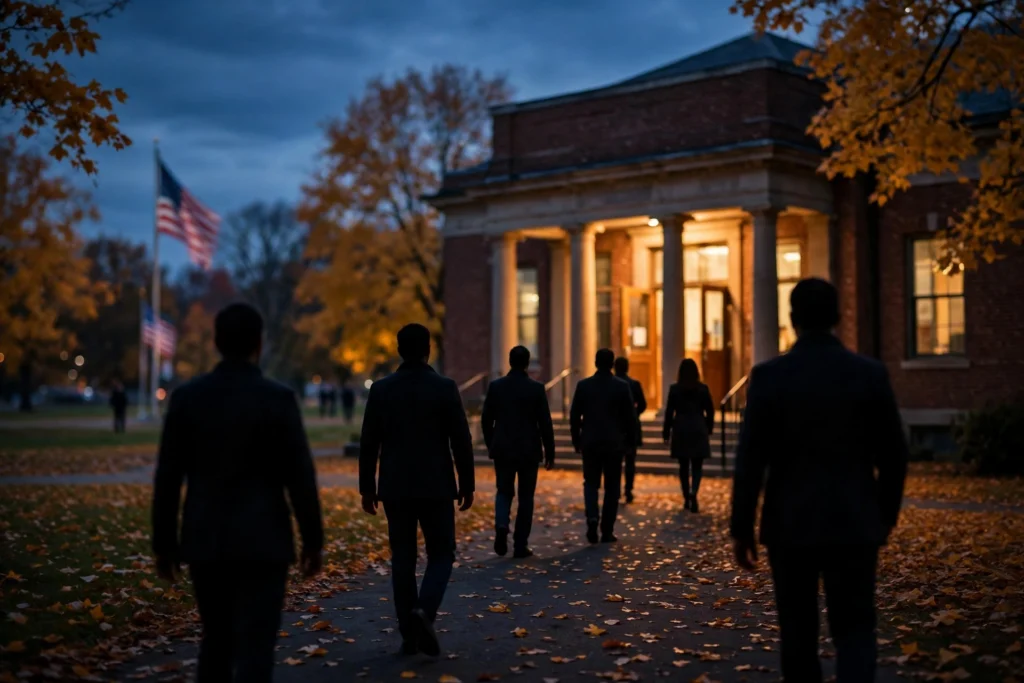
If the lawsuits are the first flashpoint, the polling place itself is the second. The Justice Department plans to send around 1,000 election monitors to all 50 states, its largest deployment ever. Monitoring of elections by federal officials is a decades-old practice, and the department says its monitors will be unarmed, barred from interfering with voting, and drawn from neither the FBI nor Immigration and Customs Enforcement. Democrats and voting rights groups, however, say the sheer scale of the deployment changes its character. A monitor in a single precinct is routine oversight; a thousand monitors spread across the country, arriving in the middle of a campaign in which the president has repeatedly questioned the integrity of the vote, can feel to a voter like surveillance, whatever the official rules say.
The fear is sharper in immigrant communities, where advocates worry that immigration enforcement near polling stations could deter people from voting. The administration says it is not planning operations targeting polling places, but Homeland Security Secretary Markwayne Mullin has said immigration agents could serve warrants there, and that mixed message has left local officials unsure what to expect on Election Day. Trump has also declined to rule out declaring a national emergency or invoking the Insurrection Act, the law that allows a president to deploy troops at home. Legal experts note that a Civil War-era law bars troops and armed federal agents from polling places, and they argue that an emergency declaration would not give the president power over elections, which the Constitution leaves to the states. The reassurance is real, but it operates at the level of law, while the worry operates at the level of perception: a voter who has heard that troops or agents might appear is not necessarily reassured by a legal argument about why they probably will not.
Trump has also urged his party to nationalise voting, a call he has made in at least 15 places, according to the reporting. The phrase captures the central constitutional tension of the whole dispute. Elections in the United States are run locally, by thousands of county and state officials following state law, and the federal government’s role is limited. A nationalised system, in which Washington set the rules for how states conduct their votes, would be a fundamental change, and it is one that courts have so far resisted. But the repeated calls, combined with the lawsuits and the monitors, have convinced many state officials that the administration is testing how far federal power can be pushed, case by case and state by state, even when individual cases fail. Each failed case still consumes time, money and attention in the final days of a campaign, and each one sends a signal to voters that the rules of the election are contested, even when the courts have said they are not.
Mail-in Voting: The Fight Over Counting the Ballots
The third flashpoint arrives after the polls close, when the ballots are counted. Federal agents could seek warrants or subpoenas for ballots, voting machines or records, potentially disrupting a count that depends on careful, documented handling of every vote. Election officials warn that such action during an active count could undermine the safeguards that track how ballots are handled, creating confusion even if no ballot is ultimately removed. There is a recent precedent that makes the warning concrete: in January, the FBI seized ballots and other election records from the 2020 election in Fulton County, Georgia, a county that has been a focus of Trump’s false claims that he won that year. Officials in other states have watched that seizure closely, and they say it shows what federal intervention in a count can look like in practice.
The counting fight also includes the familiar arguments over mail ballots. Trump could allege fraud involving mail-in ballots, voting machines or votes counted after election night, fuelling demands for recounts or attempts to halt counting altogether. That argument has already been tested in court. The Supreme Court ruled in June that states may count mail ballots postmarked by Election Day that arrive afterwards, and courts can intervene against unlawful disruption of a count. The ruling gives states a clear legal footing, but it does not prevent a political campaign against the count itself. A claim of fraud does not need to succeed in court to slow certification, to dominate news coverage, or to persuade supporters that a result they dislike is illegitimate. In a close race, even a few days of delay can become a crisis, and the history of the 2020 election, when Trump pressured state officials to dispute results after losing, is fresh in the minds of the officials now preparing for November 3.
Election Polls: Certification, Alaska and the Days After Voting
The dispute over certification has already produced its own lawsuit, and it may be the clearest example of how the administration’s strategy works. The Justice Department has sued Alaska to delay certification of its Senate race if Republican incumbent Dan Sullivan narrowly loses to Democrat Mary Peltola, citing a second candidate also named Dan Sullivan who, the department says, is trying to confuse voters, a claim the second Sullivan denies. Trump said he ordered the lawsuit. Experts say federal law does not allow the department to block certification, which courts can compel officials to carry out, and the suit therefore looks, to critics, less like a legal remedy than a pre-emptive challenge to a result the administration does not want. Supporters would say it is a defence against voter confusion. Either way, it shows that the administration is not waiting for results before contesting them; it is laying the groundwork for a challenge in advance, in a state where the Senate race could matter to control of the chamber.
That pre-emptive approach extends to the broader post-election period. Trump could pressure state officials to dispute results, as he did after losing the 2020 election, and experts warn that unresolved disputes could delay the seating of newly elected lawmakers in January, when the new Congress is due to take office. Democrats and voting rights groups say they have assembled legal teams to fight any interference, and they point to the courts’ record so far: judges have repeatedly upheld the states’ authority over elections, and the administration’s main challenges have been rebuffed. The balance of power in that argument matters for voter turnout as much as for any single race. If voters believe their ballots will be counted and the result will stand, they have a reason to vote. If they believe the result will be contested no matter what they do, some may decide that voting is pointless, while others may be motivated to vote precisely because the stakes feel higher. Both reactions are possible, and both are part of why the atmosphere around this election has become a campaign issue in its own right.
The political context sharpens the stakes. Republicans face an uphill battle to keep control of Congress, and election polls in the final weekend have pointed toward a difficult night for the party, with Democrats leading nationally and early voting surging. That context does not prove intent, and the administration’s stated motive, election security, is one that many voters share. But it explains why state officials are reading every federal move through a political lens, and why voting rights groups argue that the effect of the campaign matters even where its legal basis fails.
What Happens Next
What happens next will unfold in stages, and each stage has its own flashpoint. On Election Day itself, the test will be the polling places: whether the monitors arrive as promised, whether they stay within their stated limits, and whether immigration enforcement appears anywhere near a voting site. In the days after, the test will be the count: whether ballots, machines and records are left alone, whether mail ballots postmarked by Election Day are counted as the Supreme Court has allowed, and whether claims of fraud are made and, if so, whether they are backed by evidence that courts accept. After that comes certification, where the Alaska lawsuit and any copycat challenges will show whether courts continue to compel officials to certify results, as experts expect them to do. Finally comes January, when the new Congress is seated, and any unresolved dispute could still delay the seating of individual lawmakers.
For voters, the practical message from election officials remains straightforward. Early voting is under way, polling places will be open on November 3, and the courts have so far left the states’ election procedures in place. A federal monitor does not have the power to turn a lawful voter away, a lawsuit over a voter list does not remove a registered voter from the rolls on its own, and a claim of fraud does not change a certified result without a court order. Whether that legal reality matches what voters experience will depend on what actually happens in polling places across all 50 states, and in the courtrooms where the next challenge is already likely to be filed.
Source: France 24