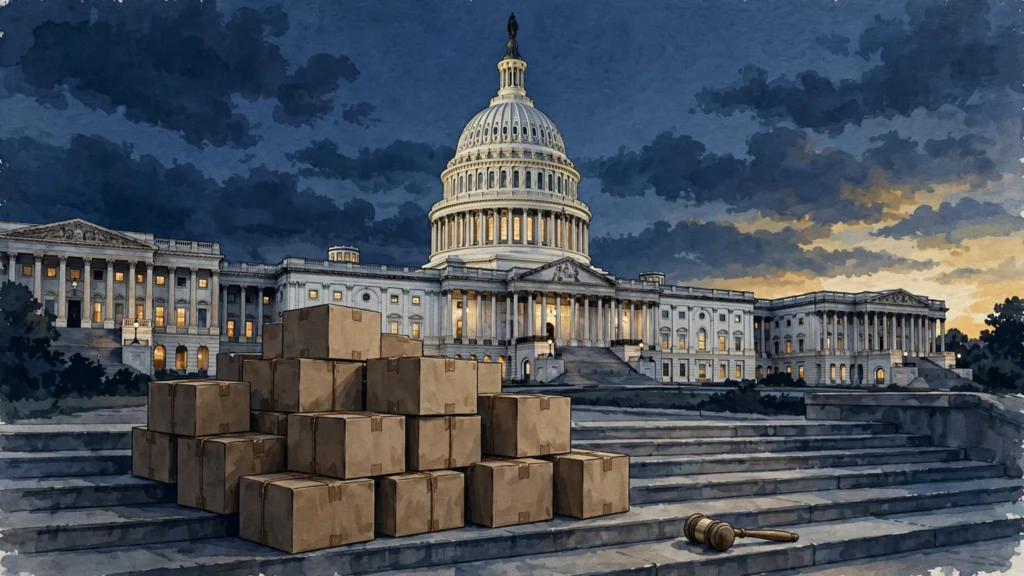
DOJ News: House Vote Looms on Epstein Records
The doj news out of Washington this week is a vote that House leaders tried for months to avoid, and that a small group of lawmakers has now made unavoidable. The House is poised to vote on legislation demanding that the Justice Department release more documents about Jeffrey Epstein, the convicted sex offender whose case has split President Donald Trump's political coalition and refused to fade from American politics. The vote will likely come after the House returns from its Thanksgiving recess on November 30, and it will arrive alongside a promise from Democrats that the next Congress will open far wider investigations into the Trump administration's handling of the Epstein files.
The fight is no longer only about what the Justice Department has released. It is about what it has held back, why it held those records back, and whether Congress can force a federal law enforcement agency to hand over material it says it is entitled to keep. A discharge petition, the rare parliamentary device that lets a majority of the House drag a bill to the floor over the objections of its own leadership, reached the 218 signatures it needed on November 11. That single fact has set the calendar for the final weeks of the Republican-controlled Congress, and it has turned a standoff over documents into a test of who controls the House in its closing days.
DOJ News: The Vote That Leadership Could Not Stop
The legislation at the centre of the fight is the Epstein Files Transparency Act II, a bill introduced on July 15 by Representative Thomas Massie, a Kentucky Republican, together with Representative Ro Khanna, a California Democrat, and Representative Teresa Leger Fernandez, a New Mexico Democrat. The bill aims to give federal courts a role the first transparency law did not provide. Under the new measure, state attorneys general, women abused by Epstein, and members of Congress would be able to challenge the Justice Department's decision to withhold Epstein documents in federal court, forcing the department to justify its redactions and its refusals before a judge rather than deciding them alone.
Massie built his case for a vote the slow way, signature by signature. A discharge petition needs 218 signatures, a majority of the House, and once it reaches that number the bill must sit on the Discharge Calendar for seven legislative days before any signer can call it to the floor. The petition was filed on August 31, and it gathered support through the autumn as frustration with the department's disclosures grew. On November 10, the petition stood at 217 names. On November 11, Representative John Garamendi of California added the final signature, and the petition reached 218.
All 214 House Democrats signed the petition, along with four Republicans: Massie himself, Representative Brian Fitzpatrick of Pennsylvania, and Representatives Nancy Mace and Ralph Norman of South Carolina. None of the four Republicans is returning to Congress in the next session, a fact that has shaped the way both sides talk about the effort. For Massie, who lost his Republican primary to a Trump-backed challenger and leaves office in January, the vote is a final act of defiance against a president and a party leadership he has clashed with for years. For his critics, the timing proves the point they have been making all along.
House Speaker Mike Johnson, a Louisiana Republican, has accused Massie of seeking to cause chaos before leaving Congress. Johnson told reporters that Massie was trying to create disruption on his way out, and he has defended the leadership's handling of the Epstein files by saying that his goal has been to protect the privacy of the women abused by Epstein. Johnson has also said that perpetrators should be brought to justice, but he did not bring the Epstein legislation to the floor for a vote without being forced to do so. Massie, for his part, has been blunt about what he wants. Speaking on the House floor on November 18, he said of Epstein's potential co-conspirators, "Until we see these men perp-walked in handcuffs into prison, I'm not satisfied."
A Year of Disclosures, and a Fight Over What Is Missing
The vote now looming is the second round of a fight that began a year ago. Congress approved the first Epstein Files Transparency Act in November 2025, legislation from Massie and Khanna that aimed to force the Justice Department to release all of its files on the Epstein investigation, with the names of abused women redacted. President Trump signed that law, and the department began releasing material, but the scale of what came out, and what did not, has driven the dispute ever since.
The Justice Department released more than three million pages of records, along with 2,000 videos and 180,000 images, most of them in December and January. But the department missed the December 19 deadline Congress had set for the full production, and on January 30, 2026, it released another substantial collection of records while maintaining that it had satisfied its obligations under the law. Attorney General Todd Blanche has said that another three million pages would be withheld, either because they were duplicative or because they described how lawyers decided who to prosecute. That explanation has not satisfied lawmakers who believe the withheld material includes evidence about Epstein's co-conspirators and about the government's own decisions.
The criticism has come from both parties, but it has been sharpest from Democrats, who say the department's production was slow, heavily redacted, and in some cases careless with the privacy of the very people the law was meant to protect. Lawyers for victims have said that thousands of redactions were missing and that the names of nearly 100 women were exposed in the released material. The House Oversight Committee's Republican-led majority issued its own 136-page report on November 10, the product of a 15-month investigation and interviews with 19 people, which found that failures by federal prosecutors allowed Epstein to keep preying on girls after 2005. That report placed blame on poor judgment and on what it called Epstein's pervasive and wide-reaching influence, and it said that testimony from numerous witnesses confirmed Trump's lack of involvement and that its facts did not suggest he was implicated in Epstein's or Maxwell's crimes.
The department's handling of the case has a longer history that feeds the suspicion. In July 2025, the FBI and the Justice Department issued a two-page memo that closed the book on the Epstein investigation in terms that satisfied almost nobody. The memo said there was no evidence of a client list and no basis to continue investigating uncharged third parties. That document became a touchstone for critics who believed the government was not being candid about what it knew, and it set the stage for the transparency law that Congress passed later that year.
The Raskin Report and the Call for a Special Counsel
The most explosive development in the weeks before the vote came on October 26, when Democrats on the House Judiciary Committee released a report detailing accusations from five women that President Trump abused them while in Epstein's company or shortly after meeting the men together, decades before his presidency. The report, which ran to more than 50 pages, was compiled from interviews conducted by committee staff, survivor accounts, FBI records and documents released under the transparency law. It described accounts from 11 women in total, five of whom said in interviews with newspapers, in a lawsuit, or directly to the committee that Trump either raped or sexually assaulted them.
The report included at least one allegation that had not been made public before, from a former Miss Switzerland who said she was raped by Trump at the Plaza Hotel in New York during a beauty pageant in 1993. It also pointed to inconsistencies in the president's public statements about his relationship with Epstein, including his claim that he never flew on Epstein's plane, when flight logs show that he did. Three additional women told the FBI of interactions with Trump in Epstein's presence, which the committee said indicated a pattern of Epstein introducing Trump to young women. Another three women have not come forward with accusations, and the report instead pointed to public files tying them to Trump and Epstein. Most of the alleged assaults described in the report took place between 1992 and 1997 in New York and Palm Beach.
The report's authors called for a criminal investigation into the president and for Congress to act to end what they described as the Justice Department's cover-up. Representative Jamie Raskin of Maryland, who is in line to become head of the Judiciary Committee when Democrats take control, called for an independent special counsel to investigate the allegations. "Trump's Justice Department appears to be covering up these crimes to protect the President," Raskin said in a statement. The committee also said that Blanche and Justice Department leadership had prematurely halted federal inquiries into Trump's ties to Epstein through an internal directive drafted with White House involvement.
Trump has denied wrongdoing in connection with Epstein, and the White House has rejected the report's claims. The Justice Department issued a statement in January denying accusations contained in the released documents. The dispute over the report's contents is now inseparable from the dispute over the documents themselves, because much of the report is drawn from the files the department has already released, and its authors argue that the files still being withheld may contain more.
The Vance Letter and the Oversight Front
While the Judiciary Committee Democrats were building their case, Democrats on the House Oversight and Government Reform Committee opened a second front. On November 18, they sent a letter to Vice President JD Vance asking him to provide information by December 2 about how the administration responded to the legislation forcing the release of the Epstein files. The letter is part of a broader effort to establish what the White House knew about the department's compliance with the law, and when it knew it.
The Oversight Committee has been central to the Epstein story for more than a year, and its work has produced some of the most concrete findings about the department's handling of the case. Its November 10 report on prosecutorial failures in South Florida was a Republican-led effort, but the committee's Democrats have used the same investigative machinery to press the administration on the transparency law. The Vance letter suggests that the next phase of the inquiry will reach beyond the Justice Department itself and into the White House's role in shaping the response to Congress.
The letter's December 2 deadline is deliberately timed. It falls just as the House returns and the Epstein Files Transparency Act II comes up for a vote, and it gives the administration a short window to answer before the floor debate begins. Whether the vice president responds, and what he says, will shape the argument lawmakers make when they vote.
Why This Fight Has Split the President's Own Coalition
The Epstein issue has been politically dangerous for Trump in a way few other controversies have been, because it divides his own supporters. During the 2024 presidential election, Trump supporters and conservative media figures demanded transparency and the release of the Justice Department's files on the Epstein case. Trump himself said he was open to releasing the files. But after taking office, he tried to block their release by pressuring members of Congress to vote against making them public, and it was only the persistence of survivors and the pressure of the discharge petition that forced the first transparency law through.
Massie has made that contradiction the centre of his argument. He has compared the Epstein scandal to Watergate and Iran-Contra, and he has argued that the case spans four administrations, which makes it different from scandals that belonged to a single presidency. That framing is designed to make the issue about the government as a whole rather than about one party, and it has helped him hold together a coalition that includes every House Democrat and a handful of Republicans willing to defy their leadership.
Johnson's decision to recess the House in September, rather than allow a vote on Massie's legislation, became a symbol of that resistance. Massie has argued that the speaker sent members home to avoid a vote he knew he would lose, and he has predicted that Johnson will not be able to do the same thing again, because the speaker has too many legislative goals to accomplish before he loses the gavel. The discharge petition has made that argument concrete. Once 218 members have signed, the leadership cannot keep the bill off the floor indefinitely, and the vote that was avoided in September is now scheduled by the calendar rather than by the speaker's choice.
What Happens Next
The calendar from here is set by House rules. November 30 is the first day any signer of the discharge petition can call the bill up for consideration, and floor action could come as early as December 2 or 3. If the House passes the bill, it must still pass the Senate before the session ends in January, and it must be signed by the president, a sequence that leaves little room for delay. Johnson could also bring the bill up himself, as he did with the first Epstein bill, rather than waiting for a signer to force the issue.
The vote itself will be only the beginning. Democrats plan to investigate Trump administration ties to Epstein in the next Congress, when they take control of the House and Senate after the November 3 midterm elections gave them both chambers. Those investigations will have subpoena power, committee staff and the ability to hold hearings that the current minority cannot compel. Raskin's call for a special counsel is likely to be renewed with greater force once he chairs the Judiciary Committee, and the Oversight Committee's inquiry into the White House's role is expected to widen.
The Justice Department, for its part, will have to decide how to respond to a second law if one reaches the president's desk. The department has already said that millions of pages are duplicative or protected by deliberative privilege, and a court challenge mechanism would test those claims in a forum the department does not control. If the courts order more material released, the political consequences could be significant, not only for the administration but for the many people whose names appear in the files. If the bill fails in the Senate or is vetoed, the fight will move to the new Congress, where Democrats will have the tools to pursue it without Republican votes.
For now, the House vote is the focal point, and the countdown to November 30 is under way. A discharge petition that took more than two months to assemble has done what months of pressure could not: it has put a date on the calendar and a bill on the floor. What happens after that will depend on the Senate, the president, and a new Congress that has already promised to make the Epstein files one of its first orders of business.
Source: USA Today