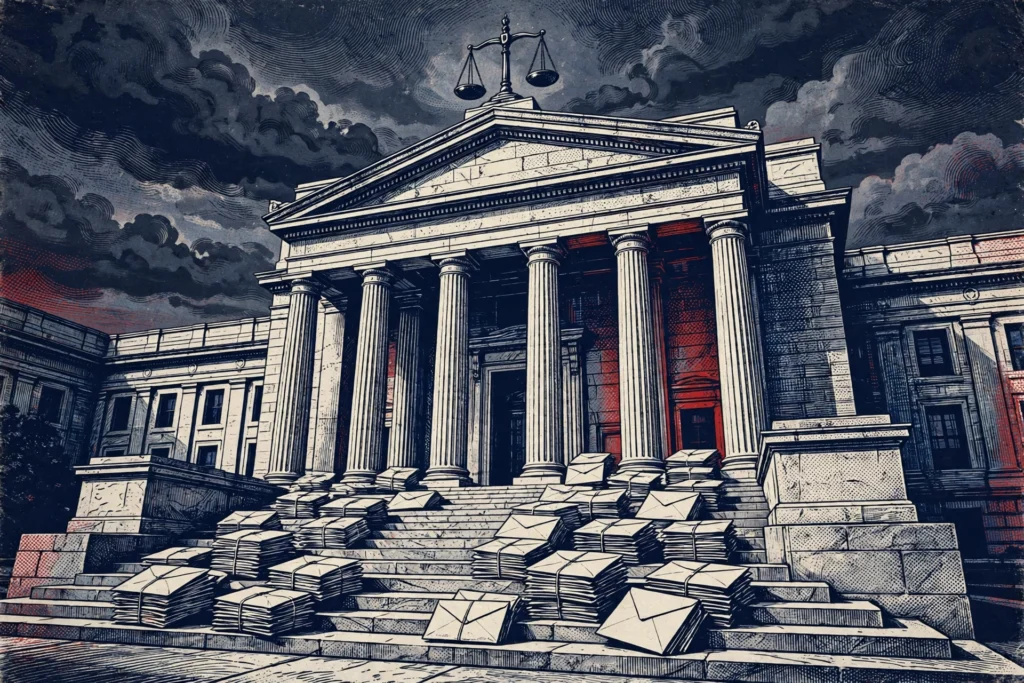
DOJ News: Court Rejects Bid to Block California Ballots
A federal appeals court on Monday rejected the Justice Department’s emergency request to force California to set aside mail ballots from more than 20,000 voters the administration claims are likely noncitizens, ruling that the government had gone to the appeals court too soon. The doj news landed eight days before the November 3 midterm elections, and it sent the dispute back to a federal trial judge in California, who is scheduled to hear the government’s request on Tuesday afternoon.
The three-judge panel of the 9th US Circuit Court of Appeals ruled 2-1 that it lacked jurisdiction over the Justice Department’s appeal, because the department had not given the district court an adequate chance to consider its request for a temporary restraining order. In its order, the majority wrote that the government’s “claimed emergency, at least in part, is a self-constructed one,” and said part of the delay was the government’s own fault — in filing its lawsuit late, in taking time to recognize that California state law governs how ballots are issued and processed, and in communicating what relief it wanted.
The ruling came after an unusual emergency hearing held by video on Sunday, and it was a setback for an administration effort that has made California the focal point of its push for a greater federal role in how states run elections. The Justice Department had asked the appeals court to intervene immediately, arguing that the ballots should be segregated while the government checks whether the voters are citizens. The court refused, and the case now returns to the trial court for the hearing the government had sought to skip.
The Appeals Court’s 2-1 Ruling
Judge Mark Bennett, appointed by President Donald Trump, and Judge Gabriel Sanchez, appointed by former President Joe Biden, formed the majority. Judge Patrick Bumatay, also a Trump appointee, dissented. The panel granted a motion by Los Angeles County to dismiss the appeal for lack of jurisdiction and denied the Justice Department’s emergency motion as moot. The case is United States v. State of California, and the decision came from the San Francisco-based appeals court that covers the western states.
The majority said the government had given the district court “a mere 15 hours,” including overnight hours and only three business hours, to rule on its request for a temporary restraining order before running to the appeals court. “The United States failed to allow the district court adequate opportunity to consider its application,” the order read. The court also noted that the government had known about its concerns with California’s voter rolls for months, had filed its lawsuit only after mail-ballot processing had begun, and had twice asked the district court to rule by November 3.
That a Trump appointee joined the majority gave the ruling added weight. Bennett wrote separately that he would also have denied the government’s request on the merits, saying the Constitution gives California the power to manage its voter rolls and run its elections. Sanchez wrote that the injunction the government wanted “would transform California’s election rules for an election that is already underway,” and that the government was asking a federal court to dictate to a state legislature a matter “squarely within the state’s traditional domain,” upending its policies and inviting “disorder and confusion for voters and election officials alike.”
Bumatay disagreed, writing that the federal government was entitled to a ruling in its favor because it “has a sovereign interest” in stopping illegal voting, and that California was not helping. His dissent argued that the court should have blocked the state from processing the ballots while the dispute was resolved. The split showed that even judges appointed by the same president can divide sharply over how far the federal government may go in directing a state’s elections.
How the Case Reached the Appeals Court
The Justice Department sued California and Los Angeles County on October 15, asking a court to bar officials from counting mail-in ballots from more than 20,000 voters on a federal list of people the government describes as likely noncitizens until their citizenship is confirmed. The lawsuit was an escalation in the president’s effort to assert a greater federal role in elections ahead of the midterms, and it was a rare intervention by the Justice Department in the voting process weeks before an election.
The confrontation had been building for days. On the Tuesday before the lawsuit, the department gave California 48 hours to review a password-protected thumb drive containing the names of people the federal government believes are likely noncitizens who had been sent mail-in ballots. Los Angeles County’s registrar said his office received the drive along with a handwritten note providing the password, and that he did not consider the thumb drive a secure device. The secretary of state’s office said the password was written on a sticky note.
Two days later, the department filed its lawsuit. The next day, acting Deputy Attorney General Trent McCotter warned Los Angeles County and California election officials that they could be held liable as aiders and abettors of a federal crime if they counted the flagged ballots. The president shared the letter on Truth Social with the comment that the officials “will all go to jail for a long period of time.” The warning marked the sharpest rhetoric yet from the White House in its weeks-long confrontation with the state.
The government then asked the district court to rule by October 22, after learning that Los Angeles County had processed more than 331,000 mail ballots. When the district court did not meet that deadline, the government appealed, calling the delay a “constructive denial” of its motion. The appeals court held its emergency hearing on Sunday and issued its ruling on Monday, sending the case back down with instructions that amount to a simple message: let the trial judge rule first.
The District Court Hearing on Tuesday
The case now goes back to US District Judge David Carter, who is due to hold a hearing at 1 p.m. Pacific time — 4 p.m. Eastern — on Tuesday in Los Angeles to consider the Justice Department’s request for a temporary restraining order barring officials from counting any ballots from the people it flagged. It is the hearing the government had asked the appeals court to let it skip, and it is now the next step in a case that has moved quickly through the courts.
A temporary restraining order is a short-term emergency measure, and the judge will weigh whether the government has shown it is likely to succeed on its claims and would suffer harm without immediate action, against the disruption of changing election rules while voting is already under way. If the judge grants the order, the flagged ballots would be set aside while the case continues. If he denies it, the ballots will be processed under California’s existing rules, and the government could return to the appeals court — this time after the trial judge has ruled.
The hearing will also test the government’s evidence. California has argued that the department’s list is unreliable, and the judge is likely to press the government on where the list came from and how the names on it were chosen. The answers could shape not only this case but the government’s wider campaign to challenge voter rolls in other states before the election.
California’s Response
California has said its safeguards against noncitizen voting are robust, and that the Justice Department’s assertions relied on “suspect data.” State officials have said complying with the government’s demands would risk disenfranchising eligible voters, and that the department’s efforts to gain access to protected voter data and purge voter rolls serve only to cause chaos and fuel public distrust in elections.
Questions have also been raised about the list itself. Tony LoPresti, counsel for Santa Clara County, said the Justice Department’s lawyer could not say where the list came from, only that it had been bought from a third party, according to KTVU. The department has not said how many of the more than 20,000 people on its list have actually submitted a mail ballot, and it has not explained how the names were matched to the voter rolls.
Governor Gavin Newsom welcomed the appeals court’s ruling and urged Californians to vote early. Attorney General Rob Bonta said the Constitution gives states and Congress, not the president, power over how elections run. The Justice Department’s filing said it had sought to work collaboratively with California to identify noncitizens registered to vote, and that “California made no serious effort to do so.” The secretary of state’s office said the outreach had not been collaborative, and that the state’s efforts to verify its rolls were already under way.
Why This Case Matters Before the Midterms
The dispute arrives at a moment when control of Congress is on the line. The midterm elections 2026 on November 3 will decide whether Republicans keep control of the House and the Senate, and California, a Democratic stronghold, holds 52 seats in the House — more than any other state. The 2026 midterms have become a test of the president’s push for a greater federal role in elections, and the California lawsuit is the sharpest example of it. The battle for the House runs through the country’s largest state, and a court ruling that changes how its ballots are counted would be felt far beyond its borders.
California’s voting system is built around mail-in voting. Every active registered voter receives a mail ballot, and the state begins processing those ballots ahead of Election Day, although it does not actually count them until the polls close. That slow count has long been a target of the president, who seized on California’s slow ballot-counting in the state’s summer primary to call the validity of the results into question. The election polls have shown a close race for control of Congress, and the outcome in California’s House districts could decide it.
Noncitizen voting is exceptionally rare in US elections, according to multiple studies and state audits, and the administration has previously flagged eligible voters as potential noncitizens while combing state registration lists. The California lawsuit was the first time the Trump administration sought to prevent a state from counting votes, and it did not indicate how many of the 20,000 people on its list had actually submitted a mail ballot. Voter turnout in the state is already under way, with early voting open and mail ballots arriving daily.
The case is also part of a broader pattern in the campaign’s final days. On Monday, the president offered a $1 million reward for voter-fraud reports leading to arrest and conviction, and the Justice Department has sued to block certification of Alaska’s Senate race if Senator Dan Sullivan loses. The trump news cycle has been dominated by these election-legitimacy fights, and the courts are now being asked to settle questions that, in past cycles, were left to election officials. White House news has framed the effort as a defense of election integrity; critics call it an attempt to cast doubt on the results before they are known.
What Happens Next
The immediate question is what Judge Carter decides on Tuesday. A ruling for the government would set aside the flagged ballots while the case continues; a ruling for California would let the ballots be processed under the state’s existing rules. Either way, the losing side is likely to appeal, and the case could return to the 9th Circuit — this time with a trial court ruling for the appeals court to review. That is the path the appeals court itself pointed to when it said the government had moved too soon.
Beyond Tuesday, the calendar is the government’s biggest obstacle. The election is a week away, early voting is already under way across much of the country, and the appeals court has already warned that changing the rules mid-election invites disorder. The Justice Department could also seek emergency relief from the Supreme Court, although no such filing has been made, and the Supreme Court has been reluctant in past cycles to change election rules in the final days before voting.
For voters, the practical effect is limited for now: the flagged ballots remain in the system, and California continues to process mail ballots under its existing rules. What to watch is whether the district court sets any of them aside on Tuesday, whether the government returns to the appeals court, and whether similar lawsuits appear in other states before November 3. The answers will shape how the final week of the campaign is fought — in the courts as much as on the trail — and whether the us politics of the midterms is decided at the ballot box or in the courtroom.
*Source: Reuters*