Breaking News Today: Port Sues Tanker Owners After Crash
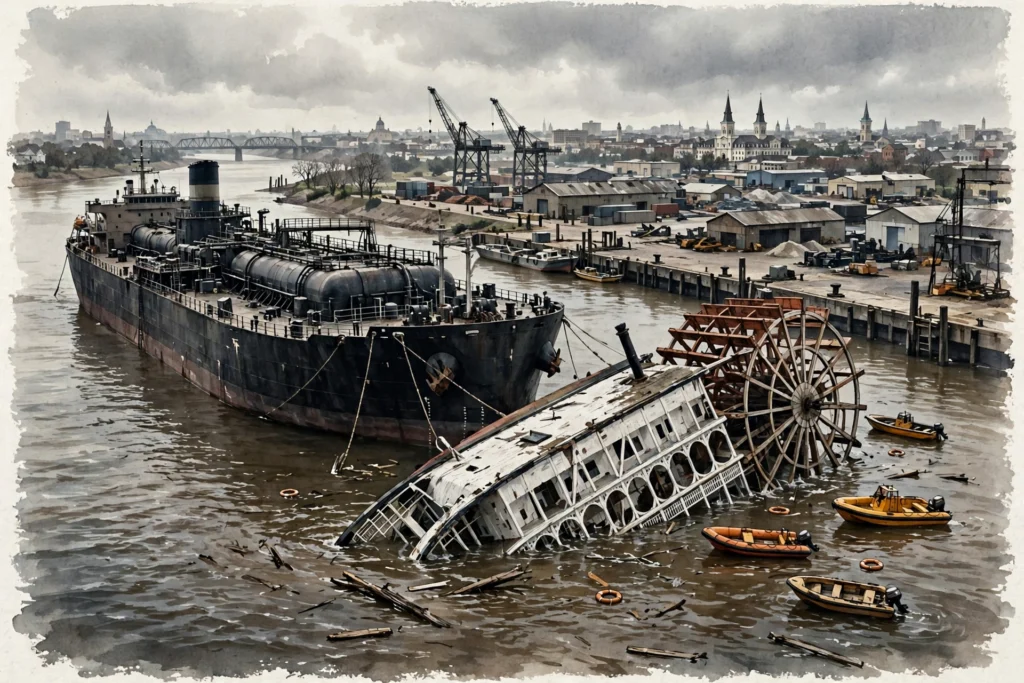
The breaking news today out of New Orleans is a federal lawsuit filed less than a day after a tanker lost control on the Mississippi River and slammed into a docked cruise ship, flipping the riverboat onto its side and sending passengers into the water. The Port of New Orleans filed suit on Friday evening, November 13, seeking more than $1 million in damages from the owners and managers of the tanker Atlantic Asphalt, and a federal court has already ordered United States marshals to seize and hold the 525-foot vessel. The lawsuit turns a dramatic rescue on the river into a legal fight over who pays for a wrecked terminal, a capsized riverboat, and a river that had to be closed to one of the busiest shipping lanes in the country. It is the first legal consequence of a collision that officials are calling a miracle because nobody was killed, even as 32 people were taken to hospitals and the riverboat was left lying on its side, mostly underwater, at the port’s Thalia Street Terminal.
The crash happened at about 12:30 p.m. on Friday, November 13, when the Atlantic Asphalt, a tanker carrying asphalt and bitumen, appeared to lose steering as it passed beneath the Crescent City Connection bridge and veered toward the dock where the American Heritage was tied up. The American Heritage, a five-deck paddlewheel riverboat operated by American Cruise Lines, had docked about two hours earlier to begin letting passengers off at the end of an eight-day cruise through Louisiana and Mississippi. About 129 passengers were still aboard, along with crew members, for a total of roughly 197 people on the riverboat when the tanker struck it broadside. The impact drove the riverboat against the dock, and within about 15 minutes it had taken on water, rolled over, and partially sunk, throwing people into the Mississippi River. By Friday evening, all 197 people had been accounted for, 32 had been taken to hospitals, and none was reported to have critical injuries. The port filed its lawsuit hours later, while rescue and recovery work was still under way.
The speed of the filing is part of the story. The port did not wait for investigators to determine what went wrong before going to court. Its lawsuit says the terminal was significantly damaged, puts the physical damage at more than $1 million, and warns that additional direct, indirect, and consequential damages are still to come, including the costs of cleanup, surveys, repair, replacement, and salvage. It also asks the court to hold the tanker itself responsible, through a maritime lien, and to have the vessel seized and sold if necessary to cover the losses. That is why a federal arrest warrant was issued for the Atlantic Asphalt on Friday, directing marshals to seize and hold the ship. By Saturday, the tanker had been towed from the crash site and was moored at the Perry Street Wharf on the west bank of the river in Gretna, under the court’s order.
Breaking news today: what the port’s lawsuit alleges
The lawsuit was filed in the Eastern District of Louisiana by the Board of Commissioners of the Port of New Orleans, the public body that runs the port, and it names three defendants: the vessel Atlantic Asphalt itself, Nave Shipping SA, and Thome Ship Management Pte Ltd. The port is represented by attorneys from the New Orleans firm Jones Walker, including Christopher Hannan, Sara Kuebel, and Abigail Weiland. Court records show the case was assigned to federal Magistrate Judge Karen Wells Roby and to Chief Judge Wendy Vitter, the chief judge at the federal courthouse in New Orleans.
The suit identifies Nave Shipping SA as a corporation registered in Liberia and says that, according to publicly available information, Nave Shipping is the registered owner and the ship manager and commercial manager of the Atlantic Asphalt. Thome Ship Management Pte Ltd., a private limited company based in Singapore, is identified as the tanker’s ISM manager, responsible for the effective implementation of the International Safety Management code aboard the vessel. The lawsuit says the port board has incurred, and will continue to incur, additional damages and expenses including cleanup, surveys, repair, replacement, and salvage costs, and that those costs give rise to a maritime lien against the Atlantic Asphalt.
The core allegation is that the collision was caused by the negligence, gross negligence, fault, or carelessness of the Atlantic Asphalt. In maritime law, the event is described as an allision, a term that refers to a moving vessel striking one that is securely moored, as opposed to a collision between two vessels that are both under way. The lawsuit says that as a result of the allision, the Atlantic Asphalt, Nave Shipping, and Thome, along with potentially other parties not yet identified who may bear responsibility for the operation, condition, crewing, and seaworthiness of the tanker, are solidarily liable for all damages sustained by the board. Solidary liability means each defendant can be held responsible for the full amount of the damages, not merely a share.
The lawsuit’s own language on the damage is blunt. It says the board’s Thalia Street Terminal was significantly damaged as a result of the allision, and that the extent of the damage remains under investigation, but physical damage is currently estimated to exceed $1,000,000, with additional substantial direct, indirect, and consequential damages anticipated. That figure is a floor, not a ceiling. The terminal is a working part of the port, and the damage to it is only one part of the loss. The lawsuit also covers the costs of cleaning up the site, surveying the damage, repairing or replacing what was broken, and salvaging the capsized riverboat, and it anticipates that the total will grow as the investigation continues and the full extent of the harm becomes clear. No statements had been made by the tanker’s owner or operator in response to the suit at the time it was reported.
How the collision unfolded on the Mississippi
The American Heritage had docked at about 10:53 a.m. on Friday, November 13, after an eight-day cruise, and had spent the morning beginning the process of letting its passengers off at the Port of New Orleans. The riverboat, built in 2015 and last renovated in 2022, is one of American Cruise Lines’ classic paddlewheel vessels, with a listed capacity of 150 passengers and a website description that puts its capacity as high as 180. It had come in from Natchez, Mississippi, and was tied up at the Thalia Street Terminal below the Crescent City Connection bridge, near mile marker 96 of the river, when the Atlantic Asphalt approached.
The tanker, a 525-foot vessel flying the flag of the Marshall Islands, was passing beneath the Crescent City Connection bridge when it appeared to lose control. Video aired by local television station WDSU showed the larger tanker approaching the docked cruise ship before the two vessels came together at what appeared to be a relatively slow speed. The Atlantic Asphalt veered to its right, its starboard side, and struck the American Heritage broadside. The riverboat began to take on water and, over the course of about 15 minutes, rolled over alongside the dock and partially sank, leaving the five-deck vessel lying on its side, mostly underwater, with passengers and crew thrown into the Mississippi.
A witness, Jamie Holford, told WDSU that it took about 15 minutes from the impact for the boat to roll over, a window in which many of those aboard were able to get off or be pulled from the water. About 87 passengers managed to leave the ship before it capsized, according to the New Orleans Advocate and Times-Picayune. The rest were caught in the rollover, and rescuers pulled people in life jackets out of the river in a frantic effort that lasted through the afternoon. The Coast Guard closed the river to all vessel traffic between mile markers 93 and 96 and suspended ferry service in the area, shutting down a stretch of one of the busiest shipping lanes in the United States while responders worked.
The collision did not strike the Crescent City Connection bridge itself, and the bridge was examined after the crash, Louisiana Governor Jeff Landry confirmed. The American Heritage’s operator, American Cruise Lines, confirmed that its riverboat was involved in a collision while docked in New Orleans. No one aboard the tanker was hurt. The port said in a Facebook update that all 197 passengers and crew members had been accounted for, a figure that covers the roughly 129 passengers and the crew who were aboard when the tanker struck.
Top news stories today: the rescue on the river
The rescue is the reason officials are calling the outcome a miracle. New Orleans Mayor Helena Moreno said at a news conference on Friday afternoon that 32 people had been taken to hospitals to be treated for unspecified injuries, and that none was reported to have suffered critical injuries. “At this moment, the information that we have, we have zero people unaccounted for,” Moreno said, adding that the outcome was “truly a miracle on the Mississippi.” The New Orleans Fire Department said 23 units and 57 personnel responded to the port for the rescue effort, and the Coast Guard, harbor police, and other agencies joined the work of pulling people from the water and accounting for everyone who had been aboard.
Of the 32 people taken to hospitals, 30 were passengers and two were harbor police officers, according to the Port of New Orleans. The two harbor police officers were released on Friday evening. At a news conference on Saturday, Moreno and other officials said only eight victims remained hospitalized, two of them in serious but stable condition. The rest had been treated and released, or were being treated for minor bumps and bruises at the port facility. The fact that no one died, and that no one was critically hurt, stands in sharp contrast to the images from the scene: a five-deck riverboat lying on its side in the Mississippi, its passengers in the water, and a tanker towering over the wreck.
President Donald Trump praised the Coast Guard and first responders on Friday evening, noting that nobody had been killed in what he described as a major collision, and that 32 people were in the hospital. The praise, posted on Friday evening, was part of the wider response to a rescue that drew on the city’s fire department, the Coast Guard, harbor police, and hospital staff across New Orleans. The rescue effort also had to work around the closure of the river, which stopped vessel traffic in both directions through the port while the wreck was secured and the search for anyone still unaccounted for was completed. By late Friday afternoon, the port was able to confirm that everyone had been found, and the work shifted from rescue to recovery and investigation.
What investigators know so far
The cause of the collision has not been determined, and officials have been careful to say that the investigation is still in its early stages. What is known is that the tanker appeared to lose steering. United States Coast Guard Captain Melanie Burnham said the tanker appeared to have “some type of loss of steering,” and an emergency response source told the Guardian that it was possible the tanker lost power before the collision. Burnham also said the tanker was being operated by a river pilot at the time of the collision. The collision is being treated as an accident rather than something done deliberately, and the exact cause remains unknown while investigators examine the vessel, its systems, and the circumstances of its passage beneath the bridge.
The National Transportation Safety Board said it would send a Go Team to New Orleans to investigate the collision, posting on X on Friday evening that the team was expected to arrive on Saturday. The NTSB’s arrival could be affected by the nationwide ground stop that halted flights across the country on Friday, a disruption that the port’s own coverage noted could delay the team’s travel. The Coast Guard is also investigating, and it is working on the case alongside the NTSB, the port, and local authorities. The river remained closed between mile markers 93 and 96 while the investigation and recovery work continued, and ferry service in the area was suspended.
The investigation will have to answer several questions. The first is what happened aboard the Atlantic Asphalt in the minutes before it struck the American Heritage: whether the steering failed, whether the vessel lost power, and whether the crew and the river pilot were able to do anything to regain control. The second is whether the vessel’s condition, its crewing, and its maintenance played a part, questions that the port’s lawsuit already raises in its allegations about the operation, condition, crewing, and seaworthiness of the tanker. The third is what the port and the Coast Guard knew about the tanker’s movements before the crash, and whether anything in its approach gave warning. Those questions will take weeks or months to answer, and the NTSB’s preliminary findings, when they come, will be the first official account of what went wrong.
The two vessels and the companies behind them
The American Heritage is a familiar sight on the Mississippi. Built in 2015, the five-deck sternwheel riverboat is one of American Cruise Lines’ classic vessels, operating cruises on the river between New Orleans and points upriver. Its website describes it as a classic paddlewheeler with capacity for as many as 180 passengers, and the company lists its capacity at 150. It was last renovated in 2022. On Friday it was finishing an eight-day cruise through Louisiana and Mississippi, and its passengers were in the middle of disembarking when the tanker struck. The riverboat’s size and its position, tied up at the dock with passengers aboard, made it vulnerable to exactly the kind of impact the Atlantic Asphalt delivered, and its rollover in about 15 minutes left little time for those still aboard to get clear.
The Atlantic Asphalt is a different kind of vessel altogether. At 525 feet, or about 160 metres, it is an asphalt tanker, a type of ship that carries heavy liquid cargo, in this case asphalt and bitumen. It flies the flag of the Marshall Islands, and its registered owner and commercial manager is Nave Shipping SA, a company registered in Liberia. According to the shipping tracker MarineTraffic and the Associated Press, the tanker is owned by a subsidiary of the China State Shipbuilding Corporation, a Chinese state-owned conglomerate. Its ISM manager is Thome Ship Management Pte Ltd., based in Singapore. The vessel was towed from the crash site after the collision and is now moored at the Perry Street Wharf on the west bank of the river in Gretna, held under the federal court’s seizure order.
The ownership chain matters because it determines who the port can hold responsible and where the money to pay for the damage will come from. The port’s lawsuit names the vessel itself, its registered owner, and its manager, and leaves room for other parties not yet identified who may bear responsibility for the operation, condition, crewing, and seaworthiness of the tanker. In maritime cases, the vessel can be arrested and held as security for a claim, which is what the federal court has ordered here, and the owner and manager can be held liable for the negligence of those who operated it. The international character of the ownership, a Liberian-registered owner, a Singapore-based manager, and a Chinese state-owned parent, means the case will play out in a federal court in Louisiana, under United States maritime law, with the tanker itself sitting in the river as security.
What happens next
The immediate next step is the legal process. The Atlantic Asphalt is under seizure, moored at the Perry Street Wharf, and the case will proceed through the federal courts in the coming months. The port will have to prove its claim: that the tanker was at fault, that the damage to the Thalia Street Terminal and the costs that followed were caused by the collision, and that the defendants are liable for them. The defendants will have the opportunity to respond, and the case may turn on the same questions the NTSB and the Coast Guard are investigating: what failed aboard the tanker, who was responsible for its operation, and whether its condition and crewing met the standards the law requires. If the port succeeds, the tanker can be sold to satisfy the judgment, and the proceeds can be applied to the damage. If the parties settle, the vessel may be released on the posting of security.
The riverboat’s future is a separate question. The American Heritage is lying on its side, mostly underwater, at the Thalia Street Terminal, and it will have to be raised, surveyed, and either repaired or written off. That work will take time, and it will be expensive, and it will be part of the damages the port and American Cruise Lines seek to recover. The terminal itself will need repair, and the port will have to assess the full extent of the damage to its docks, its structures, and its operations before it can put a final figure on the loss. The lawsuit’s estimate of more than $1 million in physical damage is only the beginning, and the port has warned that the total will include cleanup, surveys, repair, replacement, and salvage costs that are still being counted.
The investigation will run in parallel with the lawsuit. The NTSB’s Go Team is expected to arrive on Saturday, and the Coast Guard’s investigation is already under way. Their findings will shape both the legal case and any changes to how vessels are handled at the port. The Coast Guard may review the rules for docking and for vessel movements near the Thalia Street Terminal, and the port may review its own procedures for berthing riverboats alongside a working shipping channel. Whether the Coast Guard or the Port of New Orleans changes its navigation or docking safety rules is one of the questions the coming weeks will answer, along with whether the American Heritage can be raised and returned to service, and how long the river will remain closed to traffic through the port.
For the people who were aboard the American Heritage, the next days will be about recovery. Eight remained in hospitals on Saturday, two of them in serious but stable condition, and the rest were dealing with the shock of a cruise that ended in the Mississippi River. For the port, the next days will be about counting the damage and making its case in court. For the city, the story will remain the top news in New Orleans: a tanker that lost control, a riverboat that rolled over, a rescue in which everyone survived, and a lawsuit that will decide who pays for it all. The breaking news today is the filing of that lawsuit, and it is only the first step in a process that will take months to play out.
Source: WWL-TV