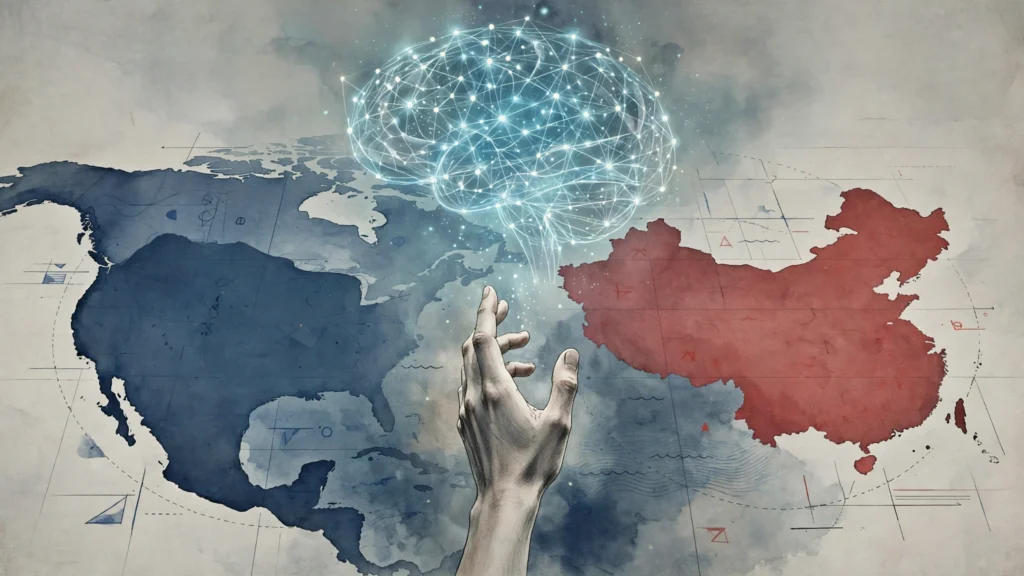
Artificial Intelligence News: Trump-Xi Military AI Pact
In the latest artificial intelligence news from Washington, the United States and China have agreed that human beings must always remain in charge of military decisions made with artificial intelligence, and that the technology must never be allowed to launch a major military operation on its own. Treasury Secretary Scott Bessent disclosed the understanding on Friday, November 20, 2026, in an interview with CNBC after returning from President Donald Trump's meeting with Chinese President Xi Jinping in Shenzhen, calling it one of the trip's most important outcomes. The agreement is narrow but striking: the world's two AI superpowers have drawn a shared line around the use of that technology in war. What they have not done is put the commitment in writing. No text has been published, no definitions have been agreed, and Beijing has not publicly confirmed the military details Bessent described.
What Trump and Xi Agreed on Military AI
The disclosure came from Bessent, who travelled with Trump to China and is the lead American official on maintaining relations with Beijing. Speaking to CNBC on Friday, he said the understanding on military AI ranked among the major achievements of the Asia trip. The core of it is simple: whenever artificial intelligence is involved in a military decision, a human being must be part of that decision, and the technology must not be permitted to act on its own in a major military operation. He said he thought it was very important that the two presidents had agreed humans should always be involved in any military decisions that SI makes, and that SI should not be allowed to be autonomous for major military actions. SI is the abbreviation the Trump administration uses for superintelligence, the term the president prefers for the most advanced forms of artificial intelligence.
Bessent was careful to draw a boundary around the agreement. He said the understanding, including the requirement for human involvement and other safeguards, would not be affected by the competition between the two countries for AI supremacy. The race goes on, in his account, but the guardrail stands apart from it. He made the point in plain terms, saying there was nothing to do with competition when both sides agree that no major military operation should be launched without a human being involved. He also argued that American AI laboratories needed to keep their technological lead, the best defence against what he called dangerous Chinese AI models used in cyberattacks. The message is twofold: cooperate on a safety rule, compete hard on the technology itself.
The meeting took place on Thursday, November 19, 2026, in Shenzhen, on the sidelines of the Asia-Pacific Economic Cooperation summit. Xi broke with protocol to greet Trump personally at the airport, and the two men then sat down with Russian President Vladimir Putin for the first meeting of the three leaders ever held. The three issued a four-point declaration on United Nations reform, refined petroleum products, and talks on reducing nuclear risks. The military AI understanding was not part of that declaration. It emerged through the leaders' own words and Bessent's account, which is why the details now in public view come entirely from the American side.
Artificial Intelligence News: Superintelligence and the Joint Guardrails
The language matters, because the words the two leaders used are doing real work. Trump has taken to calling the most advanced AI systems superintelligence, and he has said Xi liked the phrase as well. The term frames the conversation as one about systems powerful enough to make decisions that once belonged only to generals and presidents. When Trump spoke at a White House news conference on Friday after returning home, he said he and Xi had agreed to set up joint guardrails on the technology. He added that the two of them would do it together because there is no third place, and that he did not think there ever would be, arguing that the United States leads the field, China is second, and no other country is close.
The president had already signalled the direction a day earlier, telling Fox News on Thursday that both leaders wanted safety rules for the technology. The guardrails announcement was a striking shift from a president who has argued consistently that regulation of the technology would slow American innovation and help China take the lead. No details were released about what the guardrails would look like or when they would be negotiated.
It is worth being precise about what the understanding covers and what it does not. According to Bessent, the commitment is that a human being must always be involved in military decisions the technology helps to make, and that the technology must not be permitted to carry out a major military action by itself. That is narrower than a ban on military AI altogether, and broader than the understanding the two countries reached two years ago, which dealt only with nuclear weapons. It does not say what counts as a major military action, how the two sides would know whether the other was keeping the promise, or what would happen if one side broke it. Those gaps are the difference between a shared principle and a working agreement.
Cybersecurity News: Chips, the H200, and the Race That Goes On
The guardrail was agreed in the middle of a technology contest that neither side has any intention of pausing. Bessent's interview made that clear in the same breath as the AI announcement, because the Treasury secretary also used the appearance to describe the administration's hard line on the computer chips that power advanced AI systems. The most advanced chip China is permitted to buy under licence is Nvidia's H200, a second-tier processor, and Trump has taken what Bessent called a very firm line on that limit. Bessent said Chinese buyers had placed few orders for the H200 as Beijing tries to build its own chip supply chain, and that China was probably many years behind. The United States intends to keep its lead in the hardware behind the most powerful AI, even as it agrees with China on a rule for how that AI is used.
The chip restrictions tightened further this week. On Monday, the Commerce Department took steps to restrict China's access to advanced AI chips still further, including chips used by data centers overseas where Chinese entities can rent computing power. Bessent said the administration expected the proper chip restrictions to be in place and remote access to be curtailed. Trump has separately pressed for artificial intelligence data centers to be built in the United States, with penalties for companies that build them abroad. The guardrails on military AI, the chip limits, and the data center push are three faces of the same policy, pursued all at once.
From Lima to Shenzhen: A Short History of Human Control
The idea that a human being must stay in charge of the most dangerous military decisions is not new, and the Trump-Xi understanding has a direct predecessor. In November 2024, President Joe Biden and Xi met in Lima, Peru, on the sidelines of the APEC summit, and the two leaders affirmed the need to maintain human control over the decision to use nuclear weapons, according to the White House account of that meeting. The two governments had opened a formal dialogue on AI risks in Geneva earlier that year, in May 2024. The Lima statement came after more than a year of pressure, and it was limited to nuclear weapons, the narrowest and most consequential category of all.
The Lima understanding built on an earlier American initiative. In 2023, the United States launched a political declaration on the responsible military use of AI and autonomy, and more than twenty countries endorsed it. The declaration underlined that the military use of AI capabilities needs to be accountable, including through such use during military operations within a responsible human chain of command and control. That language, a human chain of command, is the same idea Bessent described in Shenzhen, now carried a step further. The 2024 statement covered nuclear weapons. The 2026 understanding, as Bessent described it, covers military decisions in general, though none of those categories has been spelled out in public.
What Is Missing: No Text and No Confirmation From Beijing
For all its significance, the understanding has the weaknesses of an announcement made by one side. No written text of it has been published by either government. It was not part of the four-point declaration issued in Shenzhen on Thursday, and neither side has announced definitions, verification steps, or a timetable. What the public knows about the military commitment comes from the American side alone.
China's public words back the general principle but do not describe a military agreement. The official Chinese readout of Thursday's meeting, published by the Xinhua news agency, said Xi told Trump that the two countries should strengthen communication and coordination to prevent the safety risks of AI and ensure that AI is always under human control. China's embassy in Washington used nearly the same words in a statement on Thursday. Beijing has not publicly confirmed the military details Bessent described, and it has not said whether it understands the commitment to cover major military operations in the way Bessent described it. Until Beijing says more, the scope of what was agreed rests on the American account alone.
What Happens Next for the Military AI Agreement
The calendar supplies the next test. A fourth meeting between Trump and Xi is expected at the Group of 20 leaders' gathering in Miami next month, and the trade truce struck in South Korea last year, extended during Xi's visit to Washington in September, expires on January 10, 2027. An extension of that truce is expected to wait until the Miami meeting. That meeting is the natural place for the two sides to say whether the commitment has a text, a definition, and a way of checking compliance, or whether it remains a statement of principle.
There are three questions to watch. The first is whether Beijing confirms the military scope in its own words. The second is whether either government publishes anything in writing, a joint statement, a fact sheet, or even a summary of the definitions, because a rule without a definition of a major military action is a rule that can be interpreted away. The third is whether the agreement survives contact with the competition that surrounds it, the chip restrictions, the data center fight, and the trade truce deadline, all of which give both sides reasons to walk away from cooperation. Bessent's argument is that the safety rule and the competition are separate things. The coming weeks will show whether that separation holds.
Source: Reuters