Apple News: HomeView Launches With Siri AI
The biggest apple news of the week arrives on Friday, November 13, 2026, when Apple’s HomeView goes on sale in the United States at 299 dollars and in the United Kingdom at 299 pounds. HomeView is a shared smart-home display with Siri AI, FaceTime, entertainment, and a shared smart-home dashboard, and it can recognise up to six faces. It is not sold in the EU. The launch is Apple’s significant step into the shared screen at the home’s centre — a device meant to be used by everyone in the household, not locked to one person’s phone — and it arrives alongside a new fourth-generation Apple TV 4K, also priced at 299 dollars, which brings Siri AI and hands-free voice commands to the living room television.
The timing is no accident. Apple has spent the autumn refreshing its hardware line-up, releasing new Macs and an iPad mini on November 6, and it is now turning to the home. For years, the smart home has been a market of many small gadgets and no clear centre: lights from one company, a thermostat from another, a speaker from a third, each with its own app. A shared display that recognises who is standing in front of it and shows that person the right controls, messages, and entertainment is Apple’s attempt to give that scattered market a centre — and to give Siri, its long-criticised voice assistant, a new stage on which to prove itself.
What HomeView Is
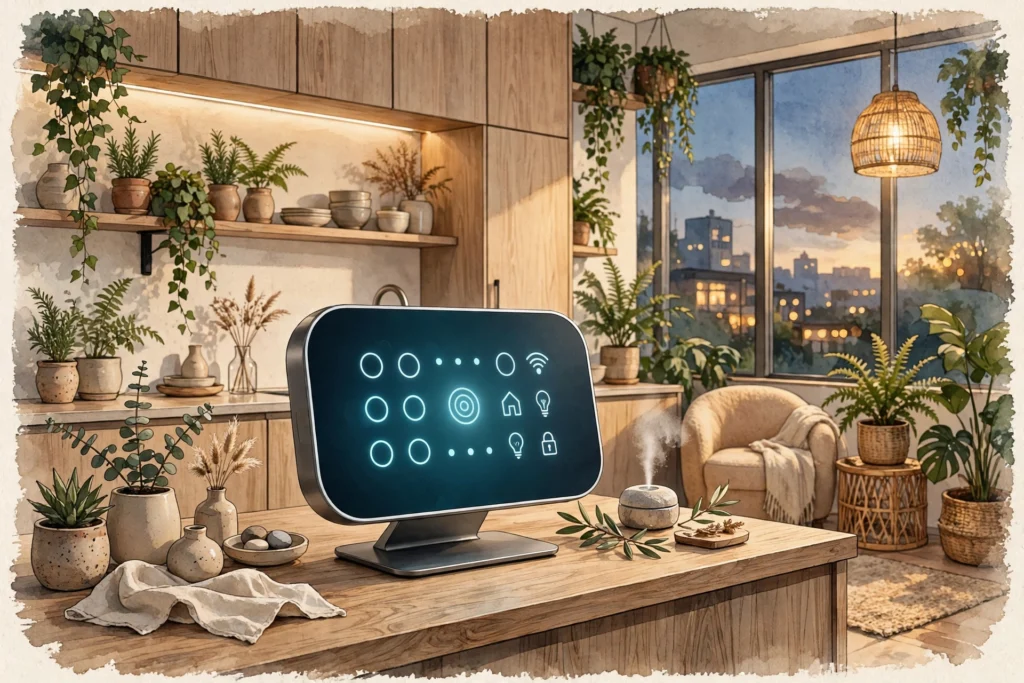
HomeView is best understood as a kitchen-counter and living-room screen built for the whole household. Unlike a phone or tablet, which belongs to one person, a shared display sits in a common space and is used by whoever walks past. That is why face recognition matters: the device can recognise up to six faces, so it can show each family member their own information — their calendar, their messages, their music — rather than a single shared view. In a family of four or five, that difference is the difference between a useful device and a confusing one.
The display also carries FaceTime, Apple’s video calling service, and entertainment features for music and video. But the centrepiece is the shared smart-home dashboard: one screen from which the household can control its lights, locks, heating, cameras, and other connected devices. The idea is simple — instead of opening a different app for every gadget, the family gathers around one display that knows the home and the people in it. Whether that idea works in practice will depend on how smoothly the dashboard handles the many brands and standards that make up a real smart home.
HomeView’s absence from the EU is a notable part of the launch. Apple has not sold it there, and the reasons — which the company has not spelled out in detail — are likely to be a subject of questions from European customers who follow Apple news closely. For now, the device is a US and UK story, priced identically in dollars and pounds at 299.
Siri AI on a Shared Display
Siri is the heart of HomeView, and also its biggest question mark. The assistant has been part of Apple products since 2011, and for much of that time it has been criticised as less capable than rivals. The arrival of Siri AI — a rebuilt, more capable version of the assistant — is Apple’s attempt to change that reputation, and HomeView is the first device built around it from the start. On a shared display, Siri must do more than answer one person’s questions: it must know who is asking, what that person is allowed to do, and how to handle requests that touch the security of the home itself.
That last point is where the new assistant faces its hardest test. A voice command that unlocks a door or opens a garage is convenient, but it is also a security decision, and the assistant must be sure about who is speaking before it acts. HomeView’s face recognition is part of the answer — the device can identify the requester before carrying out a sensitive command. But identification is only the first step; the assistant must also understand the request correctly, every time, in a noisy kitchen, with children talking in the background. The iPhone news cycle has shown how quickly a voice assistant’s mistakes become public, and a shared home display will be judged by the same unforgiving standard.
The December Update and What It Will Not Promise
Apple plans a December software update to address some of Siri AI’s limitations, including camera use and voice unlocking for certain smart-home security devices, such as compatible doors and garage doors, after HomeView identifies the requester. The update is expected to make the assistant more useful in exactly the situations where it matters most — letting a recognised person into the home with a spoken command, or using the camera as part of the home’s awareness. But two things remain unknown: Apple has not announced the software version or the exact date, and it has not said the update will fix every Siri issue.
That caution is worth noting, because it sets the terms of the launch honestly. HomeView arrives with known limitations, and the December update will address some of them, not all of them. Buyers should therefore judge the device on what it does on day one, not on a promise of what a future update might bring. The history of smart-home gadgets is full of products that launched half-finished and never quite caught up, and Apple’s decision to flag the limits up front may be an attempt to avoid that trap. Still, the gap between what Siri AI can do today and what Apple wants it to do is the story to watch through the winter.
Apple TV 4K Joins the Siri AI Push
HomeView is not the only Apple device arriving on November 13. Apple’s new fourth-generation Apple TV 4K also goes on sale the same day at 299 dollars, adding Siri AI and hands-free voice commands to the television. The set-top box has been a quiet success for Apple — a small black box that turns any television into a hub for streaming, games, and, increasingly, the smart home. Adding hands-free voice commands means the television can now be controlled without reaching for a remote, and Siri AI brings the same rebuilt assistant to the biggest screen in the house.
An early review found that follow-up questions were still unreliable — the kind of stumble where the assistant answers the first question well and then loses the thread of the conversation. That is a familiar weakness for voice assistants, and it matters more on a television than on a phone, because the living room is a shared, noisy space where people talk over each other and change the subject mid-sentence. Apple will hope software updates improve that behaviour quickly. Older Apple TV 4K models are expected to receive Siri AI in a future software update — the kind of rollout the ios update news cycle follows closely — so the new assistant will reach existing owners as well as buyers of the new box.
Apple News: A Busy November for Apple Hardware
HomeView and the new Apple TV 4K cap a busy month for Apple. On November 6, the company released an OLED iPad mini from 699 dollars, a 24-inch M6 iMac from 1,499 dollars, a 14-inch M6 MacBook Pro from 1,999 dollars, and its first touchscreen Mac — 14- and 16-inch OLED MacBook Pros from 2,899 dollars. The M6 chip at the heart of those Macs is the latest in Apple’s own silicon line, and the arrival of a touchscreen Mac ends a long-standing Apple position: for years, the company insisted the Mac would never have a touchscreen, arguing that the iPad was the touch device and the Mac was the keyboard-and-mouse device. That wall has now fallen.
The breadth of the November line-up shows a company refreshing almost everything at once — tablets, desktop computers, laptops, the television box, and now the home. It is the kind of coordinated push Apple makes when it wants to carry momentum into the holiday shopping season, and it gives the technology news a story on every shelf. The smartphone news and gadget news may belong to the iPhone for most of the year, but November 2026 is, by the evidence of the shelves, the month Apple chose to rebuild the rest of the home and the desk around it.
Siri’s Future, and the Disputes Around Apple
Beyond the launches, reports say Apple plans to turn Siri AI into an autonomous agent able to take more actions on a user’s behalf — booking, ordering, and managing tasks without being walked through each step. That is the direction the whole industry is moving, and the ai news cycle follows it closely: from assistants that answer questions to agents that act. It is also the hardest thing to build well, because an agent that acts on your behalf must understand what you actually want, and the cost of a misunderstanding rises with every action it takes. Reports also say Apple is tightening spending limits on AI tools used by employees, a reminder that even the world’s most valuable company watches the cost of the computing power behind its AI ambitions.
Apple is also in the middle of two public disputes. OpenAI has denied Apple’s claims of trade-secret theft in a court filing, reportedly saying the iPhone maker failed to present evidence and that the dispute is, in its words, “a mess of Apple’s own making”. And Apple has reportedly responded to Elon Musk’s allegation that the App Store favours OpenAI’s ChatGPT, saying the App Store is “free of bias”. Both claims are reported rather than established, and both show how the AI race now plays out in courtrooms and public statements as well as in product launches. For a company that has built its brand on privacy and on the App Store as a neutral marketplace, the allegation of favouritism is one it will want to answer firmly.
HomeView, then, arrives into a crowded and contested moment — a new device, a rebuilt assistant with known limits, a companion television box, and a company defending itself on two fronts at once. The test for HomeView will be the simplest one: does a family that puts it on the kitchen counter still use it in February, or does it become another screen that quietly gathers dust? Apple has priced it at 299 dollars, given it the face recognition a shared device needs, and promised a December update for the roughest edges. The rest is up to the assistant inside it.
Source: Gadgets 360