Ukraine War News: Kyiv Sinks Russian Warship in Libya
In the latest ukraine war news, the war between Russia and Ukraine has opened a new front nearly 1,500 miles from the battlefield, on the southern shore of the Mediterranean. Ukraine said on Monday, November 23, that its sea drones sank a Russian warship docked at a naval base in Libya and struck a Russian cargo vessel off the North African coast, in a surprise attack carried out the previous day. President Volodymyr Zelenskyy claimed responsibility for the operation, called it exemplary, and said the targets his forces set out to hit had been achieved. The attack, if confirmed in full, would be one of the most daring long-range operations of the war, and a sign that Kyiv is now willing to hunt Russian military assets far beyond the Black Sea.
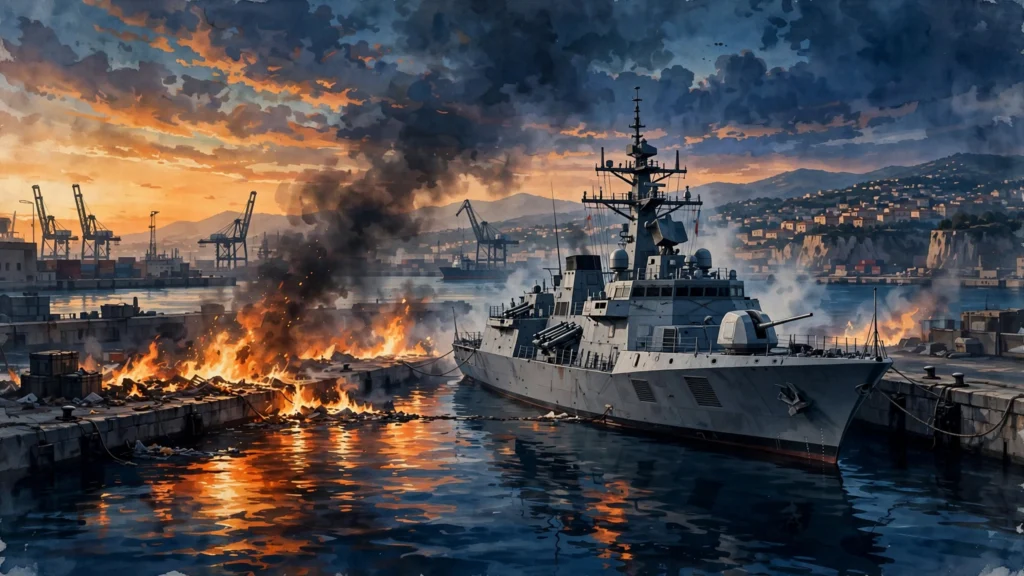
The operation took place on Sunday, November 22, in the early hours of the morning, at the Benghazi Naval Base in eastern Libya. The main target was the Merkury, a Russian navy corvette and one of the newest ships in Moscow's fleet, commissioned in 2023, a year after Russia launched its full-scale invasion of Ukraine. The 344-foot warship, a Steregushchiy-class corvette assigned to Russia's Black Sea Fleet, had docked at Benghazi to refuel and take on supplies under a cooperation agreement between Russia and the eastern Libyan authorities. Ukrainian forces deployed seven domestically made sea drones against it. Zelenskyy said the corvette was sunk and a Ka-27 combat helicopter stationed on board was destroyed along with it.
Video released by Zelenskyy showed the attack as it happened. In footage provided by Ukraine's Security Service, the SBU, a Ukrainian Sea Baby naval drone speeds across the water toward the docked warship, which is already burning. A second drone strikes moments later, and the vessel erupts into a huge ball of flame as ammunition stored on board begins to explode. The footage, posted on social media by the president himself, was the centrepiece of Kyiv's claim: not just that the attack happened, but that Ukraine was proud to own it.
Ukraine War News: How the Attack Unfolded
Zelenskyy's account, posted on X and Telegram on Monday, was detailed and specific. "Our warriors deployed seven Ukrainian-made naval drones," he wrote. "Despite all the enemy's efforts to counter the attack, the Russian corvette Merkury was sunk. It is one of their newest ships, commissioned in 2023, during the full-scale war. A Ka-27 combat helicopter was also destroyed along with the corvette." He added that the second target, the Russian dry cargo vessel MV Angara, which he said Moscow used to transport weapons, had also been hit. "Result: target hit," he wrote. "An exemplary Ukrainian operation in response to Russia's war. I thank the warriors of the Security Service of Ukraine and all our Defence Forces of Ukraine who took part in carrying out these tasks."
Libyan officials who were briefed on the attack gave a slightly different account of the damage, while confirming the essentials. Two officials told the Associated Press that the strike severely damaged the corvette at the Benghazi Naval Base, although Zelenskyy claimed it was sunk. They said at least four of the Ukrainian drones were intercepted and destroyed, while two struck the vessel. At least ten people, including Libyan and Russian nationals, were wounded in the attack, one of the officials said. Residents of Benghazi heard loud explosions and saw flames at the base in the early hours of Sunday. The eastern Libyan authorities said their forces had destroyed four other naval drones during the assault.
The differences between the accounts matter, but they do not change the core of what happened. A Russian warship was attacked in a Libyan port, far from any Ukrainian coastline, by weapons launched by Ukrainian forces operating far from home. Ambrey, a British maritime security and risk intelligence firm, said some of the explosions at the base were likely caused by ammunition detonating aboard the Merkury, which fits with the fireball seen in the video. The SBU said the Angara was a sanctioned vessel used to transport Russian military equipment, and that the Merkury regularly escorted Russian naval convoys, including guarding the Angara itself.
The operation was conducted some 2,400 kilometres, about 1,500 miles, from the front line in Ukraine. That distance is what makes the attack so striking. Ukraine's sea drones, the small uncrewed boats packed with explosives that Kyiv has used to such effect in the Black Sea, had to be launched from somewhere far closer than Ukraine itself. According to two eastern Libyan officials briefed on the investigation, the drones were launched from a base operated by Ukrainian forces in western Libya. The SBU has carried out a series of long-range operations against Russian vessels and maritime assets beyond Ukraine's waters, but this is the furthest from home its drones have ever struck.
NATO News: Why Libya Matters to the Alliance
Libya has become a proxy theatre of the Russia-Ukraine conflict, in the words of Emadeddin Badi, an associate fellow at the London-based think tank Chatham House and a specialist on Libya. The country has been divided since its civil war, with two rival governments: one based in Tripoli in the west, recognised internationally, and one based in Benghazi in the east, led by the Government of National Stability and backed by the military commander Khalifa Haftar and his Libyan National Army. Russia has built close ties with Haftar's eastern authorities, and the Merkury's visit to Benghazi was part of that relationship. The corvette had docked to refuel and resupply under a cooperation agreement with the eastern government, and it was escorting Russian cargo vessels carrying military supplies back to Russia when it was hit.
Ukraine, meanwhile, has been operating in western Libya under a covert arrangement endorsed by the West, according to Libyan officials. Ukrainian forces have used the North African country's territory to strike Russian tankers in the Mediterranean before, including an attack on a Russian tanker in March of this year. A Ukrainian naval drone operator deployed in Libya told CNN earlier this year that his unit was using a military base in Misrata, a city east of Tripoli, as a launchpad to attack Russia's shadow fleet in the Mediterranean, in exchange for training local forces. The Benghazi operation appears to be the most ambitious result of that quiet arrangement so far.
The attack is a problem for NATO as well as for Russia. The Mediterranean is the alliance's southern sea, patrolled by the navies of its southern members and by the United States Sixth Fleet. A war that began in eastern Europe is now being fought with drones launched from one Libyan port against a Russian warship docked in another. The United Nations mission in Libya expressed serious concern over the attacks and called for an immediate, independent and transparent investigation. The concern is not only about the fighting itself, but about what it means for a country that has spent a decade trying to reunite after civil war, and that now finds itself hosting a shooting war between two foreign powers.
The incident also exposes how much Russia depends on Libya. Since losing its position in Syria, Moscow has leaned on its relationship with Haftar's eastern Libya as a foothold on the Mediterranean, a place where its warships can refuel and its cargo vessels can resupply on the way between Russia and its interests in Africa. The Merkury was doing exactly that when it was attacked. If Ukrainian drones can reach Russian warships in Benghazi, then that foothold is no longer safe, and Russia's ability to move men and weapons through the Mediterranean becomes harder and more expensive.
Pentagon News: Washington Watches the Shadow Fleet
The attack will have been watched closely in Washington, where the Pentagon has tracked Russia's shadow fleet, the ageing tankers and cargo ships Moscow uses to move oil and weapons while evading sanctions, for years. The Angara, the second vessel hit on Sunday, is part of that world. The SBU described it as a sanctioned ship used to transport Russian military equipment, and Zelenskyy said it was being used to move weapons. The Merkury's job, as its escort, was to protect ships like it. The sinking of the escort and the damaging of the cargo vessel in a single operation is a blow to the logistics chain that keeps Russia's war supplied.
The Trump administration, which has been pushing for a negotiated end to the war in Ukraine, now has another complication to manage. The strike demonstrates that Kyiv retains the ability and the will to hit Russian targets far from the front, even as diplomats talk about ceasefires and settlements. That is a message aimed at Moscow, but it is also a message aimed at Ukraine's own supporters: that the country is not a passive party waiting for a deal, but an active combatant still expanding the war it is fighting. How the White House responds will say something about how much room Washington is prepared to give Kyiv to keep fighting on its own terms while negotiations continue.
The weekend brought another reminder that the war at sea is spreading. Late on Saturday, a disabled Russian cargo ship was towed by another Russian vessel out of Finnish waters in the Baltic, after being hit by a drone presumed to have come from Ukraine. Kyiv has not taken responsibility for that incident. Taken together, the two episodes suggest a Ukrainian campaign against Russian shipping that now stretches from the Baltic to the Mediterranean, targeting the vessels Moscow relies on to move its war materials by sea.
What Happens Next: A Wider War at Sea
The immediate question is how Russia responds. Moscow has not yet issued a detailed public account of the Benghazi attack, and its options are limited. It cannot easily retaliate against Ukrainian forces in Libya without deepening its own involvement in a country where its presence is already controversial. It could step up its air attacks on Ukraine, as it has after previous Ukrainian successes, or it could try to reinforce its naval presence in the Mediterranean. Either way, the attack has shown that Russia's warships are vulnerable in ports Moscow considered safe, and that will force a recalculation of where its fleet can go and what it can risk.
The second question is what happens in Libya itself. The eastern authorities in Benghazi, who hosted the Merkury, will be under pressure to explain how Ukrainian drones reached a warship inside their most important naval base. The government in Tripoli, which has quietly allowed Ukrainian forces to operate from its territory, may face questions of its own. And the United Nations, which has called for an investigation, will have to decide how hard to press a case that touches two of its most difficult files at once: the war in Ukraine and the unfinished reunification of Libya.
The third question is the longest-term one: whether the war in Ukraine is becoming a war without a fixed geography. The fighting began in the Donbas and around Kyiv. It spread to the Black Sea, where Ukraine's sea drones sank the flagship Moskva in 2022 and drove much of Russia's Black Sea Fleet from its Crimean bases. Now it has reached the Mediterranean, 1,500 miles from the front. Each expansion has been dismissed at first as a one-off, and each has then become part of the pattern. The attack on the Merkury is the furthest Ukrainian strike yet, and it will not be the last test of how far Kyiv is prepared to go, or how far the war is prepared to follow.
For now, the facts are these: a Russian corvette is sunk or severely damaged in a Libyan port, a cargo ship used to carry Russian weapons has been hit, a helicopter has been destroyed, and at least ten people have been wounded. Ukraine has claimed the operation openly, named its targets, and published the video. The war that started in Europe has now been fought in North Africa, and the map of the conflict will never look the same again.
Source: NPR