Trump News: Historic Three-Way Summit With Xi, Putin
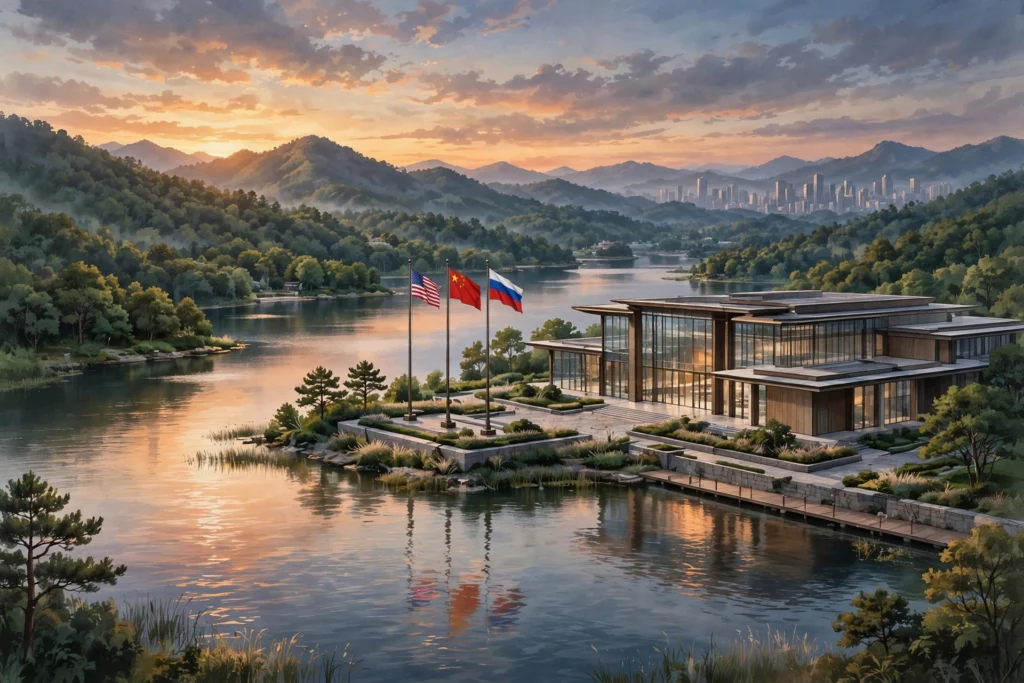
In the latest trump news, President Donald Trump, Chinese President Xi Jinping and Russian President Vladimir Putin have begun the first-ever three-way meeting of the leaders of the United States, China and Russia, sitting down together on Thursday in Shenzhen on the sidelines of the Asia-Pacific Economic Cooperation summit. The session, held at a lakeside resort known as Kylin Villa, brings together the stewards of the world's three largest nuclear arsenals in this format for the first time. The Kremlin said no more than an hour had been set aside for the encounter, and American officials have cautioned that no agreement is expected. What the meeting does offer, in the White House's framing, is the start of a conversation, one that could in time lead to negotiations on nuclear arms, at a moment when the wars in Ukraine and Iran and the wider balance of power are all in play at once.
The gathering is without precedent in modern diplomacy. Plans for the three-way summit were confirmed on Friday of last week by the White House, and China's Foreign Ministry confirmed the meeting on Monday, saying Xi would host Trump and Putin in Shenzhen on November 19. The encounter is taking place on the margins of the 33rd APEC Economic Leaders' Meeting, a two-day gathering of the leaders of 21 Pacific economies, and it has already threatened to overshadow the summit itself. Shenzhen, the fast-growing technology hub hosting the meeting, has been presented by Beijing as a showcase for China's rise.
Ukraine War News: The Subject Kyiv Fears Will Be Decided Over Its Head
The most sensitive question hanging over the meeting is the war in Ukraine, and the signals from Washington have pointed in different directions. A senior American official who briefed reporters before the trip said Trump does plan to discuss the war in Iran with Xi and Putin, but will steer away from discussing Ukraine in the three-way session. Trump himself has said something different, telling reporters he intends to raise both wars. Ukrainian President Volodymyr Zelenskyy has expressed concern that the meeting could serve as a platform for discussing a possible Ukraine deal behind Kyiv's back. Trump did hold a separate meeting with Putin on Thursday before the three-way session, a roughly 40-minute conversation in which the war in Ukraine was the main topic, according to the Kremlin, and the two presidents' first face-to-face talks since their summit in Alaska in August 2025.
The planning for the Shenzhen encounter has drawn comparisons to the Yalta Conference of 1945, when the leaders of the United States, Britain and the Soviet Union redrew the map of Europe. Kremlin spokesman Dmitry Peskov dismissed the comparison, noting that any agreements reached in Shenzhen could not be enforced on others. The unease in Kyiv is sharpened by the state of the relationship between Washington and Moscow: Trump has sought to build his relationship with Putin even as the Russian leader has persisted in his nearly five-year-old war with Ukraine, and he recently struck a diesel deal with Russia, waiving sanctions to allow the sale of millions of tons of the fuel.
Iran War News: The Conflict Trump Promised to Raise
The war in Iran is the one subject all sides agree will be on the table. The senior American official who briefed reporters said Trump does plan on discussing the Iran war with Xi and Putin, and Trump has listed Iran alongside nuclear arms, Ukraine, trade and economics as subjects for the three-way talks. The conflict has become a point of difference between Washington and Beijing, and a point of growing closeness between Moscow and Beijing. Trump has warmly embraced Xi after coming to a truce in the short-lived trade war between the two countries last year, in spite of differences over the American war with Iran. Russia has deepened its military, intelligence and diplomatic partnership with Iran even as the war has continued.
Nuclear Arms: The Arithmetic That Makes a Deal Hard
The stated centrepiece of the meeting is nuclear arms, and it is here that the gap between ambition and arithmetic is widest. The last nuclear arms pact between Russia and the United States, known as New START, expired in February, removing caps on the two largest atomic arsenals for the first time in more than half a century. When the treaty expired, Trump rejected a call by Russia to extend the two-country deal for another year and called instead for a new, improved and modernized deal that includes China. The White House has presented the meeting as the entry point to a longer process rather than a negotiation in its own right. The obstacle is the size of the three arsenals: Beijing's stockpile of more than 600 warheads, according to Pentagon estimates, is far smaller than the inventories held by the United States and Russia, each estimated to have more than 5,000 warheads. China has repeatedly rejected American attempts to include it in trilateral arms control talks. The official who briefed reporters characterised the meeting as the moment for China to step up to the adult table.
The Road to Shenzhen: Hugs, Handshakes and a Pull-Aside
The choreography of the week has mattered almost as much as the agenda. The president travelled first to Manila on Monday for a meeting of Southeast Asian leaders, where he held a bilateral meeting with Philippine President Ferdinand Marcos Jr, before flying on to Shenzhen. When he landed on Wednesday, Xi was waiting on the tarmac to greet him, and the two men shared a handshake that turned into a one-armed hug as a military band played and dancers waved flags. Analysts described it as the first time in decades that a Chinese leader had personally met a visiting leader on arrival, and a military flyover completed the welcome.
Putin had arrived earlier in the day and was welcomed by Cai Qi, Xi's chief of staff, before holding around two hours of talks with Xi. The two men have now met more than 40 times since Xi became president in 2013, and declared a no-limits friendship in the run-up to Russia's war on Ukraine. China is now the number one trading partner for Moscow, and Beijing has increased its purchases of Russian energy while becoming Moscow's principal supplier of key technologies. Later on Wednesday, Trump and Putin met for the first time in more than a year, shaking hands before a welcome banquet at the Shenzhen International Communication Centre. Around midday local time on Thursday, Trump walked into a small conference room at Kylin Villa to find Putin waiting, and greeted him with a joke, pointing at the Russian leader and asking, "Who is he?" before adding, "He's my friend." The meeting lasted roughly 40 minutes, and Russia's TASS news agency said Putin left the encounter in an excellent mood. Trump then met Xi one-on-one, describing their very special relationship, before the three leaders gathered for the trilateral session itself.
Trump Administration: Three Leaders, Three Calculations
Each of the three leaders arrives in Shenzhen wanting something different from the same photograph. For Trump, the meeting is a chance to present himself as the only American president who could bring the leaders of China and Russia to the same table, and to press his case for a three-way nuclear agreement that no predecessor attempted. It is also a stage on which to display the personal relationships he believes give him a diplomatic edge: eight face-to-face meetings with Xi, including a state visit to Washington by the Chinese leader in September, and seven with Putin, the most recent in Alaska. The trip is his first major foreign journey since Republicans lost control of both chambers of Congress in the midterm elections on November 3.
For Xi, the calculation is more cautious. By agreeing to host the meeting, he may be calculating that the moment offers him an opportunity to flex China's growing clout and prestige. But the trilateral format also cuts against China's preferred story about itself: it could undercut Beijing's push to portray itself as a defender of free trade at APEC, and muddy China's argument that a Cold War mentality in the West helped cause Russia's war on Ukraine. Hoo Tiang Boon, a professor of Chinese foreign policy at Nanyang Technological University, put the tension plainly, noting that sitting down as one of three great powers runs counter to Chinese support for multilateralism.
For Putin, the meeting is a coveted chance to posture as a superpower on par with Washington and Beijing, after years in which the West has sought to isolate him over the war in Ukraine. Edgard Kagan, a former American ambassador to Malaysia now at the Center for Strategic and International Studies, said the key for Putin was the signal the meeting sends: a desire to talk to the president and to Chairman Xi in a way that suggests they are making decisions on Ukraine, which obviously the Ukrainians and the Europeans do not like. The Kremlin has framed the encounter as a diplomatic victory, with Russian officials calling it an absolute showstopper.
White House News: Why Allies Are Watching Closely
The reaction beyond the three capitals has been wary rather than welcoming. European allies have watched the preparations with open unease, and Politico reported that the prospect of the trilateral has spooked allies who fear being sidelined on the decisions that matter most to them. The Wall Street Journal described the gathering as a further sign of the end of a unipolar world order dominated by the United States. The stakes are highest for the countries not in the room: Ukraine fears a deal on its future could be sketched out on terms Kyiv would reject, and Europe fears the biggest decisions will be taken by a small group of great powers, with allies informed afterwards rather than consulted beforehand. The White House has been careful to frame the session as a beginning, not an outcome.
What Happens Next
The first test of the meeting will be the official readouts. If the White House, Beijing and the Kremlin all describe a commitment to continue the nuclear conversation, with a date or a format for follow-up talks, the Shenzhen session will have done the one thing its organisers hoped for: turned a photograph into a process. If the statements speak only of candid and constructive exchanges, the language governments use when they have agreed on little, then the meeting will be remembered as a moment of theatre rather than a turning point. The APEC summit itself closes on Thursday, and whether the nuclear conversation they started in Shenzhen survives contact with the wars in Ukraine and Iran will be decided in the weeks that follow.
Source: Associated Press