Midterm Elections 2026: Trump Turns to White House Ballroom
The midterm elections 2026 ended in a sweeping defeat for President Donald Trump's Republican Party, which lost control of both the House of Representatives and the Senate on Tuesday, November 3. Democrats captured both chambers, making gains even in districts and states that have favoured Republicans by double-digit margins for years. It was the kind of result that normally sends a White House into a period of regrouping, with the president reaching out to the opposition, reshuffling staff and rethinking priorities. Instead, Trump's first public appearance after the vote was devoted to his White House ballroom. The day after the election, he gathered reporters to sign the final steel beam being lifted into place on the huge new structure rising where the East Wing used to stand, and he spent nearly twenty minutes talking about its design. The following day, he signed a proclamation declaring the Oval Office a national monument, so that no future president could undo his redecoration of it. The message, delivered in deeds rather than words, was that the midterm elections 2026 had changed the balance of power in Washington, but they had not changed the president's plans for the building he lives in.
The sequence was striking. On Monday, November 2, the day before the vote, Trump delivered remarks at the Lincoln Memorial Reflecting Pool, one of the landmarks he has personally remade since returning to office, and devoted much of his final televised address before the election to its renovation. On Tuesday, voters handed his party its worst electoral defeat in years. On Wednesday, he was back in front of the cameras at the ballroom site. On Thursday, he made his redecorated Oval Office a national monument. The Washington Post, which first reported the new push on the renovations, described a president doubling down on the building projects that voters had just told pollsters they did not want, at a moment when his party was reeling and his own approval rating had fallen to historic lows.
The Ballroom Takes Centre Stage After the 2026 Midterms
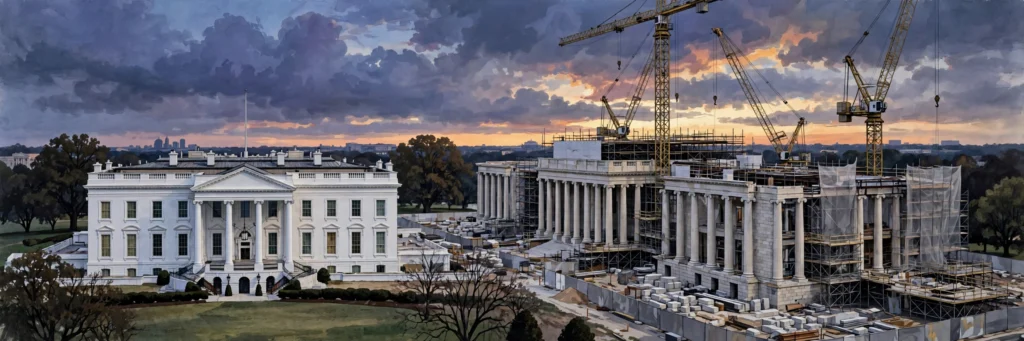
The ballroom is the centrepiece of Trump's remaking of the White House, and the ceremony on Wednesday, November 4, was its topping-out moment. Construction workers lifted what Trump described as the final steel beam of the proposed structure, and the president signed it before it was raised into place. He spent nearly twenty minutes discussing the ballroom and other renovation projects in Washington, including details of its architectural design. The columns, he said, are being carved out of beautiful limestone, in the Corinthian style, which he called the creme de la creme. There will be chandeliers all over, he told reporters. "This is a special structure," he said on a tour of the site, according to NBC News. "It's going to be not only one of the biggest, but it'll be the most beautiful ballroom, I think, anywhere in the world, and they've been trying to get it for 150 years."
The structure, officially called the East Wing Modernization Project, dwarfs the Executive Residence and the West Wing. It stands on the ground where the White House East Wing stood until Trump had it torn down in October 2025, a demolition that was not approved by Congress and has faced legal challenges ever since. The National Capital Planning Commission approved the project in April, but a lawsuit led by the National Trust for Historic Preservation drew a stay from US District Judge Leon, and in August the Supreme Court allowed construction to continue, although the dissenting opinion said the project was "likely unlawful." Photographs published this week show the scale of what has been built: a vast steel-framed hall with no sign yet of the neoclassical ornamentation that is planned for it, looming over the rest of the White House complex.
The cost of the ballroom has grown just as dramatically as its size. Trump originally said it would cost 200 million dollars and promised it would be "taxpayer-free," paid for by private donations. A contractor's estimate obtained by The Washington Post in June put the real figure at 600 million dollars, with more than half of that coming from taxpayer-funded sources such as the Secret Service. In August, the Post reported that the president's White House construction projects as a whole were expected to cost at least 900 million dollars, with the cost covered primarily by taxpayers. What began as a donated ballroom has become one of the most expensive building projects ever undertaken at the White House, and the bill is increasingly falling on the public.
A National Monument for the Oval Office
If the ballroom ceremony was Trump's first act after the election results, his second was even more unusual. On Thursday, November 5, two days after Democrats took control of the House and the Senate, Trump signed a proclamation designating the Oval Office and the Cabinet Room as a national monument, under the Antiquities Act of 1906. It was his first official action after his party was swept aside in the midterm elections, and its purpose was plain: to prevent future presidents from changing the rooms he has spent his second term redecorating. "It will not be allowed to be touched by anybody, destroyed, ripped down by stupid people, in order to build something in a slightly different shape," Trump told reporters as he signed the document in the Oval Office, with a red cap reading "VETO" sitting on the Resolute Desk.
The proclamation, which creates the Oval Office National Monument, hands the rooms to the Interior Department, and directs Interior Secretary Doug Burgum to create a management plan to preserve them. Trump said the designation would mean no major modification without the approval of Congress, and said he would send the proclamation to Congress to be ratified. But the Associated Press noted that the requirement for congressional approval does not appear in the document's text. What the text actually says is that nothing in it restricts the president's authority to redecorate the monument, select furnishings, or make ordinary operational and security modifications that do not substantially impair its historic structure or architectural character. In other words, a future president may still redecorate, and may still change the furniture. What a future president may not do, under the proclamation, is demolish or substantially alter the rooms. And as an executive action, the proclamation can be overturned by a successor, just as Trump himself has rolled back national monuments created by his predecessors.
The rooms the proclamation protects have been dramatically overhauled during Trump's second term. The Oval Office has been filled with gold-coloured picture frames, embroidery, chandeliers and furniture, a transformation that Trump has described as restoring the office to its proper grandeur and that critics have described as turning the seat of American power into a gilded showroom. The Cabinet Room has been given the same treatment. The irony of the proclamation was not lost on observers: the East Wing, which Trump had torn down the previous October to make room for his ballroom, was not a national monument, and Congress was not asked before it was demolished. On Wednesday, he signed the ballroom's final beam. On Thursday, he made sure nobody could do to his office what he had done to the East Wing.
The Wider Washington Remake
The ballroom and the Oval Office are only the most visible parts of a much wider remaking of Washington that Trump has pursued since returning to office in 2025. On the same Thursday that he signed the Oval Office proclamation, the National Capital Planning Commission gave final approval to his proposed 250-foot triumphal arch, to stand in Memorial Circle between the Lincoln Memorial and Arlington National Cemetery, topped with gold statues and an eternal flame. The arch, which Trump has promoted as a monument to American greatness, is estimated to cost 100 million dollars, paid for with a mix of public and private money. Its approval came the same week that the president's lawyers were arguing in court that the arch did not need congressional approval, even as he insisted that changing his Oval Office would require exactly that.
The Lincoln Memorial Reflecting Pool, where Trump spoke on the eve of the election, has been overhauled with more than 14 million dollars in taxpayer-funded contracts, after the president promised the work would cost 2 million dollars at most. The Kennedy Center, the performing arts centre on the Potomac, has been another focus: Trump made himself its chairman, its handpicked board added his name to the facade of a living memorial that Congress, by law, named for President John F. Kennedy, and the venue is now to close for years during a 257 million dollar renovation. His effort to rename the centre has repeatedly stalled in court. Other projects include a granite landing pad for presidential helicopters at the White House and a renovation of a public golf course. Taken together, they amount to the most ambitious physical transformation of the capital by any president in living memory, carried out largely on the president's own initiative and largely in his own taste. The midterm elections 2026 were, among other things, a verdict on that project, and the verdict was not kind.
What the Polls Say After the Election Results
The polling on Trump's building projects has been consistently negative, and it grew worse as the election approached. A Washington Post-Ipsos survey conducted over the summer found that 65 percent of Americans felt dissatisfied or upset with the ballroom, the arch and the Reflecting Pool projects. Among independents, the voters who often decide midterm elections, 73 percent viewed the projects negatively. A separate Reuters-Ipsos poll, reported by the Daily Beast, found that 67 percent of respondents considered new or renovated monuments in the capital either inappropriate or a low priority, and half of Republicans agreed with them. The rebuke crossed party lines: even the president's own supporters were, in large numbers, telling pollsters that the monuments were the wrong priority.
The wider political picture was just as bleak for the president. CBS News exit polling put Trump's approval rating at 38 percent, the lowest for any president in a midterm election year since the network began its surveys twenty years ago. Prices have risen 3.4 percent since Trump's inauguration, undercutting his promises on the cost of living, and voters cited the economy and the cost of living as their main concerns. The election results bore that out: Democrats captured both chambers of Congress, and the scale of the defeat intensified pressure on the administration to reassess its priorities, particularly its handling of the war involving the United States and Israel against Iran, which has dominated the final months of the campaign.
Trump's response to the polling has been defiant. He has insisted that the White House was in terrible condition when he took office, and that the work he has done is a public service rather than a personal indulgence. On Monday, November 16, when NBC News White House correspondent Yamiche Alcindor asked him about the renovations, he described broken windows and damaged plaster that he said had been present before the work began. "We had 18 broken windows, the exterior plaster was falling off the wall, and it was an embarrassment," he said. He told Alcindor that the White House is now in "beautiful shape" and in better condition than it was when it was built, and he claimed the work did not cost taxpayers money. "This doesn't cost money. This is peanuts. And I pay for it," he said. He also said the projects took up little of his time. "I have a responsibility to make sure the symbol of our country is in decent shape. It takes 10 minutes a day."
Costs, Air Traffic and the Clash With a Reporter
The exchange with Alcindor turned confrontational, and it captured the collision between the president's building programme and the practical problems facing the country. Alcindor had asked Trump whether he accepted responsibility for a nationwide ground stop that disrupted air travel on Friday, November 13, the longest in 25 years, and whether he could have provided more funding to fix the ageing air traffic control system, noting that Republicans controlled both chambers of Congress. Trump did not directly address the cause of the disruption at first. Instead, he began talking about the condition of the White House when he took office and the renovations carried out since then. When Alcindor pressed him, he called her "pathetic" and said she had no "talent," attacking her for asking why he was spending tens of millions of dollars on White House renovations while asking Congress for billions to fix air traffic control.
The contrast was the point of the question, and it is the contrast that has defined the politics of the renovations. Trump is asking Congress for 50 billion dollars to rebuild America's ageing air traffic control system, after already receiving about 12 billion dollars for the purpose, while his White House construction projects are expected to cost at least 900 million dollars, mostly from taxpayers. The air traffic control system is decades old, with some of its equipment dating back more than half a century, and the nationwide ground stop on November 13 stranded passengers across the country just three days after an earlier failure. The president's critics argue that a leader who can find hundreds of millions of dollars for a ballroom, an arch and a reflecting pool should have found the money for the control towers first. Trump argues that maintaining the White House is one of his responsibilities, and that the building is a symbol of the country that deserves to be kept in good repair.
What Happens Next as Democrats Take Congress
The consequences of the election will arrive in January, when the new Democratic majorities take their seats in the House and the Senate. The incoming Congress will have the power to investigate the building projects, to demand documents about their costs and their funding, and to use its control of spending to slow or stop them. The ballroom is already topped out, and construction will continue, but the arch has yet to be built, and its funding, which depends on a mix of public and private money, could become a target for a Congress that has just been handed a mandate to check the president. The lawsuits challenging the ballroom and the other projects will continue as well, and the Supreme Court's August decision allowing construction to proceed did not settle the question of whether the projects were lawful, only that they could continue while the cases are heard.
The Oval Office proclamation is likely to become a symbol of the new divide rather than a settled fact. A future president can reverse it with a stroke of a pen, and the Democrats who take power in January have already made clear that they regard the president's remaking of Washington as an abuse of power rather than a legitimate exercise of it. Whether they move to revoke the monument designation, or to legislate against it, will be one of the early tests of the new Congress. The proclamation's own text leaves the door open: it does not prevent a future president from redecorating, and it does not bind Congress, which retains the power to legislate on the White House as it chooses.
For now, the renovations continue, and so does the argument about them. Trump has shown no sign of slowing down, and his first days after the worst electoral defeat of his political career were spent not on reconciliation or regrouping, but on signing a steel beam and declaring his office a monument. The midterm elections 2026 changed who controls Congress. They did not change the president's conviction that the White House, and Washington itself, should bear his stamp. The voters have had their say on that conviction. In January, their new representatives will have theirs.
Source: The Washington Post