Trump News: Trump, Putin, Xi to Hold First Trilateral Talks
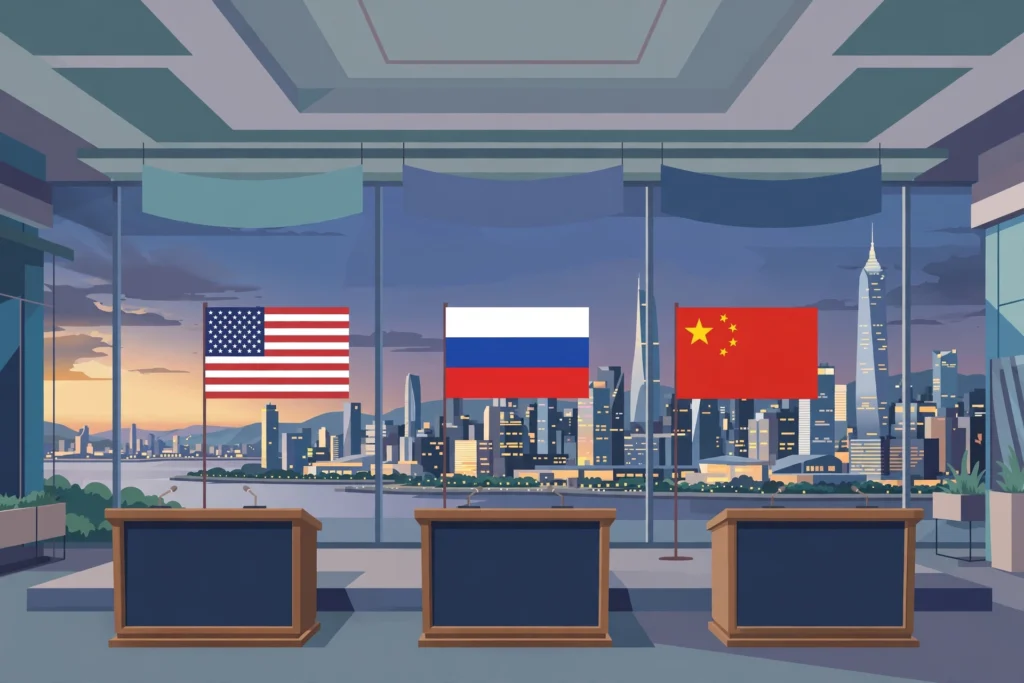
The White House delivered historic trump news on Friday, confirming that President Donald Trump will meet jointly next week with Chinese President Xi Jinping and Russian President Vladimir Putin in the first three-way summit ever held between the leaders of the United States, Russia and China. The meeting will take place on Thursday, November 19, in the southern Chinese city of Shenzhen, on the sidelines of the Asia-Pacific Economic Cooperation summit, and it will focus on reducing the world’s nuclear arsenals. White House spokeswoman Olivia Wales told reporters the president intends to press for nuclear arms reduction, and senior officials said the talks would also touch on the war in Iran.
The announcement, first reported by the New York Post and confirmed to reporters on a Friday evening briefing call previewing the president’s Asia trip, sets up one of the most closely watched diplomatic encounters of Trump’s second term. The three countries control most of the world’s nuclear weapons, and the meeting comes as the last treaty limiting the arsenals of the United States and Russia has lapsed, leaving the two largest nuclear powers without formal caps for the first time in more than half a century. Officials were quick to say the session is a starting point, not a place where a deal will be signed.
“We do not expect to get to any kind of agreement,” a senior United States official told reporters. “I would characterize this as the entry point, the first conversation, certainly at the leader level, between these countries.” Trump has spoken for years about bringing the three nuclear powers into a single arms control framework, and Shenzhen will be the first time the three leaders have sat down together to discuss it.
What the White House Announced
Wales told reporters the president “will discuss the reduction of nuclear weapons in the world, whose proliferation President Trump believes is very dangerous.” The meeting is set for Thursday, November 19, the final day of the APEC summit, which runs from November 17 to November 19 in Shenzhen. The White House described the plans on the evening call after the Post’s report, and officials stressed that the talks should be seen as the opening of a process rather than a negotiation with a document to sign.
Holding the meeting on the sidelines of APEC means all three leaders will already be in the same city for the annual gathering of Pacific Rim economies. Shenzhen, the boomtown near Hong Kong that has become a symbol of China’s economic rise, will host the summit, and the trilateral session will take place alongside the main programme. That overlap is part of what makes the meeting possible at all.
The United States government expects the summit to open discussions toward future nuclear disarmament negotiations rather than produce a concrete agreement, according to the Associated Press, and the officials on the call repeated that point several times. The framing is deliberate: by keeping expectations low, the White House protects the meeting from being judged a failure if no deal emerges.
Nuclear Arms at the Top of the Agenda
Nuclear arms reduction is the reason the meeting exists. Trump has repeatedly insisted that the first-of-its-kind gathering should focus on cutting nuclear arsenals, and the White House made that the centrepiece of its announcement. The three countries between them hold the overwhelming majority of the world’s nuclear weapons.
The urgency has grown since the last nuclear arms treaty between the United States and Russia expired in February of this year. The New Strategic Arms Reduction Treaty, known as New START, was the final agreement capping the two largest atomic arsenals in the world. Its expiry removed those limits for the first time in more than half a century, and no replacement has been negotiated. China has never been part of a nuclear arms control agreement at all.
Trump has floated the idea of a three-way meeting before, suggesting the leaders of the three nations that control most of the world’s nuclear weapons should sit down together. Shenzhen is the first time that idea has become a real diary entry, and a chance to put his argument into practice in the room.
The choice of subject has not been universally welcomed. China’s APEC summit is focused on trade and commerce, and the host government had planned a meeting built around economic cooperation. Trump’s insistence that the trilateral talks concentrate on nuclear arms has riled Beijing, according to reports, because it shifts attention away from the trade agenda China wants to showcase.
The Iran War and the Ukraine War: What Is on the Table
Beyond nuclear weapons, officials said the three leaders also planned to discuss Iran. A senior United States official said the president is willing to discuss the Iran issue in the trilateral talks, and the war in Iran is expected to feature in the conversation. The meeting comes as the administration’s diplomacy around the conflict continues at a rapid pace, with envoys and allies in regular contact this week.
The Iran discussion reflects the way the war has become entangled with the wider diplomacy of the region. Trump’s envoys recently held closed-door three-way talks with Russian and Ukrainian officials in Abu Dhabi, in the United Arab Emirates, and the administration has been working multiple channels at once. Bringing Iran into a room with the leaders of Russia and China gives the president a chance to test whether the three powers can find common ground on a conflict that has reshaped the politics of the Middle East.
What will not be on the agenda, according to the officials who briefed reporters, is Russia’s war in Ukraine. Trump is not expected to discuss Ukraine with Xi and Putin in Shenzhen, and one United States official said the topic was unlikely to be raised at all. That is notable, given that the last time Trump met Putin in person, at a summit in Alaska last August, the meeting was focused on his efforts to broker an end to the war in Ukraine.
The exclusion of Ukraine is likely to draw attention in Europe, where allies have watched the president’s diplomacy with Moscow closely and worried about being sidelined. The White House has been clear about the shape of the meeting: nuclear arms first, Iran second, and Ukraine left for another day.
Trump’s Asia Trip: The Philippines First, Then Shenzhen
The trilateral meeting is the centrepiece of a wider Asia trip that begins on Monday, November 16, when Trump leaves Washington. His first stop will be the Philippines, where he arrives on November 17 for a summit of the Association of Southeast Asian Nations, before travelling on to Shenzhen.
Trump will also hold a bilateral working lunch and meeting with the Chinese president on Thursday, their fourth meeting since the president returned to power last year. The two leaders last met when Trump hosted Xi at the White House in September, a visit during which the president showed his guest a framed photograph of himself on the West Wing’s wall and praised the Chinese leader’s knowledge of stone after viewing Trump’s new granite helipad.
There will be no equivalent one-on-one meeting with Putin. Trump is not scheduled to have a separate bilateral session with the Russian president during the trip, and the White House confirmed there will be no private meeting between the two men in Shenzhen.
A senior United States official said Elon Musk is expected to go on the trip with Trump, among others, although he is not expected to attend the trilateral meeting itself. A widely anticipated meeting between Trump and North Korean leader Kim Jong-un, meanwhile, appears unlikely to take place during the trip, according to reports.
Why the Meeting Matters for the Trump Administration
The significance of the Shenzhen meeting does not depend on whether it produces an agreement. No previous president has ever brought the leaders of the United States, Russia and China together for a formal three-way discussion, and the fact of the meeting is itself a marker in the history of great-power diplomacy.
The stakes are set by the subject. With New START gone, the world’s two largest nuclear arsenals are unconstrained, and China’s arsenal has been growing outside every existing arms control framework. Any serious attempt to reduce nuclear weapons in the coming years will have to involve all three countries, and Shenzhen is the first time they will have discussed the subject together at leader level.
There are risks as well. A meeting that raises expectations and then produces nothing can look like a failure, which is why the White House has worked hard to keep expectations low. The tension with China over the agenda is real, and the decision to leave Ukraine off the table will be read in Kyiv and in European capitals as a signal about the president’s priorities. Critics at home will ask what the United States gained from giving both Xi and Putin a shared stage with the president.
What Happens Next
The timeline from here is short. Trump leaves Washington on Monday, November 16, and arrives in the Philippines the following day. The APEC gathering runs from November 17 to November 19, and the trilateral meeting takes place on the final day, alongside the bilateral working lunch with Xi.
What to watch first is the language that comes out of the room. If the three leaders agree even to keep talking about nuclear arms reduction, that would be a result in itself, given that officials have said no agreement is expected. A joint statement, a commitment to further meetings, or a decision to set up a working group would all count as progress against the low bar the White House has set.
The second thing to watch is what follows in the weeks after Shenzhen. A single meeting cannot replace a treaty, and the real test will be whether the conversation turns into a process: follow-up talks between officials, a timetable for further leader-level contact, or the beginnings of a framework that could one day cap all three arsenals.
For now, the meeting stands as a first. Three leaders who have never sat down together will do so on Thursday in Shenzhen, to talk about the weapons that could define the century. The world will be watching what they say when they leave the room.
Source: The Washington Post