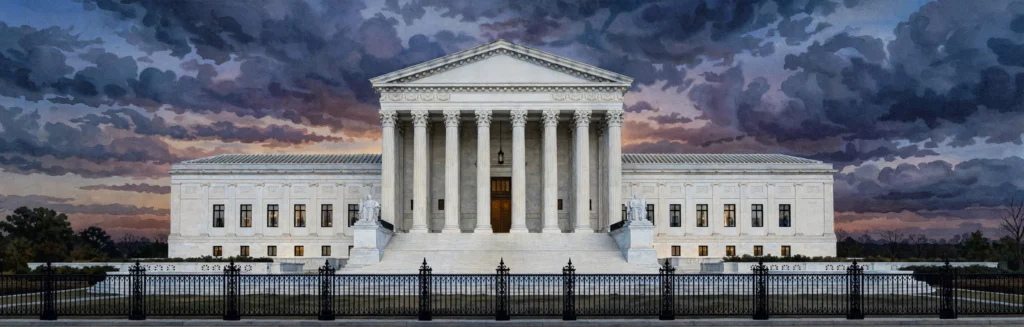
Immigration News: Supreme Court to Weigh Trump Asylum Ban
The latest immigration news from Washington is a decision that will shape the southern border for years. The Supreme Court said on Friday, November 13, that it will decide whether President Donald Trump can bar migrants who cross the southern border illegally from seeking asylum, taking up the administration’s appeal of lower court rulings that found the policy unlawful. The case, Mullin v. RAICES, puts one of the central pillars of the president’s immigration crackdown before the nine justices, and the ruling — expected by the end of June 2027 — will settle how much power a president has to shut the asylum system by proclamation. The policy has remained in effect throughout the legal fight, and it will stay in effect while the court considers the case.
The policy at the centre of the case
The dispute began hours into the president’s second term. On January 20, 2025, his first day back in office, Trump signed a proclamation declaring that an “invasion” was taking place at the southern border and suspending entry for migrants “engaged in the invasion across the southern border”. The document barred those migrants from invoking the asylum protections written into federal law “until I issue a finding that the invasion at the southern border has ceased”. Under the policy, migrants caught crossing the southern border illegally are barred from pursuing asylum claims, and the restrictions are designed to enable fast-track deportation procedures. The proclamation invoked Section 212(f) of the Immigration and Nationality Act, the provision that allows a president to suspend the entry of any class of noncitizens whose entry he finds would be detrimental to the interests of the United States.
The administration has described the policy as the most important and effective piece of the president’s effort to secure the southern border, and it has credited the restrictions with helping to reduce border crossings. It is, by the administration’s own account, one of the top initiatives of the second term — the measure that turned a campaign promise about the border into an operating rule on the first day. If the court upholds the policy, the administration’s central border tool survives intact; if it strikes the policy down, the administration loses the legal foundation of its asylum shutdown.
What the lower courts ruled
Two courts have already ruled against the administration, and both rulings explain why the Supreme Court’s answer is not a foregone conclusion. In July 2025, US District Judge Randolph Moss in Washington ruled that the proclamation was unlawful, finding that neither the Constitution nor the immigration statutes give the president authority to replace the comprehensive rules and procedures that Congress wrote into the Immigration and Nationality Act. Moss wrote that nothing in the Constitution or immigration law “grants the president … authority to replace the comprehensive rules and procedures set forth in the INA”, and he blocked the policy. His 128-page order said the president could not adopt an alternative immigration system that supplants the congressional framework for asylum processing and protections — what the judge called an “extra-statutory, extra-regulatory” system for removing people without a chance to seek asylum or related humanitarian protections.
The US Court of Appeals for the District of Columbia Circuit upheld Moss’s ruling in April 2026, concluding that the administration had unlawfully restricted access to asylum and created removal procedures outside the federal immigration system. A divided appeals court panel said the president was required to comply with the Immigration and Nationality Act and could not categorically reject asylum claims from people entering from Mexico. US Circuit Judge Michelle Childs, who was appointed to the court by former President Joe Biden, wrote that barring people who cross illegally from even being considered for asylum “cannot be squared with the statute”. The appeals court then stayed its own decision, allowing the Trump administration to continue the policy while it appealed to the Supreme Court — which is why, despite two rulings against it, the asylum ban has remained in force for the entire period since January 2025. The challenge was brought by a nationwide class of people barred from seeking protection under the proclamation, along with three immigrant legal service providers: the Refugee and Immigrant Center for Education and Legal Services, known as RAICES, the Las Americas Immigrant Advocacy Center and the Florence Immigrant and Refugee Rights Project. The American Civil Liberties Union, the National Immigrant Justice Center, the Center for Gender and Refugee Studies, the Texas Civil Rights Project and the ACLU’s District of Columbia and Texas affiliates brought the federal lawsuit.
The two sides’ arguments
The legal question is narrower than the politics, and it turns on the relationship between two parts of the same statute. Federal immigration law allows anyone in the country, or at an official entry port, to apply for asylum. The Immigration and Nationality Act sets out detailed procedures for how asylum claims are heard, who may apply, and what protections apply to people who fear persecution or torture if they are sent home. The challengers argue that the president’s proclamation replaces those procedures with a blanket ban that Congress never authorised. Their case is that the statute gives people a right to seek asylum, and that a presidential proclamation cannot erase that right by declaring an invasion — particularly, they say, when the “invasion” the proclamation describes is the ordinary flow of migration across the southern border rather than an armed attack.
The Justice Department’s answer is that the president has inherent authority to secure the border and protect national security, and that the asylum statute leaves the decision about whether to grant asylum to the government. Because granting asylum is discretionary, the department argues, the president can also broadly decide that anyone who illegally crosses the border is not eligible for it. The administration’s position is that Section 212(f) gives the president sweeping authority to suspend entry, and that the asylum provisions of the statute operate within that authority rather than overriding it. The Supreme Court agreed to review two questions in the case: whether the proclamation and the enforcement procedures built around it violate federal immigration law, and whether federal judges can grant relief covering an entire class of migrants affected by the restrictions. That second question matters beyond this case, because the challenge was brought on behalf of a nationwide class, and a ruling limiting class-wide relief would change how immigration challenges are litigated in the future.
A term crowded with immigration cases
The asylum case does not arrive at the court alone. It is the third major Trump immigration dispute on the court’s docket this term, and the justices are already weighing two more practices that sit at the heart of the president’s crackdown on immigration. One case asks whether the administration can detain millions of immigrants without giving them a chance to seek bond. Another asks whether it can deport immigrants to countries other than their own without letting them argue that they could be persecuted or tortured there. The court will decide all of these cases by the end of June, and together they will define the legal limits of the most aggressive immigration enforcement programme in modern American history. Last June, the court said the federal government may systematically turn back asylum seekers before they cross ports of entry along the border with Mexico, a previous migrant management practice that the Trump administration may want to bring back.
The court that will decide these questions has a 6-3 conservative majority, and it has been largely deferential to Trump in his second term in challenges to his immigration policies, according to Reuters. That record is part of why the administration sought review: it has won most of its immigration fights at the court so far. But the lower courts’ reasoning in this case was unusually blunt — two courts said the president had exceeded his authority, not merely that he had interpreted the statute aggressively — and the challengers will argue that the text of the Immigration and Nationality Act is on their side regardless of the court’s composition. The ACLU, which represents the challengers, said the lower federal courts ruled in its favour because the administration’s action is contrary to laws enacted by Congress to ensure that people receive an opportunity to have their asylum claims heard. The organisation said the Supreme Court had granted the government’s petition to hear the case and that argument was expected in spring 2027.
What the decision will mean
The practical stakes depend on which way the court rules, and both sides have described them in sweeping terms. If the administration wins, the asylum ban becomes settled law, and the president’s power to suspend asylum by proclamation will be confirmed for this and any future administration. The border policy that has been in force since January 2025 will continue without legal cloud, and the administration will have a Supreme Court precedent to defend the rest of its immigration programme. If the challengers win, the government will have to restore access to asylum for people who cross the border illegally, and the fast-track deportation procedures built around the proclamation will have to be rebuilt. Either way, the ruling will reach beyond the southern border: it will answer a question about presidential power that has been contested since the first Trump administration, when the courts repeatedly wrestled with travel bans and asylum restrictions issued under the same Section 212(f) authority.
For the people at the centre of the case, the timeline is the cruel part. The policy has been in force for nearly two years while the courts considered it, and it will remain in force for the months it takes the Supreme Court to hear arguments and decide. Arguments are expected in the coming months, with the challengers’ lawyers expecting them in spring 2027, and a decision is expected by the end of June 2027. Until then, migrants caught crossing the southern border illegally will continue to be barred from seeking asylum, whatever the lower courts have said. That is the paradox of the case: the courts that ruled the policy unlawful also allowed it to continue, and the court that will finally decide it has given the administration more than a year of continued enforcement in the meantime. When the decision comes, it will be one of the most consequential rulings of the term — a judgment not only on a single proclamation, but on the balance between presidential power and the laws Congress wrote to govern who may ask America for protection.
Source: The Washington Post