Border Security News: Supreme Court Backs Big Bend Wall
The latest border security news from Washington is a major win for the Trump administration and a sharp defeat for the environmental groups that have spent months fighting the project in court. The United States Supreme Court ruled on Monday that the administration may proceed with construction of a border wall through the Big Bend region of West Texas, including a stretch of Big Bend National Park, lifting a lower court's order that had halted the work while a lawsuit played out. The decision, handed down in an unsigned five-page opinion, clears the way for contractors to resume building barriers and roads across one of the most remote and ecologically sensitive stretches of the entire United States-Mexico border.
The ruling was 8-1, with Justice Ketanji Brown Jackson the only member of the court to indicate that she would have denied the government's request. She recorded her dissent without explaining her reasoning. For the administration, the decision is a vindication of its fast-track approach to border construction and of the broad waiver powers Congress granted the Department of Homeland Security three decades ago. For the challengers, it is a bitter setback that leaves them with a lawsuit still pending but a construction project that can now move ahead while that lawsuit continues.
The Court's Ruling: 'Exceedingly Likely to Prevail'
The Supreme Court acted on an emergency request from the administration, asking it to lift an injunction issued by a federal judge in El Paso that had paused construction across the Big Bend region. In granting that request, the court said the government was exceedingly likely to prevail on its central argument: that the lower court lacked the jurisdiction to block the project at all. The argument rests on a 1996 federal law, the Illegal Immigration Reform and Immigrant Responsibility Act, which limits the ability of lower courts to second-guess the secretary of homeland security's decisions about border barriers.
The court's opinion was short but pointed. It said Congress had expressed a clear preference for expeditious border construction, and that this preference outweighs any aesthetic, recreational and environmental harm that the challengers say they will suffer. The phrasing matters because it frames the case as a contest between two kinds of harm: the government's interest in securing the border quickly, and the challengers' interest in preserving a landscape they use and enjoy. The court came down firmly on the government's side, treating the speed of construction as a value Congress itself had chosen.
The opinion also rejected a key argument made by the challengers, who had claimed that the administration's use of waiver powers raised constitutional questions large enough for the courts to intervene. The court wrote that there is no such thing as a constitutional major-questions claim, a terse dismissal of the idea that the scale of the waiver power alone could bring the case within the courts' reach. The line is likely to be quoted in future cases, because it narrows one of the main routes challengers have used to contest executive action on the border.
The 1996 Law Behind the Waivers
At the heart of the case is a set of waivers issued by the Department of Homeland Security between February and July of this year. The waivers were issued by the current secretary, Markwayne Mullin, and by his predecessor, Kristi Noem, both Trump appointees. Under the 1996 law, the secretary can waive all legal requirements that would otherwise slow down the construction of barriers in areas of high illegal entry, and the administration used that power to set aside a wide range of environmental, conservation, historic preservation and Native American artifact laws that would normally apply to a project of this kind.
The challengers argued that the waivers were unlawful because the Big Bend sector does not qualify as an area of high illegal entry. Their case turned on the numbers: the sector spans more than a quarter of the entire United States-Mexico border, but it accounts for only a tiny fraction of migrant apprehensions, between 0.3 and 2.2 percent by the district judge's count. If the law only allows waivers where crossings are high, they argued, then a region with the lowest apprehension numbers of any Southwest border sector cannot be the place to use them.
The administration's answer was that the statute gives the secretary broad discretion and that the courts have only a narrow role in reviewing how that discretion is exercised. Solicitor General John Sauer told the court that gaps in the wall in the Big Bend region can be exploited by drug cartels moving into the United States from Mexico, and that the government's need for security along the border outweighs the harm the challengers described. The Supreme Court's unsigned opinion accepted the core of that position, holding that the government was exceedingly likely to win on the question of whether the lower court even had the authority to hear the challenge.
The Big Bend Region at Stake
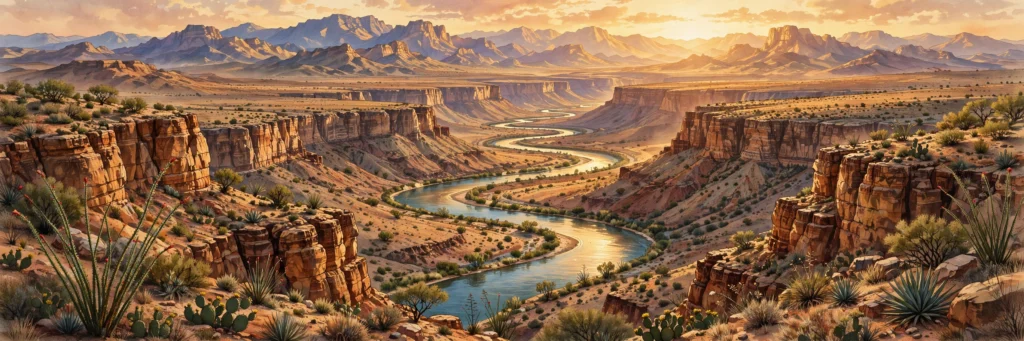
The scale of the project is what makes the case so consequential. The Big Bend sector spans 517 miles, more than a quarter of the entire United States-Mexico border, and it is the largest of the Southwest border's nine sectors. It is also, by every measure, the most remote: a landscape of desert, canyons, mountain ranges and stretches of the Rio Grande River, much of it undeveloped and difficult to reach. Big Bend National Park sits at its heart, a protected area that draws visitors from around the world for its dark skies, its desert wildlife and its sheer emptiness.
The administration has said most of the construction in the sector, spanning more than 300 miles, will take place on privately owned land rather than inside the park itself. Big Bend National Park would receive a 17-mile noncontiguous vehicle barrier system, designed to stop vehicles rather than people on foot, rather than the 30-foot pedestrian barrier planned for other areas. That distinction has not reassured the project's opponents, who argue that roads, barriers and construction traffic will damage the park regardless of the barrier's height, and that the desert ecosystem is fragile in ways that heavy equipment does not respect.
The park is home to endangered species, including the Mexican long-nosed bat, and its mountain ranges and desert habitats support wildlife found nowhere else in the United States. The lawsuit was brought by the Center for Biological Diversity, a group seeking to preserve a historic adobe church in the town of Ruidosa, Texas, and a Big Bend-area river guide and landowner. The church group says its fragile adobe structure is threatened by the construction, and the river guide says the project will diminish his ability to use and enjoy the river and the surrounding land. Their claims are the ones the Supreme Court weighed against the government's security interests, and found wanting for now.
How the Case Reached the Supreme Court
The dispute has moved quickly through the courts. The administration paused construction in Big Bend in August, after the project drew public attention and criticism, but the underlying plan never went away. In October, United States District Judge Kathleen Cardone in El Paso blocked the project, ruling that the 1996 law limits waivers to areas of high illegal entry and that the Big Bend sector, with the lowest apprehension numbers of any Southwest sector, did not meet that test. Cardone, an appointee of President George W. Bush, also said a temporary halt was needed while the legal battle continued, because construction could cause the permanent loss of protected wilderness that benefits tourism, recreation, farming, ranching, spirituality, aesthetic sensibilities and education.
The administration went straight to the Supreme Court with an emergency request, asking the justices to lift Cardone's order while the case was litigated. Emergency requests of this kind, decided on the court's shadow docket, are resolved quickly and usually without oral argument, and the justices granted the government's request on Monday. The decision does not end the lawsuit: the underlying challenge to the waivers is still pending in the lower courts. But it removes the obstacle that was stopping construction, and it signals that the Supreme Court is sympathetic to the government's reading of the 1996 law.
Reaction in Texas and Beyond
The reaction in Texas was swift and sharply divided. Laiken Jordahl, a national public lands advocate at the Center for Biological Diversity, condemned the ruling in the strongest terms, saying the administration and its contractors were determined to destroy one of America's greatest national parks and that the court had given them the green light. He described the decision as horrific and warned that it cleared the way for contractors to bulldoze pristine desert and dynamite canyon walls. His statement captured the sense of loss felt by conservationists who have fought the project from the start.
The administration, by contrast, welcomed the decision and said it would move ahead. United States Customs and Border Protection Commissioner Rodney S. Scott said the agency was moving forward with critical border security construction in West Texas, and that it had reevaluated the terrain, listened to local stakeholders and made meaningful adjustments. Those adjustments, he said, would secure the stretch of border while preserving the unique landscape and public access for generations to come. Border Patrol officials have previously said they are not building a wall through the area so much as clearing the way for roads where surveillance equipment can be installed and the area can be patrolled, a distinction the administration has emphasized as it seeks to blunt criticism.
Opposition to the project has crossed party lines in Texas. The state's outgoing Republican Senator John Cornyn was among those who spoke out against the court's decision, joining wildlife advocates and local residents who say a wall is not merited in an area where so few migrants cross. The criticism reflects a broader Texas consensus that the Big Bend region is different from the rest of the border: remote, lightly crossed, and valuable precisely because it has been left alone. Texans of all stripes have condemned the project, arguing that the low levels of crossings do not justify the damage to a national treasure.
What Happens Next
The immediate consequence of the ruling is that construction can resume. Contractors can return to the Big Bend region, and the administration can proceed with the barriers and roads it has planned across more than 300 miles of the sector, including the vehicle barrier system inside the national park. The pace of that work will be watched closely, both by supporters who want the border secured and by opponents who fear irreversible damage to the desert.
The lawsuit itself is not over. The Supreme Court's decision addressed only the injunction, not the underlying question of whether the waivers were lawful, and the case will continue in the lower courts. But the practical effect of Monday's ruling is that the challengers will now be litigating against a project that is already being built, rather than one that is paused. That is a much harder position, and it is why the emergency ruling matters so much more than its five pages might suggest.
Source: The Washington Post