Trump Rally Cancellations: Kansas, Iowa Scrapped
President Donald Trump and Vice President JD Vance have scrapped planned in-person campaign appearances in the final days before the 2026 midterm elections, switching instead to telephone rallies aimed at voters across many states at once. The change, announced by the Republican National Committee on October 29, cancels two of Trump’s weekend rallies and one of Vance’s scheduled stops, four days before voters go to the polls on Tuesday, November 3. A trump rally has been one of the defining sights of the president’s political career, from packed arenas to airport gatherings, so the decision to replace live appearances with phone calls in the last 72 hours before Election Day is a significant moment in the campaign, whatever the reason the campaign gives for it. The cancellations do not mean the president has stopped campaigning: his final rally is still scheduled in Florida on Friday, October 30, and the campaign says the telephone rallies will reach voters in nearly 20 states. But the shift from arenas to phone lines, in the week when campaigns normally want their most visible closing images, has drawn immediate attention from supporters, opponents and analysts alike.
Trump Rally: What Was Cancelled
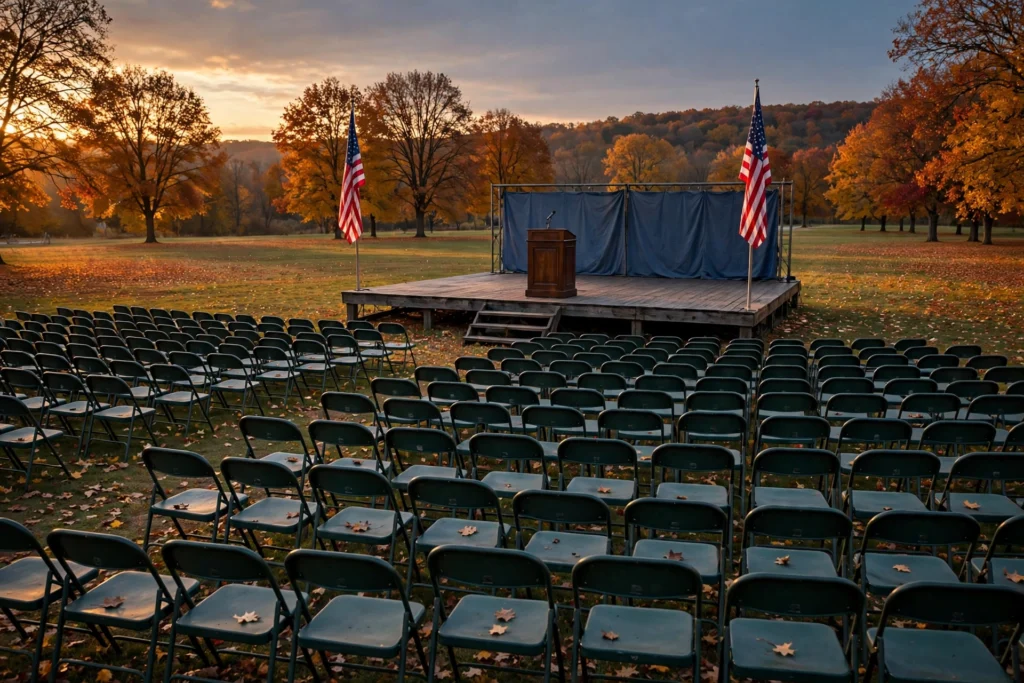
The cancelled events were two of the president’s planned weekend rallies. According to reports of the Republican National Committee announcement, Trump had been set to appear in Salina, Kansas, on Saturday and in Dubuque, Iowa, on Sunday. Both will no longer be held in person. Instead, the president will take part in online and telephone rallies reaching voters in several states, a format the campaign says will let him speak to far more voters than a single arena event could hold.
Vance’s cancelled appearance was separate. The vice president had been scheduled to visit St. Cloud, Minnesota, on Friday, and that visit has also been cancelled, according to a summary of the day’s campaign developments. No separate explanation for the Minnesota cancellation was reported in the summaries reviewed for this article, and it should not be assumed that the same reasoning applied to both men’s schedules. What is clear is that, within a single day, both of the administration’s top two figures dropped planned in-person stops in the upper Midwest and the Plains, in states where Republicans are contesting Senate and other races.
The Florida event remains on the schedule. Trump is still set to hold a rally at the Ocean Center in Daytona Beach, Florida, on Friday, with reports putting the start time at 23:00 GMT. That rally, rather than the Kansas or Iowa events, will now serve as the president’s final in-person rally of the campaign, at least on the current schedule. The contrast between a Florida arena rally going ahead and two Midwestern rallies being replaced by phone calls is one reason the announcement has attracted so much attention: the campaign is plainly still willing to stage a large live event, but it has chosen not to do so in Kansas and Iowa this weekend.
Midterm Elections 2026: Why the Campaign Says It Changed Plans
The campaign’s stated reason for the change is reach, not retreat. Republican National Committee Chairman Joe Gruters said the switch would allow Trump to reach more voters than he could with in-person appearances, and he framed the telephone rallies as a closing sprint. “Voters across the country want to hear from President Trump before Election Day, and this 72-hour sprint will be a huge boost in the closing days,” Gruters said, according to the reports. The logic is straightforward: a president can address voters in nearly 20 states by phone over a weekend in a way that no amount of flying between arenas could match, and in a campaign’s final days, breadth of contact can matter as much as the spectacle of a single rally.
Trump himself, asked about the cancellations on Thursday, questioned the need to travel to Kansas at all. “I don’t feel I have to go to Kansas,” he said, in remarks reported from the exchange. When a reporter asked whether the decision had anything to do with fatigue from travelling, Trump rejected the suggestion. “I feel perfect,” he said, before criticising the reporter. Those remarks matter because they set the tone for how the campaign wants the decision understood: not as a scaling back forced by circumstances, but as a choice about where the president’s time is best spent, in states where his presence is judged most necessary.
That framing is, naturally, contested. Opponents will read any cancelled rally in the final days as a sign of weakness, and supporters will read the same decision as evidence of confidence, a campaign so sure of its position in a state that it does not need to visit it. Both readings are political spin until the results are known, and the honest position is that a scheduling change of this kind can be consistent with either story. What can be said with confidence is that campaigns do not usually cancel rallies lightly in the final weekend, because rallies do more than persuade undecided voters: they energise volunteers, generate local television coverage, and give a campaign its closing pictures. Giving those things up in two states suggests that the campaign’s internal calculations, whatever they are, pointed firmly towards the telephone format.
Kansas and the Battle for the Senate
Kansas is the clearest illustration of why the decision matters. Trump had been due to appear in Salina in support of Republican Senator Roger Marshall, who is facing Democrat Adam Hamilton. Polls suggest a neck-and-neck race, and the Kansas Senate contest is one of several close races that will help decide the battle for the Senate. In that context, the president’s remark that he does not feel he has to go to Kansas can be read in two very different ways. It could mean that the campaign’s private polling shows Marshall in a stronger position than public polls suggest, and that a presidential visit would add little. Or it could mean that the campaign has decided its resources, including the president’s time, are better spent elsewhere, including on the telephone rallies that will reach Kansas voters without a physical visit.
The wider polling picture, as reported in the days before the cancellations, underlines how competitive the Senate map remains. Polls conducted by CNN in four states with notable Senate races showed Democratic candidates leading in Michigan and Texas, while results in Maine and Kansas remained quite close. Those are only four states, and a single poll in each state is not a forecast, but they help explain why the closing days are being fought so intensely: control of the Senate may come down to a handful of races, and Kansas is among those where the margin looks narrow. A presidential visit is normally one of the most powerful tools a party has in such a race, which is why its absence is notable.
Iowa, the second cancelled state, fits a similar pattern of a closing campaign making choices about where to spend its final hours. The Dubuque rally had been planned for Sunday, the last full day before the election in practical campaigning terms, and replacing it with telephone rallies means Iowa voters will hear from the president by phone rather than in person. Iowa has long been a state where personal appearances carry particular weight, and the decision to forgo a live event there, like the Kansas decision, will be pored over by analysts looking for clues about the campaign’s internal map of the race.
JD Vance News: Minnesota Stop Also Scrapped
Vance’s cancelled visit to St. Cloud, Minnesota, scheduled for Friday, adds a second dimension to the story. The vice president has been one of the administration’s most active campaigners, and Minnesota contains competitive races further down the ballot that Republicans have been contesting. The cancellation means that voters in the St. Cloud area will not see the vice president in person in the campaign’s final days. The reports reviewed for this article did not attribute a specific reason to the Vance change, and campaigns routinely adjust vice-presidential schedules for logistical reasons that have nothing to do with the state of a race. What makes the Minnesota cancellation significant is its timing and its company: it came on the same day as the president’s Kansas and Iowa changes, and it forms part of a broader pattern of late schedule changes at the top of the ticket. Taken together, the three cancellations describe a closing campaign that is moving, at least for its final weekend, from physical appearances towards remote ones.
Early Voting: 43 Million Ballots Already Cast
One reason the shift to telephone rallies may matter less than it would have in an earlier era is the sheer scale of early voting. More than 43 million Americans have already cast their ballots for the 2026 midterm elections, according to reports of the latest turnout figures, and early turnout appears to be heading towards potentially historic levels. That means that by the time the president would have stood on stage in Salina or Dubuque, a very large share of the electorate in those states and across the country will already have voted. The audience for a closing rally is therefore, in part, an audience that has already made its choice, and the value of a rally lies as much in energising volunteers and dominating news coverage as in persuading voters who are still undecided.
High early turnout also changes how the final days should be read. Reports have noted high turnout among Hispanic, Black and young voters, groups whose participation is watched closely by both parties, and the scale of early voting means that Election Day itself will tell only part of the story. Campaigns know this, and it is one reason why the telephone rally format, which can reach voters in many states in a single evening, may be a rational use of a president’s time even if it lacks the visual drama of an arena. The question is whether the loss of local coverage and volunteer energy in Kansas, Iowa and Minnesota outweighs the gain in national reach, and that is a question only the results, and the post-election analysis of turnout in those states, will answer.
The broader campaign trail in the last 24 hours before the announcement also provides context. Trump travelled to South Carolina to campaign for Republican senator Darline Graham, who is running against Annie Andrews in a closely contested race. That visit went ahead as planned, which suggests that the campaign is still staging in-person events where it judges them most valuable. The pattern that emerges is therefore not a blanket withdrawal from live campaigning, but a selective one: South Carolina and Florida in person, Kansas, Iowa and Minnesota by phone. Analysts will spend the coming days debating what distinguishes the states in each group, and whether the distinction reflects confidence, caution, or simple logistics.
Trump Approval Rating: The Polling Backdrop
The cancellations are happening against a difficult polling backdrop for the administration. The latest Marquette Law School poll, conducted in Wisconsin from October 14 to October 22 and released on October 28, put Trump’s approval rating at 37 percent, with disapproval at 61 percent. A single state poll is not a national approval rating, and Wisconsin is only one state, but the figures are consistent with the broader picture reported by Al Jazeera and others: with four days to go before the midterm elections, Democrats are leading in national polls as both parties make their final push for votes. Approval ratings do not decide midterm elections on their own, but a 37 percent approval figure in a major swing state is the kind of number that shapes how every campaign decision is interpreted.
Other threads in the closing campaign add to the sense of a high-stakes final week. A legal dispute threatens to delay the Senate result in Alaska, a reminder that the outcome of the midterms may not be fully known on election night itself. Democrats have made corruption within the Trump administration a central theme of their midterm campaign, and reports have noted that former President Barack Obama has accused Trump of self-enrichment, while a poll indicates that 89 percent of Americans believe government corruption is widespread. Those are the themes that will compete with the rally story for voters’ attention in the final days, and they illustrate why the campaign’s closing message, whether delivered from a stage or by telephone, matters so much.
It is also worth noting what the cancellations do not signify. They do not signify that the election itself has changed date, that voting has been suspended anywhere, or that the Florida rally has been cancelled: none of those things has been reported. They signify a change of format and venue for three specific events, announced by the party committee, explained by its chairman in terms of reach, and accompanied by the president’s own remarks about Kansas. Keeping that distinction clear matters, because in a heated final week, a scheduling change can quickly be exaggerated into something larger than it is, by either side, and voters deserve a precise account of what actually happened.
Election Polls: What Happens Next
What happens next will unfold quickly. The Florida rally on Friday will be the first test of the campaign’s closing message in its new form, and it will show whether the president uses the stage to address the cancellations directly or to move on to the themes he wants to close on. Over the weekend, the telephone rallies across nearly 20 states will test a different proposition: that a president’s voice on the phone can substitute, in the final 72 hours, for his physical presence in a state. If turnout in Kansas, Iowa and Minnesota holds up for Republicans, the campaign will be able to argue that the format worked. If it does not, critics will point to the empty stages as a missed opportunity, fairly or not.
Election Day itself, on Tuesday, November 3, will then deliver the verdict that matters. The Senate races in Kansas and elsewhere, the House contests, and the state races that have drawn the president and vice president across the country will be decided by voters, many of whom have already cast their ballots and some of whom will vote on the day. The Alaska dispute may mean that the full Senate picture takes longer to emerge, and close races may take days to call. But the broad outcome, whether Democrats’ national polling lead translates into control of one or both chambers, will shape the second half of the president’s term, and it will also shape how the story of the cancelled rallies is remembered: as a clever reallocation of a president’s time, or as a warning sign that was visible in the final weekend and not heeded.
For now, the facts are these. Two Trump rallies, in Kansas and Iowa, have been replaced by telephone rallies. A Vance visit to Minnesota has been cancelled. A Florida rally goes ahead on Friday. More than 43 million Americans have already voted. The polls point to a competitive and consequential election. Everything else, for the moment, is interpretation, and voters will have the chance to deliver their own verdict on Tuesday.
Source: CNBC