Thursday Night Football: Christian Watson’s Stunning Return
A thursday night football game that looked, for a worrying stretch, as though it had lost one of its brightest performers ended with that same player back on the field, catching passes and helping his team close out a win. Green Bay Packers wide receiver Christian Watson suffered a chest injury during the first half of the Week 8 meeting with the Carolina Panthers, left the stadium in an ambulance for hospital checks, and then returned to Lambeau Field in time to play in the second half. The Packers went on to beat the Panthers 27-19, holding off a late comeback push from the visitors to improve to 5-3 on the season.
The sequence was startling even by the standards of a league in which injuries are a weekly reality. Players leave games for medical attention all the time, and most do not return that night. Watson did, roughly an hour after he had been taken away, to a roar from the home crowd. He finished with eight catches for 113 yards, a line that would have been impressive on an ordinary night and was remarkable given that he had spent part of the evening in a hospital being checked for internal bleeding. After the game he revealed that he had suffered a broken rib, an injury that explains both why the medical staff acted so quickly and why his return, once the serious dangers had been ruled out, was possible at all. For Green Bay, the result mattered as much as the story: a Thursday night win, on a short week, keeps the Packers firmly in the mix and gives them extra recovery time before their next game.
Thursday Night Football: How the Injury Happened
The injury came in the second quarter, on a play that had started as one of the highlights of the game. Quarterback Jordan Love threw deep to Watson, who was working against Carolina cornerback Will Lee III in coverage. Watson hauled in the pass for a 53-yard gain, but he landed hard on the football as he came down, with his body weight driving into the ball, and he stayed down on the turf, rolling onto his back as the Packers medical staff hurried to him.
The immediate signs were worrying. Watson had the wind knocked out of him and could not catch his breath properly on the field. He was eventually able to get to his feet under his own power, a reassuring sign in itself, and he was taken to the blue medical tent on the sideline for further evaluation. From there he walked to the locker room, still in uniform, before the decision was made to send him for hospital tests. The television broadcast showed him climbing into an ambulance under his own strength, a picture that captured both the seriousness of the situation and the fact that he was conscious, mobile and communicating with the staff around him.
Lee was also hurt on the same play, clutching his hamstring as he went down. The Packers initially listed Watson as questionable to return because of a chest injury, the standard designation for a player whose status is genuinely uncertain. Shortly afterwards, the sideline reporter on the Amazon Prime Video broadcast, Kaylee Hartung, reported that Watson was being taken to a local hospital for precautionary reasons. The team later confirmed that he was being taken for precautionary testing, without giving a further update at that stage.
Before he left, Watson had already made his mark, with six catches for 100 yards in the first half. He had also lost a fumble, a reminder that the game had not been perfect for him even before the injury. The 53-yard catch had helped establish the rhythm of the Green Bay passing game, and losing a receiver in that kind of form, in the middle of a primetime game, would normally change the whole shape of an offence. Green Bay had to adjust, and for the rest of the first half and the early part of the second, it did so without knowing whether its deep threat would be back at all.
Player Injury Update: The Hospital Trip and the All-Clear
The reason for the hospital trip was not the rib itself, but what a rib injury can hide. Watson explained after the game that he had been spitting up a little blood, and that the medical staff wanted to be certain there was no internal bleeding or other serious damage. A broken rib, on its own, is painful but manageable in the short term. A broken rib that has damaged something underneath it is a different matter, and it cannot be ruled out from the sideline. That is why the doctors insisted on a scan, and why Watson, who by his own account did not want to go, had no choice in the matter.
In his postgame interview with Hartung, Watson was frank about how difficult the trip had been. He said it was tough, and that he had never wanted to go to the hospital. He had hoped the staff would let him stay, telling them that he was starting to feel better once he had caught his breath. The medical team, however, saw signs that made the trip necessary, and Watson went, praying as he did so that the results would be good enough for him to return. It was a period of anxious waiting, spent following the game as best he could, including checking the score on a doctor’s phone while he was being evaluated.
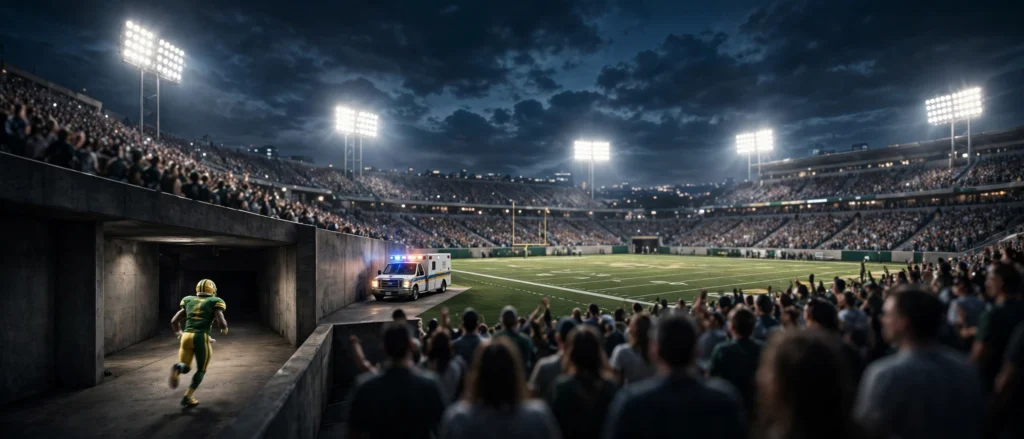
The tests, which included a CT scan, gave the answer the Packers and their fans were hoping for. There was no internal bleeding and nothing that raised suspicion of a more serious injury. The scan confirmed the broken rib, but it also cleared Watson of the dangers that had prompted the ambulance ride. Once the medical team had that reassurance, and once Watson himself had been cleared, the question changed from whether he was safe to whether he could play through the pain of a broken rib with extra protection. Watson was gone from the stadium for roughly an hour. The Packers, notably, never ruled him out, even while he was at the hospital, and at the start of the second half Hartung reported that he had been tested and was set to return. The broadcast then showed him arriving back at the stadium in the same ambulance that had taken him away, running to the locker room and then, a short time later, running back onto the field.
NFL Scores: Packers Hold Off Panthers 27-19
Watson re-entered the game midway through the third quarter, to cheers from the Lambeau Field crowd that had watched his departure with concern an hour earlier. His first involvement was immediate: Love threw in his direction on his very first snap back, a pass Watson could not haul in against tight coverage from two defenders, but which showed that the Packers had no intention of easing him back gently. He went to the ground on that play without further harm, got up, and carried on.
He then added two receptions in the second half, taking his final tally to eight catches for 113 yards on ten targets. One of those catches came on the opening play of the fourth quarter, a short gain that helped Green Bay keep the chains moving at a stage when Carolina was pressing. The value of Watson’s return was not just in the yards he added after it. His presence changed how Carolina had to defend, forcing the Panthers to account for a deep threat they had hoped was gone for the night, and it lifted a home crowd that had spent the interval worrying about a teammate.
The final score, Packers 27, Panthers 19, reflected a game Green Bay controlled for long stretches without ever fully putting away. Carolina mounted a late comeback push, as visiting teams in primetime games often do when the home side is short-handed and tired on a short week, but the Packers held on. The win took Green Bay to 5-3, and it gave them the extra recovery time that comes with playing on a Thursday. A Thursday win is worth more than a Sunday win in one respect: the players get a mini-bye, a long weekend to rest, treat injuries and prepare for the next opponent. For Carolina, the result will sting because the opportunity was real: the Panthers had a chance to beat a Packers team that had lost its most dangerous receiver for an hour, and instead the receiver came back and the visitors left Lambeau Field with a defeat.
NFL Injury Report: What a Broken Rib Means
A broken rib is a serious injury, and Watson’s return should not be read as evidence that it is a minor one. Ribs protect the lungs and other organs, and a fracture can be extremely painful with every breath, every twist and every contact. That is why the hospital checks mattered so much, and why the Packers will manage Watson carefully in the days ahead even though he was able to finish the game. After the game he was wearing extra padding and a moulding around his ribs, protection designed to shield the fracture from direct contact, and he will almost certainly need similar protection, and careful management of his practice workload, in the week ahead.
The timing helps him. Because the game was on a Thursday, the Packers now have a mini-bye before their next game, against the New England Patriots in Week 9. Watson expressed confidence after the game that he would be able to heal during that break and be ready for the Patriots game, saying that he was feeling good and that being on the football field was, first and foremost, what he wanted. That confidence is encouraging, but it is not a guarantee. Broken ribs do not heal in a few days, and a player’s ability to play through one depends on pain tolerance, the exact location of the fracture, and whether further contact causes a setback. The Packers medical staff will monitor him through the week, and his status for Week 9 will be a story to watch in the team’s injury report.
NFL Standings and What Happens Next
What happens next, in the short term, is rest and assessment. The Packers will use the mini-bye to give Watson, and the rest of a squad that has just played on a short week, time to recover. The injury report in the days before the Patriots game will give the clearest indication of whether Watson is on track to play, and whether he will be a full participant in practice or limited to lighter work. If he does play, expect the extra rib protection to remain, and expect the Packers to be careful about how often they ask him to go over the middle or take contested catches in traffic. If he does not, Green Bay will need to adjust its passing game again, as it did for an hour on Thursday night, and Love will need to spread the ball to other receivers.
Watson, at 27 and in his fifth season, is no stranger to the physical demands of his position. Receivers who specialise in deep routes take hits as they come down with the ball, often with defenders arriving at the same moment, and the landing itself can be as dangerous as the contact.
For Watson, the night will be a story he tells for the rest of his career, and not just because of the statistics. He left in an ambulance, feared the worst, prayed for a clear scan, and then ran back onto the field to help his team win. He did so, by his own account, because he never wanted to leave in the first place, and because, once cleared, being on the football field was where he wanted to be. That is a simple motivation, but on Thursday night it produced one of the most memorable returns of the season, a reminder that in the NFL, as in all sport, the most dramatic moments are often the ones nobody planned.
Source: USA Today