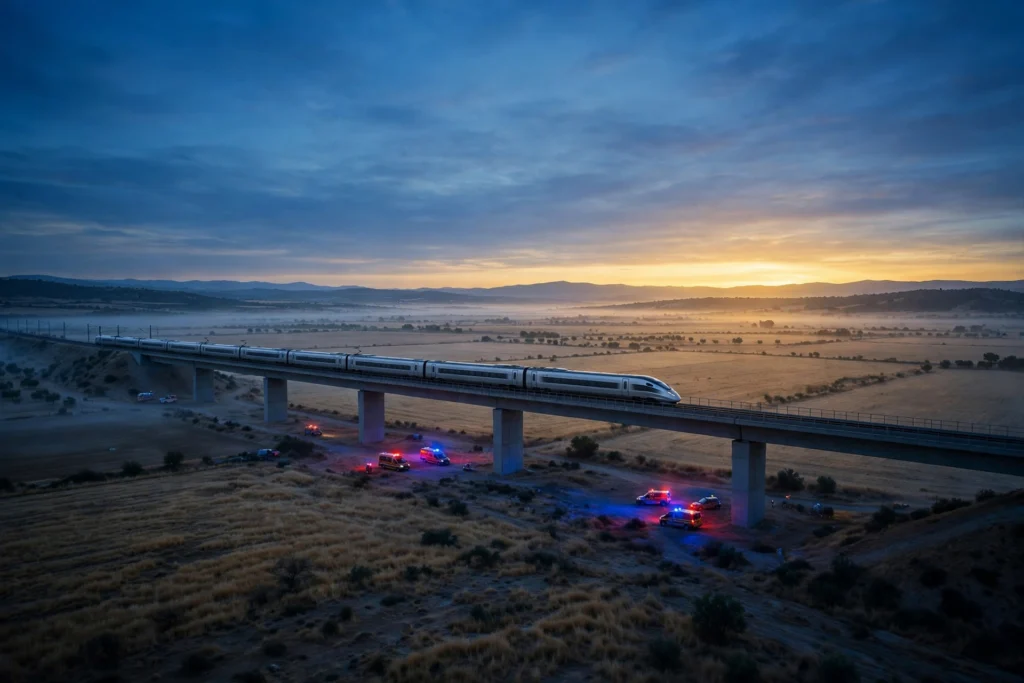
World News: Two High-Speed Trains Collide in Spain
In world news, two high-speed trains collided in central Spain on Wednesday morning, killing at least 68 people and forcing the suspension of the high-speed line that links Madrid with the southern region of Andalusia, in the second deadly accident on the country’s high-speed network in less than a year. The crash happened shortly after nine in the morning local time near the towns of Los Yébenes and Urda in the province of Toledo, when a Renfe high-speed service ran into the rear of an Iryo train travelling in the same direction, derailing two carriages that tumbled down an embankment beside the track. Emergency crews rushed to the scene, and officials warned the number of victims could rise as rescuers worked through the wreckage.
Spain’s rail infrastructure manager, Adif, announced the collision in a message posted on the social network X, saying traffic on the Madrid–Andalusia high-speed line had been suspended following a rear-end collision between two trains. The two services were carrying hundreds of passengers between them: the Renfe train had 397 people aboard, while the Iryo service was carrying 147, according to regional authorities. The crash struck one of the country’s busiest high-speed corridors on a weekday morning, and within hours it was one of the top news stories today across Europe.
Breaking News Today: What Happened Near Urda
The collision took place at about 08:54 local time, at kilometre point 119.7 on the Madrid–Seville high-speed line, in the vicinity of Urda in Toledo province, at what Adif describes as a passing and train stabling facility. The location sits between the towns of Los Yébenes and Urda, in the flat, dry countryside of Castilla-La Mancha, roughly halfway between the capital and the Andalusian coast. The Renfe service involved was an AVE train that had left Madrid’s Puerta de Atocha station at 08:00, bound for Seville Santa Justa with an arrival scheduled for 10:39. The Iryo train was travelling from Madrid to Seville on the same route.
According to regional authorities, the Renfe train struck the rear of an Iryo train that had stopped ahead of it on the same track, knocking two Iryo carriages off the rails and down an embankment beside the elevated line. Footage broadcast by regional Castilla-La Mancha television showed a derailed train with at least one carriage still resting on the elevated section of track, while twisted metal, broken panels and wreckage lay strewn across the slope below. Early wire reports differed on the direction the trains had been travelling, but Adif’s description of a rear-end collision, backed by later reporting from Spanish broadcasters, established that both services had been heading in the same direction on the Madrid–Seville route.
The cause of the collision was not immediately known, and officials were careful in the first hours not to speculate. But the accident had happened on a stretch of line where two trains should never have been able to come together, and questions about signalling, scheduling and the state of the track will be central to the investigation that follows.
At Least 68 Dead as Rescue Teams Reach the Scene
UPDATE (evening, Oct 28): the early casualty figure in this article has been superseded. The regional government of Castilla-La Mancha later confirmed at least 68 people dead and about 80 injured, with 58 people receiving hospital treatment, as rescue workers continued searching the wreckage for survivors and bodies. Early reports had put the toll at 10, then 30, before the confirmed figure rose through the day; regional president Emiliano García-Page warned that some of the most seriously injured might not survive. Among the dead was former labour minister Fátima Báñez, 59. Prime Minister Pedro Sánchez, speaking from the crash site at Urda, announced three days of official mourning from October 29 to 31, promising that if there was negligence it would be revealed and if there were system failures there would be a strong response. Transport Minister Óscar Puente said the crash occurred after the Renfe train was authorised to continue despite an active red signal because of a stationary train ahead, describing the accident as caused by a fault in one of the track safety systems, with the order to resume the journey given before that fault had been rectified. The first confirmed casualty figure had come from the regional government: spokeswoman Esther Padilla initially confirmed 10 deaths and warned the number would likely rise as rescue operations continued. Witnesses cited by the Spanish newspaper El País described numerous injuries and the arrival of emergency medical teams at the scene.
The emergency response was large and fast. Fire crews from the stations at Alcázar de San Juan and Orgaz were operating at the scene, alongside Civil Protection teams from several nearby towns, three air ambulances and two intensive-care emergency units. The mayor of Urda, Manuel Galán, told the radio station Cadena SER that the authorities had asked the town council to prepare emergency facilities, including a sports hall, to accommodate passengers and the injured. The mayor of Los Yébenes, Jesús Pérez Martín, told TVE that very little information was available in the first hours. “We have very little information; I’ve been told it’s a serious accident,” he said.
Madrid–Andalusia Line Suspended as Travel Halts
Adif’s announcement on X was brief and left no doubt about the scale of the disruption: “Traffic on the Madrid-Andalusia high-speed rail line has been suspended following a rear-end collision between two trains.” The suspension covered the services between Madrid and the Andalusian cities served by the line, and reporting later in the day said services between Madrid, Ciudad Real and Andalusia had also been suspended. For a corridor that carries thousands of passengers a day between the capital and the south, the closure meant cancelled trains, stranded travellers and a long wait for information about when services might resume.
The Madrid–Seville line was the country’s first high-speed line, opened in 1992, and it remains one of the busiest routes in a network that ranks among the largest in Europe. The suspension of the whole corridor, rather than a single section, showed how seriously Adif treated the accident and how much of the network’s southern traffic depends on this one stretch of track.
A Second Disaster in Ten Months: The Adamuz Crash
Wednesday’s collision is the second serious accident on Spain’s high-speed network in ten months, and the comparison with the first is unavoidable. On January 18, 2026, an Iryo train travelling from Málaga to Madrid derailed near Adamuz, in Córdoba province, at about 19:40, and crossed into the adjacent track, where it collided with a Renfe Alvia service travelling from Madrid to Huelva. That crash killed 46 people and injured 123 of the 525 passengers aboard. The first two carriages of the Renfe train were forced off a roughly four-metre embankment, concentrating the worst of the casualties in those cars.
The investigation into the Adamuz disaster is still under way. The first inquiries pointed towards a faulty rail weld as a possible cause, with a 40-centimetre break in a rail as the working hypothesis. The track had been renovated in May 2025, and the transport minister, Óscar Puente, described the crash as “tremendously strange” on a section that had received hundreds of millions of euros of investment and was, in his words, supposedly in perfect condition. The Iryo train that derailed was relatively new, manufactured in 2022, and had passed its last safety inspection three days before the crash.
A criminal investigation is being conducted by a court in Montoro, in Córdoba province, into alleged homicide and negligent injury, although no one has yet been placed under formal investigation. Alongside it, Spain’s Railway Accident Investigation Commission, known as the CIAF, is carrying out a technical safety investigation. The two inquiries have not yet produced final findings, and the technical picture has become contested: a Civil Guard report cited in Spanish media said the rail broke at a weld and suggested the break had occurred about 22 hours before the crash, detected as a voltage drop in the track monitoring system without triggering an alarm. Adif has pushed back, arguing that the data was misinterpreted. The victims’ association has called for high-speed services on the affected routes to be halted until safety can be guaranteed, and Adif’s insurer has raised its compensation provision for the victims to 21 million euros.
The January crash triggered a national debate about the level of investment in railway maintenance in recent years, and that debate will now return with greater force. Two deadly accidents on the same network, on the same corridor, within ten months of each other, will raise questions that go beyond the circumstances of either crash on its own. Whether the two accidents share a cause, or whether they are separate failures that happen to have struck the same system, is a question only the investigations can answer. But the fact that the second crash happened while the first was still being investigated, with its causes still disputed, will make the public demand for answers sharper.
Reaction: Sánchez and the Towns Near the Crash
Spain’s prime minister, Pedro Sánchez, was among the first senior figures to respond. In a post on X, he said he was “shocked by the serious train incident” in Toledo, and added that emergency services were on the ground to assist those affected. “My affection, solidarity, and support to all the victims and their families,” he wrote. The transport minister, Óscar Puente, was expected to travel to the site later in the day, and Emiliano García-Page, the president of the Castilla-La Mancha region, said on X that he was travelling to the crash site.
The political response will widen in the coming days. The transport minister, who has already spent much of the year defending the rail network after the Adamuz crash, will face questions in parliament and in the press about what has changed since January, and what has not.
What Happens Next: Investigation and the Questions Ahead
The immediate work is the rescue and the recovery of the victims, and the death toll is expected to be updated as emergency crews reach the wrecked carriages. The number of injured will also become clearer once hospitals have received and assessed the passengers taken from the scene. Live news updates will follow through the day as the regional government, Adif and the emergency services release new figures.
Behind the rescue, the investigation will begin. The CIAF, the same body still investigating the Adamuz crash, is expected to open a technical inquiry, examining the track, the signalling system, the trains’ data recorders and the communications between the drivers and the control centre. A judicial inquiry is also likely, following the pattern set after Adamuz. The questions will be direct: how did a Renfe train come to strike the rear of an Iryo train on the same track, what did the signalling system show, and was there any warning that the line ahead was occupied?
There is no timetable yet for the reopening of the Madrid–Andalusia line, and Adif has given no indication of when services might resume. The line will stay closed while the wreckage is cleared, the track is inspected and the investigators complete their first examination of the scene. For travellers, that means days of disruption at least.
For readers asking what happened in the news today, the answer from Toledo is a stark one: at least 68 people dead, carriages off the track, and a high-speed line closed indefinitely, with three days of national mourning declared from October 29. The fuller answer — why it happened, and whether it could have been prevented — will take weeks or months to emerge. The January crash is still waiting for its final findings after nine months, and its victims are still waiting for full compensation and for someone to be held responsible. The questions are no longer only about one stretch of track near Adamuz. They are about the safety of the network as a whole, and about whether two accidents in ten months are a coincidence or a warning.
Source: Reuters