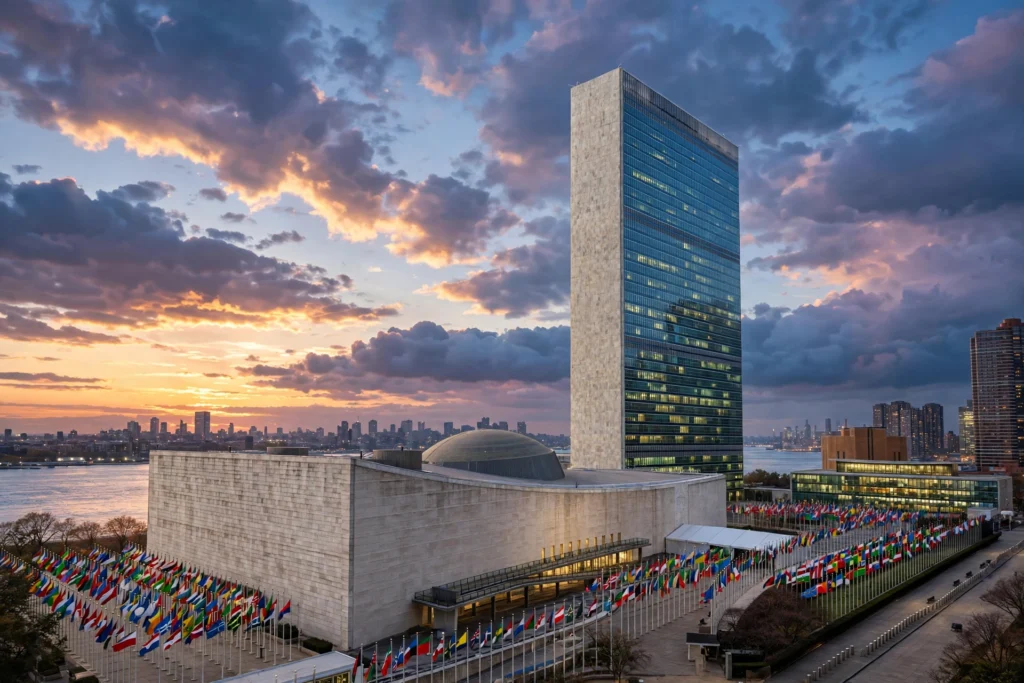
Trump Administration Backs Orbán as Next UN Chief
The Trump administration is urging former Hungarian prime minister Viktor Orbán to run for secretary-general of the United Nations, exploring a joint candidacy that would carry the backing of the United States, Russia and China, according to a report in The Wall Street Journal on Sunday. The proposal, confirmed by sources in all three countries, would put one of Europe’s most divisive nationalist leaders at the head of the world body, and it could only happen if Washington, Moscow and Beijing agree on the same name.
The idea is still a trial balloon rather than a done deal. Orbán is said to be interested but unwilling to enter the race unless he is confident he can win, and no final decision has been made. President Donald Trump and Vice President JD Vance are expected to support him, and any announcement could wait until after the midterm elections on November 3. Orbán himself declined to comment on the report.
White House News: How the Orbán Idea Took Shape
According to the Journal’s reporting, the idea originated with American officials, who had repeatedly mentioned “someone like Orbán” in discussions about who should lead the United Nations next. Russian and Chinese counterparts responded favourably to the suggestion, and Washington then approached the former Hungarian premier directly about a possible candidacy backed by all three powers.
A State Department official acknowledged to the newspaper that the proposal might at first sound far-fetched, but argued that the three powers working together could secure enough support in the Security Council to carry it through.
The Journal’s report described Orbán as the “dream MAGA-conservative candidate,” a phrase that captures why the Trump administration would see him as a natural fit. Orbán built his reputation on opposition to mass migration, on confrontation with liberal non-governmental organisations, on battles with Hungary’s left-leaning courts and media, and on frequent clashes with the European Union. Each of those positions mirrors a fight the Trump administration has picked at home or abroad.
The personal relationship between the two men is well established. Orbán was received at the White House in November 2025, and he has been one of the few European leaders to enjoy consistent public praise from Trump. That closeness matters: a secretary-general who shares the president’s worldview would transform an institution Trump has often treated with open contempt.
The Security Council Math: Nine Votes and No Veto
The path to the job runs through the 15-member UN Security Council, and the arithmetic is exacting. A candidate needs at least nine votes in favour and must avoid a veto from any of the five permanent members: the United States, Russia, China, France and the United Kingdom. The Council recommends a candidate, and the General Assembly of all member states then formally appoints the choice.
A State Department official estimated that Orbán could secure eight votes “comfortably” on the Council, with ten potentially within reach. That would clear the nine-vote threshold, but only if none of the permanent members blocks him. Even with American, Russian and Chinese support, Britain and France could still stop the selection, and neither London nor Paris has been cited as having taken an official position on the idea.
Officials from the United States and another country told the Journal that when Washington, Moscow and Beijing agree on an outcome at the Security Council, they can generally secure it. The three powers rarely agree on anything at the Council, and a joint candidate would be a demonstration that they can still cut a deal on the most symbolic appointment in international affairs.
The race Orbán would be entering is already crowded and deadlocked. Seven candidates remain in contention after former Chilean president Michelle Bachelet withdrew earlier this month. They are Ivonne A-Baki and Maria Fernanda Espinosa of Ecuador, Rafael Grossi of Argentina, the International Atomic Energy Agency chief, Rebeca Grynspan of Costa Rica, the UN trade and development chief, Olara Otunnu of Uganda, Carolyn Rodrigues-Birkett of Guyana, and Macky Sall, the former president of Senegal.
The Council has held six rounds of informal straw polls, the most recent on October 17, and as of that round no candidate had secured the required nine “encouraged” votes without a “discouraged” vote from a permanent member. The straw polls are closed-door ballots in which each Council member marks a candidate “encouraged,” “discouraged” or “no opinion expressed,” and the results are not officially released. Grynspan has led the polling, taking ten favourable votes in the fourth round, her third first-place finish in four rounds, but she also drew three “discourage” votes, which is why her lead has not translated into a locked-up victory. Rodrigues-Birkett placed second in the same round with eight favourable votes, and Grossi finished third.
There is also the question of precedent. No woman has served as UN secretary-general since the organisation was founded in 1945, and four of the seven current candidates are women. There have also been calls for the next secretary-general to come from Latin America and the Caribbean, in line with the principle of geographic rotation, currents an Orbán candidacy would cut across.
Orbán’s Fall: From Budapest to the Sidelines
On April 12, 2026, Hungarian voters swept him out of office after 16 years in power, handing a landslide victory to Péter Magyar’s Tisza party. Tisza won at least 138 of the 199 parliamentary seats, a two-thirds supermajority, in an election that drew turnout of more than 74 percent, shattering previous records. Orbán, who had ruled Hungary for 16 years as its longest-serving prime minister, conceded defeat immediately.
Orbán returned to power in 2010 and built what he called an “illiberal democracy,” dismantling checks and balances, bringing the courts and the media under political control, and enriching allied business figures, largely through lucrative state contracts financed by the European Union, according to his critics. Concerns over corruption and democratic backsliding prompted the bloc to begin withholding billions in funding to Hungary in 2021.
When Orbán returned to power in 2010, Hungary ranked 23rd on the World Press Freedom Index compiled by Reporters Without Borders. By last year it had dropped to 68th, and the group had put Orbán, an ally of both Trump and Russian president Vladimir Putin, on its list of media “predators.”
Orbán’s foreign policy made him a thorn in the side of the European Union establishment and a hero to the nationalist right. The 62-year-old cultivated an international reputation as a staunch opponent of immigration, LGBTQ rights and the West’s support for Ukraine against Russia’s invasion. He stood out among European leaders as someone different, a politician who treated confrontation with Brussels as a governing strategy rather than a risk.
His successor, the 45-year-old Magyar, leads a centre-right, pro-European government that is less than six months into its term. Magyar told the Associated Press on October 20 that his government was pursuing former officials accused of corruption and abuses of power and working to recover assets allegedly misused under his predecessor. “The Hungarian people obviously want to see results in holding those responsible accountable, punishing them and recovering stolen property,” he said.
US Politics: Why the Trump Administration Wants Orbán at the UN
The appeal of Orbán to the Trump administration is ideological before it is diplomatic. The Wall Street Journal’s description of him as the “dream MAGA-conservative candidate” points to a shared worldview: scepticism of mass migration, hostility to liberal non-governmental organisations, impatience with courts and media that stand in a leader’s way, and open confrontation with the European Union. According to the report, American officials began by asking “Why not Mr. Orbán?” in discussions among officials from the three countries. For an administration that has spent its second term remaking American institutions along similar lines, putting that worldview at the head of the United Nations would be a statement of intent.
There is also a strategic logic. The United Nations has been a frequent target of Trump’s criticism, and his administration has cut funding and withdrawn from parts of the system. A secretary-general sympathetic to Washington’s priorities would change the institution from the inside rather than from the outside.
Hungary is a member of the alliance, and Orbán’s positions on Ukraine have repeatedly put him at odds with his allies, frustrating partners who see the war as the defining security question in Europe.
What Happens Next: A Decision After the Midterms
The first question is whether Orbán says yes. He is said to be interested but unwilling to enter the race without confidence that he could win, and he declined to comment on the report. A failed bid for the world’s top diplomatic job would be a public defeat hard on the heels of his election loss, while a successful one would give him a platform larger than any he has held before.
The timing is also deliberate. Trump and Vance are expected to back him, but an announcement could be delayed until after the midterm elections 2026.
The second question is whether Britain and France can be brought along or will use their vetoes. The two countries have generally been cautious about using their vetoes, and the report suggested they might refrain from blocking a candidate backed by a majority of the Council and the other three permanent members. But neither has taken a public position, and both have reasons to resist a secretary-general whose record on the rule of law and press freedom sits uneasily with the values the United Nations claims to uphold.
Meanwhile the existing race continues. Guterres’s second term expires at the end of this year, and his successor is scheduled to take office on January 1, 2027, leaving about nine weeks for the Council to settle on a name. If Orbán enters, he would be a late and formidable entrant against a field that has spent months deadlocked. If he declines, the race will continue among the seven, and the deadlock that created the opening for him will remain unresolved.
Source: The Wall Street Journal via Hungarian Conservative, The Jerusalem Post, Ynet, Bytes Europe