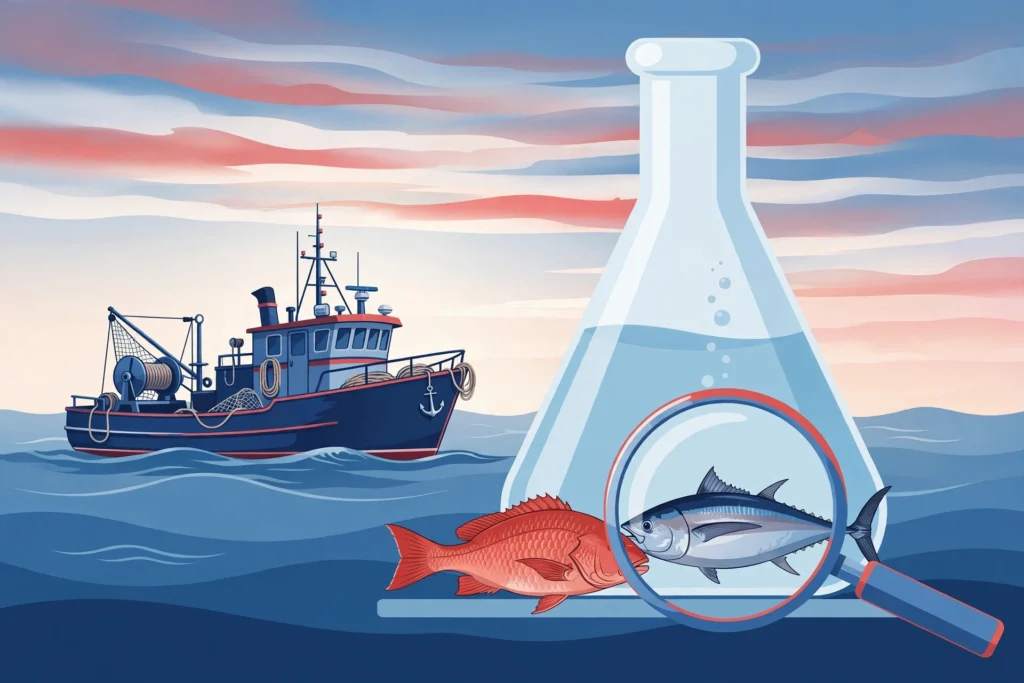
Trump News: Seafood Testing Bill Signed Into Law
In the latest trump news from Washington, President Donald Trump has signed the Illegal Red Snapper and Tuna Enforcement Act into law, launching a federal effort to use chemistry to determine where seafood sold in the United States was actually caught. One of three bills signed on Thursday, October 15, the measure directs the National Oceanic and Atmospheric Administration and other Commerce Department offices to develop a standardized, science-based method for identifying the country of origin of fish — a new enforcement tool aimed at illegal, unreported, and unregulated fishing that undercuts American fishermen.
The signing drew less attention than the administration’s larger legislative fights, but it is one of the more concrete steps Washington has taken against seafood fraud in years. For coastal fishing communities from the Gulf of Mexico to the Pacific, where a fish was caught is not an academic question: mislabeled foreign seafood slipped into American supply chains competes directly with legally caught domestic product and depresses prices for fishermen who follow the rules. The new law bets that chemical analysis of the fish itself can succeed where paper labels and shipping records have repeatedly failed.
Trump News: Three Bills Become Law on October 15
The White House announced the enactments on October 15, closing out legislative efforts that had moved through Congress with broad bipartisan backing. Alongside the seafood measure, Trump signed the Crow Tribe Water Rights Settlement Amendments Act, which gives the Crow Tribe in Montana more flexibility to complete long-delayed water infrastructure projects, and the Retire through Ownership Act, which sets clearer valuation rules for employee stock ownership plans buying shares in closely held companies.
The three measures share a profile: each is narrow, technical, and aimed at fixing a specific operational problem in an existing federal system rather than creating a sweeping new program. None of them produces an immediate nationwide change visible to most households. Their effects will instead emerge through implementation — federal and tribal project decisions in Montana, research and enforcement protocols at the Commerce Department, and valuation practices used by employee-owned companies across the country.
What the Illegal Red Snapper and Tuna Enforcement Act Does
At its core, the new law tasks NOAA and its Commerce Department partners with building something that does not yet exist in standardized form: a validated, chemistry-based test that can determine a piece of seafood’s country of origin. The work must begin with pilot studies on two species at opposite ends of the spectrum — red snapper, associated with a more stationary stock, and tuna, which is highly migratory.
The choice of pilot species is deliberate: a method that works for both a localized fish and a highly migratory one stands a better chance of scaling. The law’s effectiveness will ultimately depend on whether scientists can produce a repeatable method that holds up across species, waters, and real-world supply chains.
The Congressional Budget Office described the agencies’ assignment in three stages: conduct pilot studies, develop the methodology, and report the findings to Congress, with an initial report due within two years of enactment. That timeline means the signing starts a research and validation process rather than putting a field-ready test into officers’ hands — the science must be built, tested, and proven before it can support seizures or cases.
NOAA Fisheries is expected to work alongside the National Institute of Standards and Technology on the effort, combining fisheries science with the measurement expertise needed to make a test defensible. The ambition, as described during the legislative process, extends to testing prepared foods — including raw products like ceviche, sashimi, sushi, and poke — where visual identification of a fish’s origin is impossible and documentation is thinnest.
The Illegal Fishing Problem Behind the Bill
Illegal, unreported, and unregulated fishing — known in policy circles as IUU fishing — is one of the most persistent enforcement challenges in the global seafood trade. The problem the new law targets is straightforward to describe and difficult to solve: once fish enter a supply chain, the labels attached to them and the paper records that accompany them may not provide enough evidence to establish where they were actually caught. A fish labeled as legally harvested domestic product may in fact have been taken illegally in foreign waters, and by the time it reaches an American port, market, or restaurant, the paperwork tells whatever story the seller wants it to tell.
That evidentiary gap has real consequences. Enforcement officers policing seafood imports have long relied on documentation that can be falsified or incomplete. A validated chemical method would give them an independent tool rooted in the physical properties of the fish itself — if a fillet’s chemistry contradicts its label, investigators have a starting point no forged document can provide.
For domestic fishermen, the stakes are economic. Illegally caught foreign seafood that enters the American market unlawfully competes with legally harvested domestic catch, undercutting prices and market share for fleets that comply with quotas, seasons, and conservation rules. Lawmakers from Gulf Coast and Pacific states — the regions whose fishing industries feel this competition most directly — were among the bill’s strongest backers, and the Senate Commerce Committee framed the legislation’s goal in exactly those terms: helping authorities distinguish legally harvested domestic seafood from foreign fish that may have been caught or imported unlawfully.
Congress Passed the Measure With Bipartisan Backing
The bill’s path through Congress reflected the kind of cross-party consensus that has become rare in Washington. Originally introduced in the Senate in January 2025, the legislation won unanimous Senate approval — passing by unanimous consent in July 2025 — before moving to the House, which passed an amended version on September 14 via voice vote. The Senate agreed to the House’s changes on September 24, sending the final version to the president’s desk.
The House amendments made two notable changes to the Senate’s original text. First, they clarified that the chemical test would be used not only to combat IUU fishing but also to fight seafood fraud more broadly — the mislabeling of species and origins that cheats consumers as well as fishermen. Second, the House version eliminated a provision that would have authorized the Defense Department to spend operations and maintenance funding on IUU enforcement activities, including observers, shipriders, specialized personnel, remote sensing, data analysis, and operational intelligence. Those changes were recommended by the House Science, Space, and Technology Committee during a February 2026 markup of the House version.
Representative Aumua Amata Coleman Radewagen, the Republican delegate from American Samoa, co-sponsored an earlier House version of the bill. She called it “a good bipartisan effort to safeguard U.S. tuna and protect American Samoa’s share of the market by better identifying IUU-produced tuna and preventing American imports of illegal competition that undercut our fishing,” adding: “As part of our national food security, we need a dependable U.S. fishing supply that’s not forced to compete against fraudulent IUU bad actors. I appreciate key leaders on both sides of the aisle recognizing the need for this initiative to help keep our fishing competitive.”
White House News: A Two-Year Clock for Results
In White House news terms, the October 15 signing was a routine enactment — no ceremony-driven headlines, just an announcement that the bills had become law. But the two-year reporting clock the legislation sets in motion will be the real measure of whether the law delivers. Within two years, NOAA and its partners must report back to Congress on the pilot studies and the methodology, and that report will show whether chemical origin-testing is a practical enforcement tool or an idea that falters against the complexity of real-world fisheries.
The scientific challenge is significant. A chemical signature reliable enough for enforcement must account for natural variation within species, differences across fishing grounds, and the transformations fish undergo during processing. A method proven in a laboratory on whole fish must eventually work on the fillets and prepared dishes that actually move through commerce.
A validated test would slot into a broader enforcement toolkit that already includes dockside inspections, catch documentation programs, and cooperation with foreign governments. None of those tools has fully solved the origin-verification problem, which is precisely why Congress reached for a scientific solution.
Trump Administration Fisheries Policy in 2026
The seafood testing law lands in the middle of a busy period for Trump administration fisheries policy. Since the president began his second term in January 2025, the administration has pushed to reopen large areas of ocean that had been closed to commercial fishing, arguing that restrictions went too far and harmed American fishermen. In April 2025, Trump issued a proclamation allowing commercial fishing within the Pacific Islands Heritage Marine National Monument, and the administration has directed fishery councils to develop new opportunities in other protected Pacific waters.
That push has drawn criticism from conservation groups, who argue that opening marine monuments to commercial fishing threatens endangered species and fragile ecosystems. The administration counters that American fishermen should not be locked out of American waters while foreign fleets fish with fewer constraints.
The new testing law sits somewhat apart from that fight. It is an enforcement measure, not a deregulation measure, and it drew support from some of the same coastal constituencies that have cheered the administration’s access expansions. Cracking down on illegal foreign seafood and opening domestic waters to American fishermen are, in the eyes of the bill’s supporters, two sides of the same coin: both aim to tilt the playing field back toward domestic fleets.
Political News Today: Why the Signing Matters
In political news today, the seafood bill’s signing is a reminder that bipartisan legislating still happens — mostly on subjects too technical to become partisan battlegrounds. A chemistry test for fish origins does not map onto Washington’s ideological divides, which is why it moved from Senate introduction to presidential signature in under two years with unanimous support in one chamber and a voice vote in the other.
For the fishing industry, the law offers a federal commitment to building the scientific infrastructure enforcement has lacked. Whether it arrives on schedule — and whether it works well enough to change behavior in global supply chains — will be determined in the pilot studies and the report to Congress now underway.
Together, the three signings illustrate the less visible machinery of federal lawmaking: targeted bills, technical fixes, and agency assignments that accumulate into real changes in how the government operates. The seafood testing law now heads into its two-year scientific trial. Its supporters in Congress, on the Gulf Coast, and in the Pacific will be watching the results — and so will the fishermen whose livelihoods depend on a fair market.
*Sources: SeafoodSource, The American Quorum*