2026 Midterms: Trump’s $5,000 Mar-a-Lago Joke
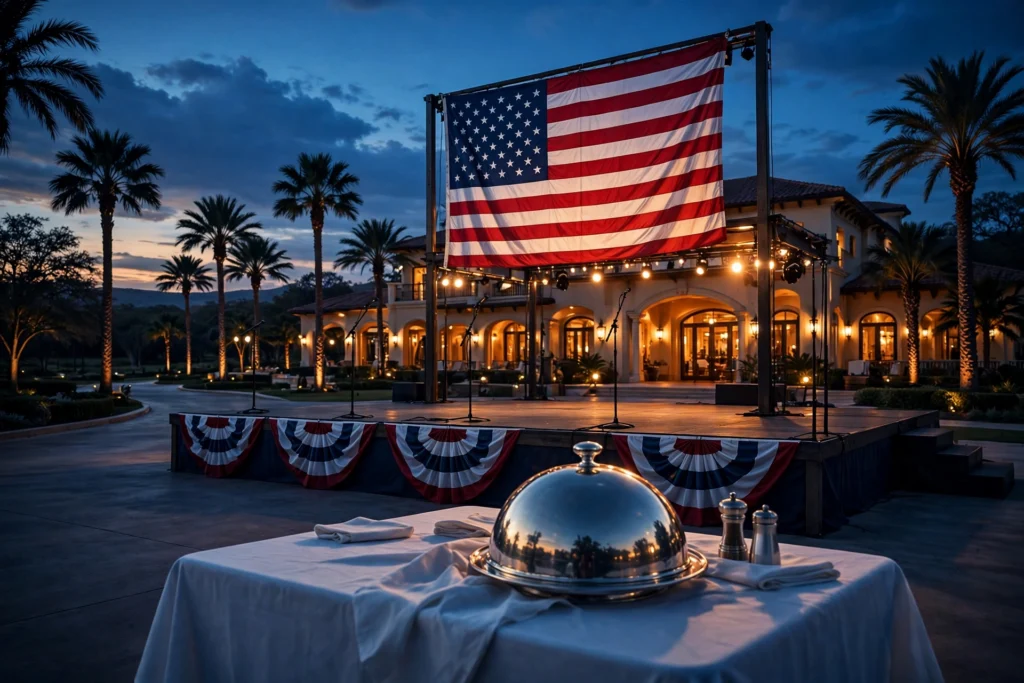
One week before the 2026 midterms, President Donald Trump stood on a rally stage in Corpus Christi, Texas, on Tuesday and returned to the promise that has become the closing pitch of his campaign: $5,000 for every adult American, if Republicans keep control of Congress. Then he told the crowd where to spend it. “You could even come to Mar-a-Lago. You’ll be my guest,” Trump said, in remarks shared by the journalist Aaron Rupar. “The problem is that for $5,000 the most you’ll be able to buy is a hamburger and maybe a small dessert. I’m not even sure you could buy that! No, don’t go there. It’s not a good place if you’re price conscious.”
The line drew laughter in the room and a fast backlash online. The joke was not new — Trump had told versions of it at rallies in Georgia days earlier — but repeating it in Texas, a week before Election Day, turned a throwaway line into a symbol of the affordability debate that will decide the 2026 midterms.
2026 Midterms: How the $5,000 Dividend Became the Closing Pitch
The promise began at the Republican midterm convention in Dallas last month, where Trump told the crowd that the economy’s strength would let him send money directly to voters. “Because of our tremendous strength and success, economically, I will issue a dividend to every adult citizen in the United States of America for $5,000,” he said. The offer came with a condition: it would happen only if Republicans hold both the House of Representatives and the Senate. It also came with a rule. “The caveat is you have to spend it in the United States of America,” Trump said. “So, let’s go to Miami, darling. Let’s go to Palm Beach and join the president for lunch.”
He has repeated the pitch at nearly every rally since. At a Saturday rally in Kentucky, he presented the payment as a certainty. “If the Republicans win, you’ll each have $5,000 in your pocket and economic success for our country like we have never seen before,” he said. When he acknowledged the doubters, he answered them directly. “And remember, ’cause they like to say, ‘Oh, well, maybe he won’t do that.’ Uh, I always do it.” The campaign has framed the dividend as a way to stimulate domestic spending and support American consumers.
The Mar-a-Lago line entered the pitch at a Friday rally in Dalton, Georgia. There, Trump again suggested that a voter who received the money should spend it at his club in Palm Beach, Florida. “Let’s have lunch at Mar-a-Lago, where for $5,000, you’ll get one hamburger and a small dessert,” he said. He caught himself almost immediately. “I shouldn’t say that,” he added, before conceding that the price was probably accurate. The Senate race between Republican Ken Paxton and Democrat James Talarico is one of the closest contests in the country, and more than 4.2 million Texans had already cast a ballot in the first seven days of early voting when Trump arrived.
Trump News: “I Shouldn’t Say That” and the Backlash That Followed
The joke has now been told three different ways in less than a week, and each version has landed a little differently. In Dalton, it was a quick aside, delivered with a chuckle and an immediate retraction. In Corpus Christi, it was longer and more deliberate, with the invitation to be his guest and the warning not to go there if you are watching your budget. In Texas, a week before the vote, it carried a different weight.
The response online was swift and unsparing. Ron Filipkowski of MeidasTouch wrote that the president “has nothing but contempt for the people he’s talking to.” MeidasTouch itself added: “Really driving home that affordability message before the midterms.” Zeteo media columnist Justin Baragona wrote: “Just really hitting it out of the park on affordability and relating to the plight of the working class.” The account PatriotTakes summed up the moment as “Trump unveils $5,000 combo meal.” The criticism shared a single theme: that a president campaigning on the cost of living had just joked that $5,000, a sum that would cover months of groceries for many families, barely buys lunch at his resort.
Inside the rallies, the reaction was more muted than the online storm. In Dalton, the line drew only a light round of applause, noticeably quieter than the cheers that greet the dividend promise itself. That contrast is the heart of the problem for the campaign. The $5,000 pledge is popular in the room. The joke about what it buys at Mar-a-Lago is not, because it invites the audience to measure the promise against the price of a meal at the president’s club. Trump himself seemed to sense the risk, which is why the self-correction has become part of the routine.
Trump Tariffs: Who Pays for a $5,000 Dividend
Beyond the joke, the dividend raises a question that has followed it since Dallas: where does the money come from, and who has to approve it. Paying $5,000 to every adult citizen in the country would cost well over $1 trillion, a sum far larger than any single payment program in recent American history. Trump has pointed to tariff revenue as the source of the money, presenting the tariffs as a stream of income from abroad that can be returned to Americans at home. But the tariffs themselves have been the subject of a Supreme Court fight this month, and the revenue they produce is neither settled nor unlimited.
The second question is who gets to decide. Democrats argue that the plan is politically motivated and would face significant hurdles, because a payment of this size would require formal approval from Congress. The Constitution gives Congress the power of the purse, and no president can send $5,000 to every adult on his own authority. The campaign has not laid out a legislative path for the payment, or said what form the money would take. That silence has let critics call the promise a gimmick rather than a workable policy.
Trump has pointed to one precedent. He noted at a rally that he had previously delivered a $1,776 “Trump dividend” to troops in the military, a figure chosen for the year of American independence. But those payments came from a congressionally approved housing supplement, which is to say they went through exactly the process the new proposal has not. The president has also tied the payment to the outcome in a starker way, saying the nation could not afford the payments if Democrats hold a chamber of Congress, because the nation would be “flat broke.”
Election Polls: Affordability Is the Issue That Will Decide the Midterms
The reason the joke stung is the same reason the dividend exists: the cost of living is the central issue of this election, and voters feel it every day. Recent polling indicates that inflation, alongside the rising prices of groceries and household goods, continues to be a primary concern for the electorate. Energy prices have surged as well, and at his Corpus Christi stop Trump vowed to reduce the fuel prices that have climbed in recent months, pointing to the Venezuelan oil shipment behind him as proof that relief is coming.
The polling around the promise itself is mixed. In polling reported alongside the debate, about half of respondents said Trump tries to keep his promises but is unable to, while about four in ten said he keeps them. That split captures the gamble of the dividend: for believers, the $5,000 is a reason to turn out; for doubters, it is a reminder of the gap between rally-stage promises and Washington delivery. Republican candidates have not echoed the promise on the trail, and campaign spending tracked by AdImpact suggests that Republicans are not running television or online advertisements about the $5,000 payments. The few advertisements that do exist come from pro-Democratic groups, including the Rolling Sea Action Fund, whose voiceover asks voters: “Come on, do you really think he’s sending you a check? Yeah, right, we won’t get fooled again.”
The voters who have heard the pitch in person are less cynical than the advertisements. Mike Boatman, a 58-year-old from Evansville, Indiana, and a frequent rally attendee, told reporters he could use the money. “I could use $5,000,” he said. “I mean, he’s done everything he’s said he’s going to do.” Others in the crowd took Trump at his word that he would fight to get them the money, but added a caveat of their own: if he did not come through, it would not be his fault.
What Happens Next: One Week to Election Day
The midterms take place on Tuesday, November 3, and the final week will test whether the dividend survives as the campaign’s closing message or becomes a liability that Democrats use against it. The campaign, for its part, is likely to keep the pledge at the center of its rallies, because it is the most concrete offer on the table in a race fought largely over prices and the cost of living.
The practical questions will not be answered on Election Day. If Republicans keep both chambers, the president would still need Congress to approve a payment of more than $1 trillion, and he would need to say how it is funded, when it is paid, and who qualifies. If Democrats win a chamber, the promise dies in the legislature. Either way, the dividend will be judged by what happens after the votes are counted, not by what was said on a stage in Corpus Christi. For now, the line that will be remembered is not the promise itself but the joke that came with it: $5,000, the president said, barely buys a hamburger and a small dessert at Mar-a-Lago.
Source: CNBC