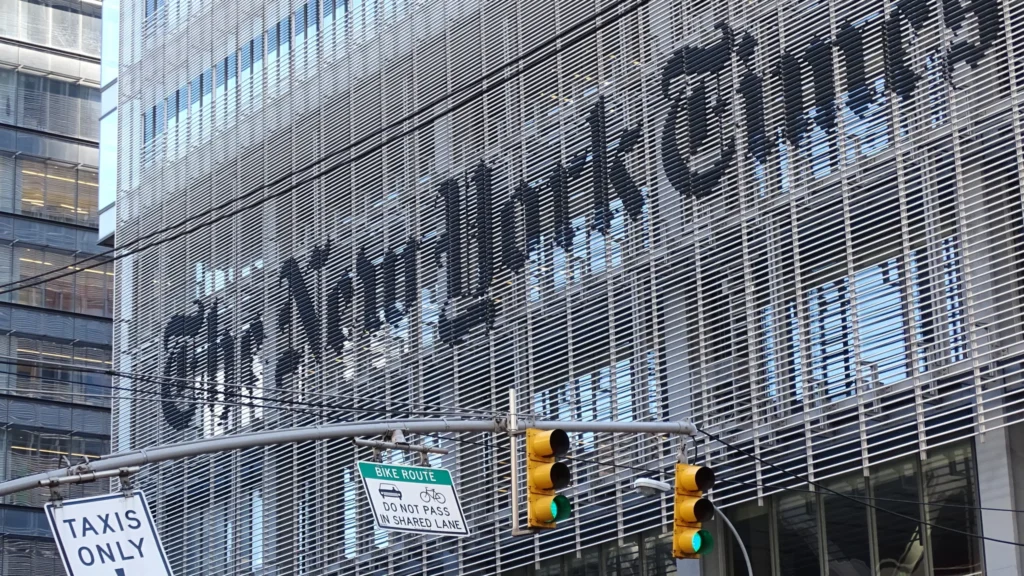
Truth Social News: Trump Blasts ‘Lowlife’ NYT Reporter
President Donald Trump kicked off Thanksgiving Day with a blistering late-night attack on a New York Times reporter, using his Truth Social account in the early hours of the holiday to brand the veteran journalist a lowlife and accuse him of writing only what his bosses tell him to write. The outburst, posted at 12:47 a.m. Eastern time on Thursday, November 26, was aimed at David E. Sanger, the newspaper's White House and national security correspondent, over an article about the president's relationship with the stock market.
It was, by the standards of this presidency, a familiar kind of message — personal, furious, and posted in the small hours — but the timing gave it a particular edge. Americans were waking up to Thanksgiving, a holiday the president has repeatedly used as an occasion for public grievance as much as for gratitude. Within hours, the post had been picked up by news outlets across the country, and the reporter at its centre had become the latest figure in a long-running feud between the president and the newspaper he calls the failing New York Times.
The trigger was an article Sanger published on Wednesday, titled Trump Rejoiced in the Market's Nvidia Surge. It Didn't Last Long. The piece examined how the president had taken a public victory lap over a rebound in the stock market after he helped bring Jensen Huang back as chief executive of Nvidia, the chipmaker at the centre of the artificial intelligence boom — and how the rally faded almost as quickly as it arrived. Trump, who has long treated the market as a scoreboard for his presidency, took exception to the framing, and to the suggestion that he claims credit for the market's rises while blaming others for its falls.
Truth Social News: What Trump Posted at 12:47 a.m.
The president's post opened with a direct attack on the reporter by name, and then moved into a long list of achievements he said Sanger had left out of his article. He called Sanger the mediocre reporter for the Failing New York Times, and complained that the story had not mentioned what he described as his successes in office.
The list was sweeping. He cited the successful closing of the border, the best crime statistics in years — including what he called the lowest murder rate since 1900, a span of 126 years — and the biggest tax and regulation cuts ever. He pointed to the most successful naval blockade in history, the destruction of Iran's navy and air force, and what he called the one day win against Venezuela. And he cited what he described as that day's big success in straightening out what he called the Obama caused mess in Iowa, a reference to the Army's controlled detonation of dangerously degraded bomb-making chemicals in that state earlier on Wednesday.
He closed the post with a second, sharper insult and a broader claim about his record. David Sanger is a lowlife that only writes what he is told to write by his bosses, the president wrote, before adding that until the election the market had been the best ever, that he had settled eight wars, and that the United States was respected again like never before.
The post was the president's first message of Thanksgiving Day, and it set the tone for the holiday. It was not a greeting. It was a grievance, posted in the middle of the night, and it was aimed at a single journalist whose reporting had displeased him. As of the morning, neither Sanger nor his employer had responded to the attack.
The Article That Set It Off
Sanger's article, published on Wednesday, was an analysis of the president's handling of the market's recent turbulence, and of the Nvidia episode in particular. The president had taken credit for Nvidia reinstating Jensen Huang as its chief executive, after the chipmaker's board had removed him earlier in the month, and the market had surged on the news of Huang's return. But the rebound was short-lived. Stocks began sliding after the initial jump on Monday, and Sanger's piece noted the pattern: the president celebrates the gains as his own doing, and looks elsewhere for someone to blame when the numbers turn.
On Wednesday, the president had already posted about the market's slide, blaming the midterm election results. Stocks are down sharply because of the November Third Election results, he wrote on Truth Social. I wasn't on the Ballot, but if I was, the results, just like all three times before, would have been much different, and the Stock Market, and your 401-k's, would be BOOMING. He added, in a separate line, I told you so.
Sanger's article acknowledged that most presidents love to take credit for economic success and deflect responsibility for bad news. But it argued that Trump goes a step further than most, and it faulted two of his policies in particular for the market's troubles: his tariff wars, and the conflict in Iran. The president's Thanksgiving post was, in effect, his answer to that argument — a point-by-point rejection, delivered in his own words, in the middle of the night.
The dispute is about more than one article. It is about who owns the story of the market. For the president, the market is a measure of his leadership, and a rising market is evidence that his policies are working. For his critics, the market's recent slide is evidence that the same policies — tariffs that raise costs for businesses, and a war that has pushed up energy prices — are now exacting a price. Sanger's article sits squarely in that argument, and the president's response shows how personally he takes it.
The Market Numbers Behind the Row
The backdrop to the row is a market that has taken a real hit in recent weeks. The Dow Jones has fallen about 2,100 points this month, and the slide has been driven in part by concerns about an artificial intelligence bubble — doubts about whether the enormous valuations of the companies leading the AI boom can be sustained. Nvidia, the most important of those companies, has been at the centre of the turbulence, and its shares have swung sharply as the story of Huang's removal and return has unfolded.
According to reporting on the episode, Nvidia shares closed at 149 dollars for the Thanksgiving holiday, down by nearly 100 dollars from October. The fall captures the scale of the reversal: a stock that had been the emblem of the AI boom has lost roughly two-fifths of its value in a matter of weeks, and the president's association with the company — through his intervention in the Huang affair — has tied his reputation to its fortunes.
There have, however, been positive developments elsewhere in the economy, and the president has been quick to highlight them. The Bureau of Economic Analysis revised its numbers for gross domestic product growth up from an annualised rate of 3.4 percent to 4.3 percent for the third quarter, the fastest pace in about three years. The president highlighted the revision on Truth Social, and it is one of the numbers his supporters cite when they argue that the economy's fundamentals remain strong despite the market's slide.
The tension between those two sets of numbers — a falling market on one side, a strong growth revision on the other — is the substance of the argument Sanger was making. The president's case is that the growth figures prove his policies are working, and that the market's decline is the fault of the election results and his political opponents. Sanger's case is that the president cannot have it both ways: if he claims the market's rises as his achievement, he must also own its falls, and the falls have been driven in part by his own decisions on tariffs and on Iran.
American markets are closed on Thursday for Thanksgiving, which means the argument will have to wait for Friday's trading to get its next instalment. But the president's post guarantees that the row will still be live when trading resumes, and that the market's next move will be read, by both sides, as a verdict on the argument.
Iowa, Venezuela and the Eight Wars
The list of achievements in the president's post ranged far beyond the market, and each item on it has its own backstory. The reference to Iowa concerned an operation earlier on Wednesday, when Army engineers safely detonated a stockpile of dangerously degraded lead azide, a bomb-making chemical, that had been stored in the state. The president had posted about the operation several times on Wednesday, blaming his predecessor Barack Obama for failing to deal with it during his presidency, and using the successful detonation to launch a broadside at the media, writing that Fake News CNN was hoping for a bad outcome in Iowa and that their pre-coverage was inaccurate and deplorable.
The reference to the most successful naval blockade in history, and to the destruction of Iran's navy and air force, concerned the war with Iran that has dominated the second year of the presidency. The United States has been at war with Iran since February, a conflict the president began without congressional authorisation, and the administration has pointed to the damage inflicted on Iran's military as evidence of its success. The president's critics, including a growing number of Democrats in Congress, argue that the war has cost tens of billions of dollars, driven up energy prices at home, and left the administration with no clear plan for ending it.
The one day win against Venezuela referred to another military operation, one the president has presented as a swift and decisive success. And the claim of having settled eight wars is one he has made repeatedly since taking office, listing conflicts he says he brought to an end through diplomacy and pressure. The figure has been challenged by fact-checkers and by the leaders of some of the countries involved, but it remains a central part of the president's account of his foreign policy.
The crime statistics claim — the lowest murder rate since 1900 — is likewise a figure the president has cited often, and it is one his critics dispute. The border claim, the tax cuts claim, and the rest of the list are all items the president has used before, in speeches and on social media, to argue that his presidency has been a success on every front. What was new on Thanksgiving was not the list, but the occasion: a holiday post, in the middle of the night, that used the list as a weapon against a single reporter.
Who Is David E. Sanger?
The target of the president's attack is one of the most experienced reporters in Washington. David E. Sanger is the White House and national security correspondent for the New York Times, a role in which he covers the president and his administration, with an emphasis on foreign and national security policy and its intersection with global politics, technology, intelligence and superpower competition. He was born and raised in White Plains, New York, and graduated from Harvard College in 1982.
Sanger has covered the administrations of five different presidents over four decades, and has been part of three Pulitzer Prize-winning teams. He is the author of books on American power and on the cyber conflict between the United States and its rivals, and he is regarded within the profession as one of the leading reporters on national security. His Wednesday article on the market and Nvidia was in keeping with that record: an analysis of how the president's decisions, and his habit of claiming credit, shape the way the country understands the economy.
This is not the first time the president has attacked him. In March, Trump called Sanger a lightweight analyst from a failing newspaper that always gets it wrong, after Sanger wrote an analysis of the president's Truth Social post about the Iran war. The Thanksgiving attack is the second public broadside in eight months, and it follows the same pattern: the president reads an analysis he dislikes, and responds by attacking the analyst rather than the analysis.
Neither Sanger nor the Times had responded to the Thanksgiving post as of the morning it was published. The newspaper has, in the past, declined to engage with the president's attacks on its reporters, and there was no sign on Thursday that it intended to break with that approach.
A Thanksgiving Tradition of Holiday Broadsides
The president has a long tradition of using his holiday messages on social media to air out his grievances and go after his political rivals in fiery tirades, and Thanksgiving 2026 fits the pattern. The habit goes back years. In May 2015, he used a Memorial Day message to wish everyone, including all haters and losers, a truly happy and enjoyable Memorial Day. The formula has barely changed since: a holiday greeting that doubles as a score-settling exercise, posted in the early hours, and aimed at whoever has most recently displeased him.
The tradition is, in part, a matter of temperament. The president is known for staying up late and scrolling through social media, and his late-night posts have become a recognised feature of his presidency. But it is also a matter of strategy. A holiday post guarantees attention, because the news cycle is quiet and the audience is at home, and an attack posted at 12:47 a.m. on Thanksgiving will dominate the morning's coverage in a way that a daytime statement would not.
This Thanksgiving, the president is spending the holiday in Palm Beach County, Florida, where he arrived on Tuesday for his 32nd visit of his second term. The setting — Mar-a-Lago, the resort he calls his winter White House — is the backdrop for the post, and it is a reminder of how the presidency has been conducted from Florida as much as from Washington. The post itself, however, could have come from anywhere. It is the product of a phone, a late hour, and a grievance, and it is a form of communication the president has made entirely his own.
What happens next will depend on whether Sanger or the Times choose to respond, and on what the market does when trading resumes on Friday. If the market rebounds, the president will say he was right. If it falls further, his critics will say the same about Sanger.
Source: New York Post