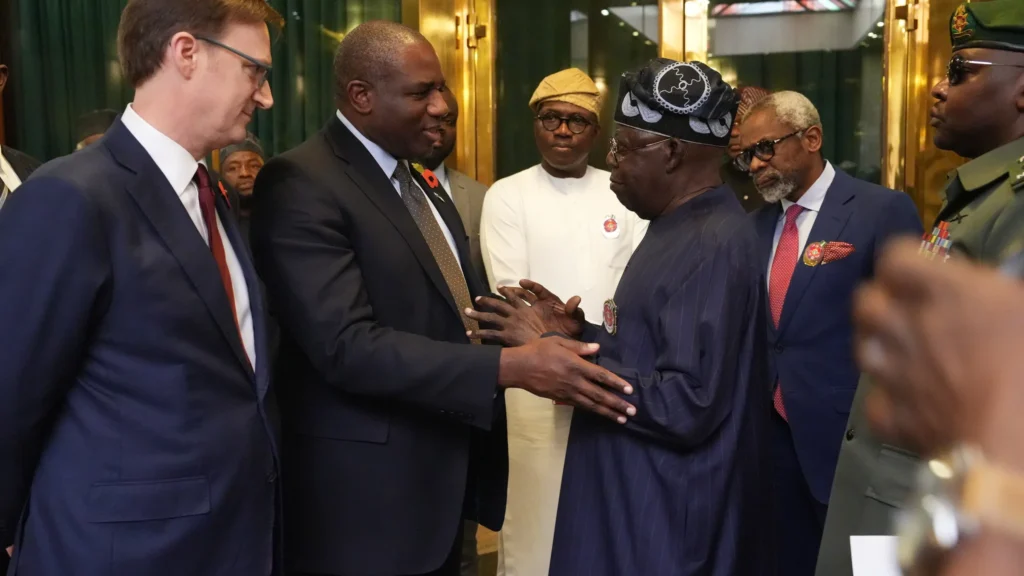
Nigeria News: Tinubu Declares End to Economic Emergency
President Bola Tinubu has declared that Nigeria has moved beyond the emergency phase of its economic reforms, announcing a transition to an era of shared prosperity and setting a target of a $1 trillion economy by 2030. The declaration, made on Thursday at the presentation of a book on economic diversification in Abuja, was the President's most confident statement yet that the painful reforms introduced since he took office in May 2023 are beginning to yield results, with external reserves rising to about $55 billion and non-oil exports exceeding $6 billion, the highest in the country's history. But the declaration was met with caution from some of those present, who warned that the country's growth rate is still too low to tackle poverty, and that the benefits of the reforms have yet to reach ordinary Nigerians.
Tinubu, who was represented at the event by the Speaker of the House of Representatives, Tajudeen Abbas, said the administration had successfully laid the foundation for economic recovery and was now shifting attention from stabilisation to productive expansion, industrial growth and improved living standards. "The emergency is behind us. Non-oil activities now account for about 96 per cent of our Gross Domestic Product. Our non-oil exports have crossed $6 billion, the highest in our history," the President's message said. "Our external reserves have risen to about $55 billion, more than 14 months of import cover. Our non-oil revenue has grown from N13.63 trillion in 2023 to N16.4 trillion in the first half of this year alone. Our task has moved from stabilisation to shared prosperity, and our compass points firmly to a $1 trillion economy by 2030."
Economy News: The Reforms Behind the Declaration
The reforms that Tinubu is celebrating are the most far-reaching in Nigeria's recent history, and they have been among the most painful. When he assumed office in May 2023, the President inherited an economy in fiscal distress, with currency instability, mounting debt obligations, depleted reserves and declining industrial productivity, in his own words. His response was to remove the petrol subsidy, a policy that had cost the government trillions of naira a year and that had been a source of corruption and waste, and to unify the foreign exchange market, ending the system of multiple exchange rates that had distorted the economy and enriched those with access to cheap dollars.
The two decisions, taken in the first weeks of his presidency, were described by the President as difficult but necessary, and they have defined his administration ever since. The removal of the subsidy caused petrol prices to triple overnight, and the unification of the exchange rate caused the naira to lose more than half its value against the dollar. The result was a surge in inflation, which peaked at over 30 percent, and a cost-of-living crisis that hit the poorest Nigerians hardest. The reforms were defended by the government as the only way to fix an economy that was heading for collapse, and they were attacked by critics who said the pain was being borne by those least able to afford it.
The figures Tinubu cited on Thursday are the evidence the government offers that the pain was worth it. External reserves of about $55 billion, more than 14 months of import cover, are a measure of the country's ability to pay for imports and to defend its currency, and they are far higher than the levels inherited in 2023. Non-oil exports above $6 billion, the highest in the country's history, are a sign that the economy is beginning to diversify away from its dependence on crude oil, which has dominated Nigeria's exports and government revenues for decades. Non-oil revenue of N16.4 trillion in the first half of the year, up from N13.63 trillion in the whole of 2023, is a sign that the government's tax reforms are broadening the revenue base. And non-oil activities accounting for about 96 percent of GDP is a reminder that, for all the attention paid to oil, the Nigerian economy is far more diverse than it is often assumed to be.
The Sceptics: Growth Too Slow, Poverty Unchanged
The declaration was not received without challenge. Anambra State Governor Chukwuma Soludo, who was present at the book presentation, warned that the country's current growth rate of around 4 percent was insufficient to tackle poverty or to achieve the $1 trillion economic ambition, and he called for double-digit economic growth and investments exceeding 30 percent of GDP to accelerate industrialisation and create jobs. Soludo, a former governor of the Central Bank of Nigeria and one of the country's most respected economists, was speaking as a friendly critic, but his message was clear: the macroeconomic indicators may be improving, but the growth rate is not enough.
Soludo's warning is grounded in the arithmetic of development. An economy growing at 4 percent a year, with a population growing at more than 2 percent a year, is barely raising living standards, and it would take decades to reach the $1 trillion target at that pace. Double-digit growth, of the kind that China and other Asian economies achieved during their rapid industrialisation, would be needed to transform the economy in the timeframe Tinubu has set, and that would require investment on a scale that Nigeria has never achieved. The call for investment exceeding 30 percent of GDP, against a current level that is far lower, is a measure of the gap between where Nigeria is and where it needs to be.
Former presidential spokesman and veteran journalist Dr Reuben Abati sounded a different caution, warning that the sustainability of the reforms would ultimately depend on whether their benefits translated into improved living conditions for ordinary Nigerians. The point is one that the President himself acknowledged, conceding that improved economic indicators had yet to translate sufficiently into the daily lives of Nigerians, and saying the government was determined to ensure that macroeconomic gains produced tangible benefits. The acknowledgment is significant, because it concedes the central criticism of the reforms: that they have improved the numbers without improving the lives of the people they were meant to help.
The Book, the Budget and the Politics of Reform
The occasion for Tinubu's declaration was the presentation of a 526-page book, "Economic Diversification and Structural Transformation in Nigeria: The Past, The Present, The Future", authored by Abdulmumini Kofa, a four-term member of the House of Representatives, at the State House Conference Centre in Abuja. The book, which examines Nigeria's long struggle to diversify its economy away from oil, provided the backdrop for a discussion of the reforms and their results, and the presence of Soludo and Abati, two of the country's most prominent public intellectuals, ensured that the discussion was not a one-sided celebration.
The declaration comes at a politically sensitive moment. The same week, Tinubu asked the National Assembly to cut the 2026 budget by about N3.15 trillion, from N68.32 trillion to N65.18 trillion, while retaining the fiscal deficit at N31.46 trillion and the borrowing plan at N29.2 trillion. The request, contained in a letter dated November 20 and read to lawmakers on November 24, was presented as a technical adjustment, to align spending with existing financial obligations and available resources, but it is also a sign of the fiscal pressures the government faces, even as it declares the emergency over. The Senate has passed the bill for second reading, and the National Assembly is expected to approve the revision, but the juxtaposition of a declaration of success and a request to cut the budget has not gone unnoticed.
The Central Bank's decision on Tuesday to hold its benchmark interest rate at 23 percent, after a 3.5-point cut in September, is another sign of the balancing act the government faces. Headline inflation eased to 14.1 percent in October from 14.6 percent in September, a modest improvement, but the rate remains far above the levels that would allow the Central Bank to cut further. The Governor, Olayemi Cardoso, has said the fall in reserves is temporary, blaming year-end demand and election spending, but the need to keep rates at 23 percent, a level that chokes borrowing and investment, is a reminder that the economy is still fragile.
The $1 Trillion Target and What Comes Next
The $1 trillion economy by 2030 is the centrepiece of Tinubu's economic vision, and it is an ambitious target. Nigeria's GDP, at current exchange rates, is a fraction of that figure, and reaching $1 trillion within four years would require a combination of rapid real growth, a stable or appreciating currency, and a significant increase in the dollar value of the economy. The President said the private sector would provide approximately 86 percent of the investment needed to reach the target, a recognition that the government cannot do it alone, and that the reforms must create the conditions for private investment to flow.
The path to $1 trillion runs through the diversification that the book presented on Thursday examines. Non-oil exports above $6 billion are a start, but they are a small fraction of what a $1 trillion economy would require, and the non-oil sector, which accounts for 96 percent of GDP, is dominated by services and agriculture that are largely informal and low-productivity. Transforming that sector into one that can generate the exports, the jobs and the tax revenues of a $1 trillion economy will require investment in infrastructure, in power, in education and in the institutions that make private investment possible. The Apapa and Tin Can Island ports upgrade, whose groundbreaking was set for November 25 with UK-backed financing of £746 million, is one example of the kind of investment that is needed, but it is one project among many that will be required.
For ordinary Nigerians, the test of Tinubu's declaration will not be the reserves figure or the export total, but the price of food, the cost of transport and the availability of jobs. The President has said the task has moved from stabilisation to shared prosperity, and the promise is that the macroeconomic gains will now produce tangible benefits. The sceptics, from Soludo to Abati, will be watching to see whether that promise is kept, and whether the emergency that Tinubu says is behind the country is truly over, or whether it has simply changed its form. The declaration is a statement of confidence, but it is also a gamble, and the next four years will determine whether it was justified.
The Cost of the Reforms: What Nigerians Have Endured
The declaration that the emergency is over will be judged not in Abuja but in the markets and homes of Nigeria, where the cost of the reforms has been borne by ordinary people. When the petrol subsidy was removed in May 2023, fuel prices tripled overnight, and the cost of transport, of food and of everything that depends on fuel rose with them. When the naira was floated, its value against the dollar fell by more than half, and the price of imported goods, from medicine to machinery, rose accordingly. Inflation, which was already high, surged past 30 percent, and for months Nigerians watched the price of staple foods climb beyond the reach of wages that had not risen to match.
The pain was not evenly shared. Those with savings in dollars, with businesses that export, or with access to foreign exchange, were cushioned. Those who earn in naira, who buy food in the market and who depend on public transport, were not. The cost-of-living crisis that followed the reforms has been the defining experience of the Tinubu presidency for millions of Nigerians, and it is the reason the President's declaration, that the emergency is behind the country, will be met with scepticism by those who are still living with its consequences. The government has introduced measures to cushion the impact, including cash transfers and support for agriculture, but the scale of the hardship has dwarfed the relief.
The question that will determine the legacy of the reforms is whether the hardship was a necessary price for a better economy, or a price that was paid for nothing. The reserves, the exports and the revenue figures that Tinubu cited are the evidence for the first view. The growth rate of around 4 percent, the interest rate of 23 percent and the inflation rate of 14.1 percent are the evidence for the second. The truth, as ever, is more complicated than either, and it will be written not in the statistics but in the lives of Nigerians over the next four years, as the country discovers whether the emergency is truly over, or whether it has simply moved from the economy to the kitchen table.
Source: Daily Advent