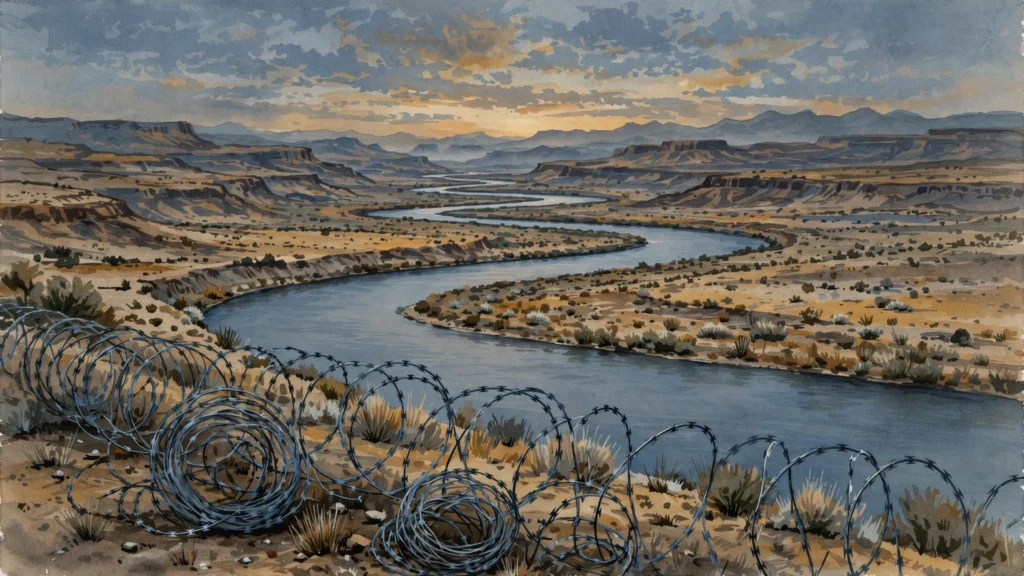
Border Security News: Texas Razor Wire Locked for 30 Years
In the latest border security news from Texas, the Trump administration has agreed with the state's outgoing Republican leaders that both sides will be barred from removing razor wire along a stretch of the United States-Mexico border for the next 30 years. On Wednesday, the two sides told a federal judge they wished to dismiss the lawsuit over the barrier, after reaching an unusual settlement to end a dispute that began more than three years ago. The deal, signed on November 18 and announced by Texas Attorney General Ken Paxton on November 19, binds the officials who signed it and their successors, including the Democrats who won Texas's top offices on November 3 and take office in January.
The agreement covers state-owned concertina wire on non-federal land within 25 miles of the border in the Border Patrol's Del Rio Sector, between Big Bend and Laredo, including Eagle Pass. Under its terms, federal agents may not willfully cut, damage, destroy, remove or otherwise interfere with the wire. The settlement lapses unless United States District Judge Alia Moses grants both requests the two sides made on Wednesday — to dismiss the case and to retain authority to enforce the deal — within 60 days of the agreement's effective date.
"Through coordination between federal and state authorities, this settlement ensures that concertina wire will remain in place to protect our southern border," Paxton said in a statement announcing the deal. Governor Greg Abbott lost his re-election bid on November 3 to Democrat Gina Hinojosa, and Paxton lost his Senate race to Democrat James Talarico. Before the Democrats take over the governor's mansion and the attorney general's office in January, the outgoing Republicans have written a border policy into a federal court agreement their successors cannot simply sign away.
Border Security News: What the 30-Year Deal Actually Says
The settlement was worked out in cooperation with Abbott, Homeland Security Secretary Markwayne Mullin and Customs and Border Protection Commissioner Rodney S. Scott, according to Paxton's office. It binds the Department of Homeland Security, Customs and Border Protection and the Border Patrol, including their current and future officials. Associate Attorney General Stanley E. Woodward Jr. signed for the Justice Department.
Its central promise is a list of "restricted acts" that federal agents have sworn off. For the next 30 years, federal agents and contractors may not willfully cut, damage, destroy, remove or otherwise interfere with any concertina wire owned or placed by the State of Texas on land the federal government does not own, within 25 miles of the border in the Del Rio Sector. The federal map attached to the settlement shows about 228 miles of border in the sector.
The exceptions are narrow. Federal agents may still cut the wire to administer emergency aid to someone facing imminent death, to apprehend and process people suspected of entering illegally, to respond to active safety emergencies, or to make emergency repairs to federal border infrastructure. In those cases, agents must notify Texas within 72 hours, giving the location, extent and reason, and make temporary repairs where feasible. New construction and routine maintenance require coordinating with the state in advance.
The deal cuts both ways. Texas has promised that it "will not undertake or authorize any Restricted Acts without the prior written consent of DHS," the same cutting and removing that federal agents swore off, outside of emergency aid or a real threat to officers or the public. Citing the federal rule on substituting public officers, the agreement says "all successors to the named Defendants and Plaintiffs in their official capacity are legally bound as if they were named in the Agreement." Abbott is a named plaintiff in his official capacity, so whoever holds his office next inherits his side of the deal — Hinojosa, who becomes governor in January, and Nathan Johnson, the Democrat who will become attorney general, as well as future senior officials in the Justice Department and the Homeland Security Department no matter who wins the presidency. The agreement also applies to subcontractors and to "all those in active concert and participation" with the government.
Immigration News: A Three-Year Legal Fight Comes to an End
The dispute began in October 2023, when Paxton sued the Biden administration after federal Border Patrol agents cut through spools of concertina wire that Texas had strung up near Eagle Pass. The wire was part of Abbott's effort to deter illegal immigration during a period of record crossings, and Paxton alleged agents were cutting it to help migrants cross. Texas quickly secured an emergency restraining order from a federal judge ordering federal agents to stop.
The legal fight bounced around the courts for three years. In January 2024, the Supreme Court temporarily allowed federal agents to keep cutting the wire while the case played out. Then, in November 2024, a three-judge panel of the Fifth Circuit Court of Appeals ruled two to one that federal agents could not interfere with the state's concertina wire fencing near Eagle Pass, subject to specified conditions. The federal government has been barred from removing the wire since that ruling, and the case has been pending in federal court in Del Rio ever since.
The settlement ends that case, The State of Texas v. United States Department of Homeland Security. In the joint filing on Wednesday, the Justice Department and the attorneys for Paxton and Abbott asked Judge Moses to dismiss the case. Neither side admits liability, and the federal defendants do not concede that Texas prevailed. Nothing in the agreement limits agents' authority to enter private land within 25 miles of the border to patrol for illegal entry.
Trump Administration: Why the Timing Matters
The settlement was signed less than two months before Abbott and Paxton leave office, and the timing has drawn the most attention of any part of the deal. Democrats decisively swept into nearly every statewide office in Texas in the November 3 midterms, and they also flipped the Texas House. Republicans keep a majority in the state Senate, with 19 of 31 seats and two vacant. Hinojosa has said she supports strong border protection, and she told Fox News on November 20 that she wants the federal government to put more resources along the border, calling it a federal responsibility to keep the borders intact and secure. She has also pushed back against the actions of Immigration and Customs Enforcement agents. "It is a separate thing, what ICE is doing, and then Border Patrol, and what they're doing on our border to secure our border," she said.
The New York Times, which first reported the settlement on Wednesday, described it as the latest example of a tactic the Trump administration has used repeatedly: settlements with friendly adversaries in which both sides agree to limit the government's powers far beyond their time in office, locking in shared political goals. Newsweek described the deal as showing "a Republican determination to entrench what they can of their immigration policy before the newly elected officials take office."
Spokespeople for Hinojosa and Johnson declined to comment to the Times this week. The Justice Department, Abbott and Paxton did not respond to the newspaper's requests for comment. The silence is itself significant: the agreement was written to bind them whether they like it or not, and any attempt to unwind it would now have to go through a federal judge rather than a governor's order.
DOJ News: The Critics and the Questions
Not everyone agrees the deal is good policy. Tom Jawetz, a former deputy general counsel at the Homeland Security Department under President Joseph R. Biden, told the Times he worried the restrictions would make it harder for Border Patrol agents to rescue people drowning in the Rio Grande, and said Abbott and Paxton had "simply gave away the state's ability to decide what to do with all of this concertina wire that it owns." He added: "There is no reasonable justification for tying Texas' hands to mitigate those dangers or to otherwise decide to remove its own razor wire."
The criticism points to a real tension. The wire was built to deter crossings, but the Rio Grande is a dangerous river, and agents have long cut through barriers to reach people in distress. The settlement's emergency exception covers aid to someone facing imminent death, with Texas to be notified within 72 hours. Whether the exception is broad enough to cover the rescues agents actually perform will only be answered the first time it is tested, and Jawetz's concern is that the legal risk will make agents hesitate in exactly the moments when hesitation costs lives.
There is also the question of how much the deal actually locks in. For all the headlines about a barrier that cannot be removed for decades, the agreement is narrower than it sounds. Texas has roughly 1,254 miles of border with Mexico, and this settlement applies strictly to non-federal land within 25 miles of the border inside the Del Rio Sector; wire in the El Paso, Big Bend, Laredo or Rio Grande Valley sectors gets no protection at all. And the deal is fragile in another way: it lapses entirely unless Judge Moses grants both requests within 60 days of its effective date. An incoming Democratic administration could argue that a lame-duck agreement cannot bind a future government to a policy it never chose, and a court would have to decide whether it survives that challenge.
What Happens Next
The next step belongs to Judge Moses, who must decide within 60 days whether to dismiss the case and retain authority to enforce the deal. If she grants both requests, the wire in the Del Rio Sector stays for 30 years, and the only way it comes down is with the written consent of the Department of Homeland Security or through the narrow emergency exceptions. If she does not, the settlement lapses, and the three-year legal fight over the wire would be back where it started.
Either way, the razor wire is now a legal question rather than a political one. When Hinojosa and Johnson take office in January, they will inherit a border policy written by the men they defeated, enforced by a federal court and binding on their successors for three decades. The wire strung up in the heat of a border crisis in 2023 is now, for the Del Rio Sector at least, a fixture of the landscape until 2056, and the fight over whether it should stay there has moved from the riverbank to the courtroom.
The Court Fight, Step by Step
The settlement closes a case that travelled through nearly every level of the federal courts, and the route it took explains why both sides wanted it over. Texas sued on October 24, 2023, after Border Patrol agents cut the wire near Eagle Pass, claiming the cuts destroyed state property. Chief US District Judge Alia Moses denied Texas a preliminary injunction that November, while sharply criticising the Border Patrol's conduct. A Fifth Circuit panel then barred the cutting pending appeal that December — only for the Supreme Court to vacate that order on January 22, 2024, and temporarily allow agents to keep cutting while the case played out. Justices Clarence Thomas, Samuel Alito, Neil Gorsuch and Brett Kavanaugh would have left the panel's order in place.
The turning point came on November 27, 2024, when a divided Fifth Circuit panel ruled for Texas. Judge Stuart Kyle Duncan, joined by Judge Don Willett, held that the state was likely to win its state-law trespass claim and that the Administrative Procedure Act waived federal immunity for the relief Texas sought. Judge Irma Carrillo Ramirez dissented. The court barred agents from damaging the wire "in the vicinity of Eagle Pass," but still let them cut it for enforcement or emergencies where they lacked access to both sides of the fence. The federal government has been barred from removing the wire since that ruling, and the case has sat in federal court in Del Rio ever since — until Wednesday's filing asked Judge Moses to end it.
The Fine Print: "Up to 30 Years" and the Dismissal Clock
For all the headlines about three decades, the paperwork carries a small puzzle. Paxton's press release headline says the wire will stay "for up to 30 years," while its text says the agreement remains in effect for 30 years, and the release does not explain the difference. The settlement also has a procedural tripwire the headlines skipped: within five business days of the effective date, both sides must ask the trial court to dismiss the case with prejudice and keep jurisdiction to enforce the settlement, and if the court does not act within 60 days, the agreement ends with no further legal effect. Judge Moses, the same judge who denied Texas its injunction in 2023, now holds the deal's fate in her hands.
One more silence stands out. As of Thursday, the Department of Homeland Security and Customs and Border Protection had not issued their own public statements on the agreement — the announcement came entirely from Paxton's office, with the signed agreement posted as a PDF. Newsmax, reporting the deal, framed it plainly: it preserves a signature measure of Abbott's crackdown on illegal immigration as Democrats prepare to take control of Congress and replace both Abbott and Paxton in January. Whether the wire survives as a fixture until 2056 now depends on a judge's signature, on whether the emergency exceptions work in practice, and on whether a court will let a lame-duck agreement bind officials who never signed it.
Source: The New York Times