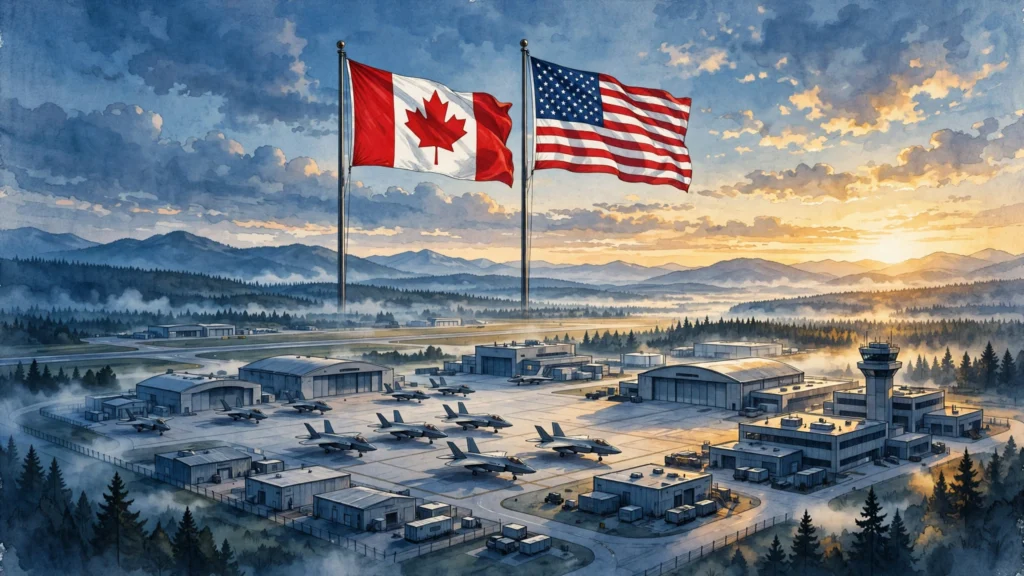
NATO News: Carney Says Trump Silent on Canada Military
In the latest nato news, Canadian Prime Minister Mark Carney said on Wednesday that President Donald Trump has not raised the Pentagon's sharp criticism of Canada's military with him. Carney, who speaks regularly with Trump, said their talks have focused on resolving conflicts around the world, not on the complaints about Canadian defense spending that the Pentagon published in a fact sheet on Monday. The remark came two days after that fact sheet accused Canada of falling short as a credible partner in defending North America.
"The commander in chief of the U.S. military is the president of the United States," Carney told reporters in Toronto. "And I can assure you that in my discussions with the president of the United States we're focused on conflict resolution around the world and he has not raised issues such as has been reported recently." His answer did not dispute that Canada's armed forces face readiness problems. Instead, it drew a line between the president and his Defense Department, framing the dispute as a disagreement with the Pentagon rather than a rupture between the two leaders.
The exchange matters because the relationship has been battered for months by a trade war, tariffs imposed by the Trump administration, and the president's repeated suggestions that Canada should become the 51st state. Carney's response was calibrated to cool that reading without conceding the Pentagon's claim, and without picking a public fight with a president he still has to work with on trade, Arctic security, and continental defense.
Pentagon News: The "Canadian Defense Shortfalls" Fact Sheet
The document at the center of the row is a Pentagon fact sheet published on Monday and titled "Canadian Defense Shortfalls." In unusually blunt language for an assessment of a close ally, the Defense Department said Ottawa had failed to make the tough decisions needed to modernize its military and meet its NATO commitments. "Canada's defense shortfalls speak for themselves," the fact sheet said. "Canada must get serious and focused." It added that the department stands ready to work with the Canadian Armed Forces to make the alliance stronger than ever, but only if Ottawa changes course.
The fact sheet put numbers to the charge. It said only 41.9 percent of Canada's air force fleet was serviceable in the 2025-26 fiscal year, and only 53.9 percent of its naval fleet was in working order. The army's operational readiness stood at 48 percent. The paper also said Canada's navy has just four aging submarines, only one of which is operational at any given time, and that Canada is entirely dependent on the United States and NATO to provide Airborne Early Warning and Control aircraft.
Defense Secretary Pete Hegseth was described in the fact sheet as "laser focused" on modernizing Canada's military after decades in which American taxpayers footed the bill for its homeland defense. The Pentagon accused Ottawa of having no credible, fully costed plan to meet NATO's target of spending 5 percent of gross domestic product on defense and related security investments, and of postponing the largest spending increases until after the 2029 federal election. It said Canada had promised to spend 2 percent of GDP on defense in 2006 and needed almost two decades to reach that target in 2025, by which time the alliance's commitment had already been raised to 5 percent. Canada's military did not immediately provide a substantive response when the fact sheet was published.
Carney's Answer: "He Has Not Raised Issues"
Carney's Wednesday remarks were his most direct response to the fact sheet, and he used them to defend what he called historic military investments, including higher pay for Canadian service members. "Canada is taking responsibility for our defense," he said. "We're at the front lines of NATO's defense." He pointed to Canada's deployment in Latvia, where Canadian troops lead a multinational NATO battle group, and to cooperation with the United States and European allies across the Arctic and Europe. The message was that the alliance should be judged by what Canadian forces actually do, not only by what they spend.
Canada reached NATO's previous 2 percent spending target, and its latest budget projects combined defense and security spending of 4.1 percent of GDP by 2027-28, including 2.6 percent for core defense. Simon Lafortune, a spokesperson for Canada's defense minister, said Canada had committed 81.8 billion Canadian dollars, about 56.9 billion American dollars, over five years to rebuild its armed forces, and had reached the 2 percent benchmark five years ahead of schedule.
Carney has also been candid about the scale of the problem. He has acknowledged readiness problems in the armed forces, saying only one of Canada's four submarines was seaworthy. His government has since named Germany's Thyssenkrupp Marine Systems as the preferred supplier for up to 12 replacement submarines, pending contract negotiations.
NATO News: The 5 Percent Pledge and the 2029 Review
The deepest disagreement between Washington and Ottawa is not about the past but about the future, and specifically about NATO's pledge to spend 5 percent of GDP on defense and related security investments by 2035. On Tuesday, Canadian Defense Minister David McGuinty told reporters that Canada is a sovereign nation and that it does not report to Washington. He insisted that Canada remained on track to meet the 5 percent pledge by 2035, while emphasizing that the allies had agreed to review the spending plan in 2029.
Not everyone in Canada is convinced the numbers add up. The country's parliamentary budget watchdog has questioned how the government will reach 5 percent, and the gap between the 4.1 percent projected for 2027-28 and the 5 percent target for 2035 is large. The Pentagon's fact sheet made the same point in blunter terms, accusing Ottawa of postponing the largest increases until after the next federal election. Carney's government has not published a detailed year-by-year path to 5 percent, the heart of the Pentagon's complaint about a credible, fully costed plan.
Stephen Fuhr, Canada's secretary of state for defense procurement, acknowledged the readiness shortfalls on Wednesday while insisting that the government is moving faster to fix them. "Our readiness has been not where we want it to be, and we all acknowledge that, but we're making great progress and changing it," he said. Fuhr said the government was accelerating purchases and recruitment, two areas where the armed forces have struggled for years. The Pentagon's warning that a mixed fighter fleet could worsen personnel shortages goes directly to that problem.
The F-35 Review and the NORAD Question
The most consequential decision hanging over the dispute is the future of Canada's fighter fleet. Carney put the planned purchase of 88 American-made F-35s under review as Trump imposed tariffs and threatened to make Canada the 51st state, and Canada has examined Swedish-made Gripen fighters as an alternative. The Gripen option would bring manufacturing jobs to Canada, which is part of its appeal, and it would reduce Canada's dependence on American weapons at a moment when the relationship with Washington is at its most uncertain in decades. In June, Carney said that Canada should no longer send three-quarters of its defense capital spending to America, a statement that captured the shift in thinking inside his government.
The Pentagon's warning about a mixed fleet is a technical one with strategic consequences. Operating two different fighter types would complicate training, maintenance, and spare parts, and it could worsen the personnel shortages that already limit the air force. It could also create uncertainty for NORAD, the joint command that defends North American airspace, which depends on Canadian and American aircraft working seamlessly together. The F-35 is the aircraft both countries' air forces are built around, and a Canadian decision to split its fleet would be felt in the command's daily operations. The review has become a test of how far Canada will go in rethinking a defense relationship built around American equipment for generations.
A Relationship Under Strain: The Hegseth Memo and Halifax
The Pentagon fact sheet did not arrive out of nowhere. It followed a classified directive from Hegseth that Senator Mike Rounds, a Republican from South Dakota, said largely restricts American military officials' participation in Canadian think tank events and social engagements. The directive was reported earlier in November, and the Trump administration had already barred Pentagon officials from attending the Halifax International Security Forum under restrictions imposed in 2025. At that forum, its president, Peter Van Praagh, a former adviser in Conservative Prime Minister Stephen Harper's government, warned on Friday that the United States can no longer be counted on as a predictable leader of the democratic world.
The reaction in Canada to the fact sheet was swift and sharp. Wesley Wark, a Canadian national security expert and former government adviser, titled his Monday newsletter "Pentagon Pete strikes again," calling the criticism "insulting and infuriating." The fact sheet was read in Canada as a political document as much as a military assessment.
In February, NATO Secretary-General Mark Rutte said he was "really proud" of the country, adding: "Canada is back in NATO, on the 2%, leading the charge when it comes to the support for Ukraine." Rutte measured Canada against the old 2 percent target, which it has met; the Pentagon measures it against the new 5 percent target and a readiness standard Canada's own leaders admit it does not yet meet.
What Happens Next: The 2029 Review and the Fighter Decision
The near-term calendar now gives both sides a series of moments to test each other's claims. The allies' agreed review of the NATO spending plan in 2029 will be the first formal check on whether Canada is on a credible path to 5 percent, and Ottawa will need to show a detailed plan by then, not just a target. Before that, the F-35 decision will signal how far Carney is willing to go in reshaping the defense relationship. A decision to proceed with all 88 jets would reassure Washington and NORAD. A decision to split the fleet, or to choose the Gripen, would confirm that Canada is prepared to accept friction with the Pentagon in exchange for greater independence.
The White House has not publicly responded to Carney's claim that Trump has not raised the Pentagon's concerns with him, and the president's own view of the dispute remains unspoken. Whether Trump shares the Pentagon's verdict will decide if the fact sheet was a single sharp message or the opening of a longer campaign. For Carney, the weeks ahead will be a balancing act: showing Washington that the money is real and the readiness is improving, while showing Canadians that he will not accept being lectured by the Pentagon about a country that he insists is sovereign.
Source: Associated Press