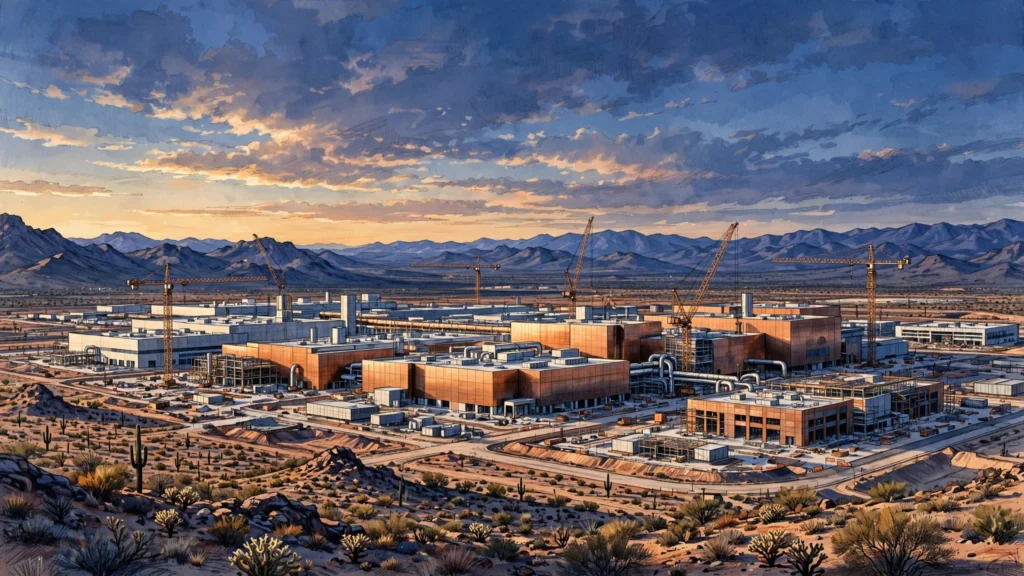
Semiconductor Chip News: Trump to Lead TSMC Groundbreaking
In the latest semiconductor chip news, President Donald Trump will headline the groundbreaking ceremony for TSMC's factory expansion in Phoenix, Arizona, on Friday, December 4, according to Bloomberg, which cited a White House official familiar with the plans. The ceremony marks the next phase of the Taiwanese chipmaker's vast manufacturing buildout in the Arizona desert, and puts the president at the center of an industry he has spent the past year pulling closer to Washington. The event has not yet been formally announced, and the official spoke on condition of anonymity, but the plan is already shaping a crowded week: Jensen Huang, the chief executive of Nvidia, is due to testify before the Senate the day before, on December 3, with his Phoenix attendance still unclear.
The visit would deepen a pattern that has defined Trump's second-term relationship with the semiconductor industry. In the space of a few weeks, the president has pressed Nvidia to reinstate Huang as its chief executive, floated a pardon for him, and now plans to stand at the site where the chips at the heart of the artificial intelligence boom are made in America. Senior TSMC executives are expected to attend, along with suppliers, customers, and business partners. The Phoenix facility produces Nvidia's Blackwell chips and advanced semiconductors for Apple and AMD, making it one of the most strategically important factories in the country.
Nvidia News: A Hearing the Day Before the Groundbreaking
The timing of the trip is no accident. On Wednesday, December 3, Huang is scheduled to appear as the sole witness so far at a Senate Banking Committee hearing titled "Protecting America's AI Advantage: Oversight of U.S. Export Controls." Two days earlier, on December 1, he has agreed to sit for a transcribed interview with three House committees examining national security concerns around Nvidia's advanced chips and his reported relationship with a woman suspected of ties to Chinese intelligence.
Trump has already weighed in on Huang's predicament in extraordinary terms. In an interview with the New York Post on November 24, the president said he would consider pardoning Huang if necessary, while urging him not to plead the Fifth Amendment when he testifies before Congress. No criminal charges against Huang have been publicly announced, and the Justice Department has said it has no evidence of wrongdoing by Huang or by Nvidia, which leaves the pardon offer as a precaution rather than a response to any case. Senator John Kennedy, a Republican from Louisiana, has predicted Huang will invoke the Fifth when he testifies, while Senator Elizabeth Warren, a Democrat from Massachusetts, has warned he will face hard questions from both parties.
Behind the personal drama lies a policy fight of enormous consequence. Three bills now before Congress would tighten China's access to advanced American chips further: the AI Overwatch Act, the Chip Security Act, and the Match Act, each taking a different approach to closing the gaps that lawmakers say have allowed advanced chips to reach Chinese buyers through intermediaries and third countries. An Artificial Intelligence Policy Institute poll found that 71 percent of American adults oppose Nvidia selling its chips to China, a figure that gives lawmakers in both parties a political incentive to take a hard line. Yet the politics are complicated by the president's own record: Trump last December gave the green light to sales of Nvidia's advanced H200 AI chips to China, a decision his critics now point to as evidence that his administration's approach to export controls has been inconsistent. That tension will be a central question at the December hearings, and the Phoenix ceremony puts the president on the industry's side of the argument the day after Huang is questioned about it.
AI News: What TSMC Is Building in the Arizona Desert
The scale of what TSMC is building there explains why a groundbreaking in Phoenix commands a presidential visit. The company announced a single fab in Arizona in May 2020, a roughly 12 billion dollar project that was supposed to begin production by 2024. In December 2022, TSMC tripled the plan to two fabs and 40 billion dollars. By April 2024 the commitment had grown to 65 billion dollars, and in March 2025 the company added another 100 billion dollars, taking the total to 165 billion dollars for six fabs, two advanced packaging plants, and a research and development center. A further 100 billion dollars announced in July 2026, for at least four more fabs for 2 nanometer and below technologies, brought the total pledged in Arizona to 265 billion dollars.
The first fab, known as Fab 21, is already in volume production on the 4 nanometer process, having reached that milestone in late 2024 with yields reported comparable to TSMC's plants in Taiwan. The first Nvidia Blackwell wafer came off the Phoenix line in October 2025. Blackwell chips power the data centers where the world's most powerful artificial intelligence systems are trained. Production began at a rate of about 10,000 wafers a month, with plans to scale up to 30,000. The second fab, built for the 3 nanometer process, has its structure complete and is being equipped for volume production in the second half of 2027. A third fab, planned for 2 nanometer and 1.6 nanometer chips, is under construction with production targeted for around 2029, and a fourth fab is expected to follow around 2030. The site sits at 5088 West Innovation Circle in north Phoenix.
The buildout has been supported by the federal CHIPS Act, under which TSMC received 6.6 billion dollars in direct funding, finalized in November 2024, plus up to about 5 billion dollars in loans. TSMC, founded in 1987, pioneered the pure-play foundry business and remains the world's leading dedicated foundry, manufacturing chips designed by other companies rather than selling its own. That is why the Phoenix fabs matter to so many American firms at once: the same lines that print Nvidia's Blackwell chips also make advanced semiconductors for Apple and AMD.
Artificial Intelligence News: Why the Phoenix Fabs Matter
The strategic case for making advanced chips in Arizona rests on three arguments, and the December 4 ceremony touches all of them. The first is supply chain resilience. The pandemic-era chip shortages showed how quickly a disruption on the other side of the world can idle American car plants and electronics factories, and the concentration of the most advanced chipmaking in Taiwan has long worried planners in Washington. The second is geopolitics: Taiwan sits at the center of the most dangerous flashpoint in United States-China relations, and making leading-edge chips on American soil is now treated as a national security asset. The third is the artificial intelligence race itself, the engine of the data center news cycle: the data centers being built across the United States need a reliable supply of the most advanced chips, and every month of delay in domestic production is a month in which that supply depends on factories an ocean away.
For all the scale of the investment, the Arizona project still has gaps that the groundbreaking will not close on its own. Wafers printed in Phoenix still travel to Taiwan for the most advanced packaging step, the process that stacks and connects finished chips into the packages that go into servers, and TSMC's own Arizona packaging plants are part of the later phases of the buildout rather than the current ones. TSMC has said that once the campus is complete, about 30 percent of its most advanced capacity could sit in Arizona, but that figure describes a finished campus, and as of October 2026 the site's leading-edge output was still at 4 nanometers. The December ceremony, in other words, celebrates a project that is very real and very large, but also very far from finished.
Trump Administration: A President Hands-On With the Chip Industry
In the latest trump news, the president's involvement with the chip industry in recent weeks has been unusually direct, even by the standards of a president who delights in intervening in corporate affairs. On November 23, Nvidia reinstated Huang as chief executive under pressure from the president, an intervention that itself raised eyebrows, since presidents do not ordinarily dictate who runs a public company. The Financial Times reported that the president's tech allies had lobbied him to defy the intelligence agencies and press for Huang's return, and the reinstatement followed. A day later, Trump floated the pardon. Now he plans to headline the groundbreaking for the industry's flagship American factory. Taken together, the three moves amount to a president placing himself at the center of the semiconductor story in the space of a fortnight.
The approach reflects a broader shift in how this administration pursues industrial policy. Where the previous administration leaned on the CHIPS Act's grants and loans to lure chipmakers, Trump has favored a mix of tariff threats, public pressure, and high-profile deals, extracting investment pledges and then appearing at the ceremonies that mark them. The TSMC announcement in March 2025, when the company added 100 billion dollars to its Arizona commitment, was made at the White House with the president present, and the December 4 event follows the same script. For the administration, the political payoff is straightforward: construction jobs and factory jobs in Arizona, a swing state, and a visible answer to the question of what "made in America" means for the most advanced technology on earth.
What Happens Next: December 3, December 4, and Beyond
The week ahead will be watched in Washington, Taipei, and Beijing alike. On December 1, Huang sits for his transcribed interview with the three House committees, and the answers he gives there will shape the questions he faces two days later. On December 3, the Senate Banking Committee hearing will put the export controls debate on television, with Huang as the sole witness named so far. On December 4, Trump will be in Phoenix, where the questions will be different: whether Huang joins him, what the president says about chip tariffs and export controls while standing in a fab, and whether the White House formally announces an event confirmed so far only through an anonymous official.
Beyond that week, the milestones are industrial rather than political. The second fab's tooling and qualification will determine whether 3 nanometer production really begins in the second half of 2027. The third fab's progress will show whether the 2 nanometer timeline holds. The packaging plants will decide whether Arizona can ever be a complete chipmaking ecosystem rather than the front end of a supply chain that still runs through Taiwan. And the three export control bills in Congress will decide how much of what Phoenix makes can be sold, and to whom. The December 4 ceremony is the easy part. The harder test is what gets built after the speeches end.
Source: Bloomberg