Stock Market Today: Futures Slip Before Inflation Data
The stock market today opened Wednesday in a cautious mood on Wall Street, as United States stock futures slipped overnight and traders braced for the October inflation report due on Wednesday morning. The move followed a split session on Tuesday, when the Dow Jones Industrial Average climbed back above 50,000 even as technology stocks sold off sharply, giving back part of the extraordinary rally that had lifted the whole market on Monday. With the market closed on Thursday for Thanksgiving, Wednesday carries an unusually heavy load of economic data, and the inflation numbers will shape how investors judge the Federal Reserve's next move in December.
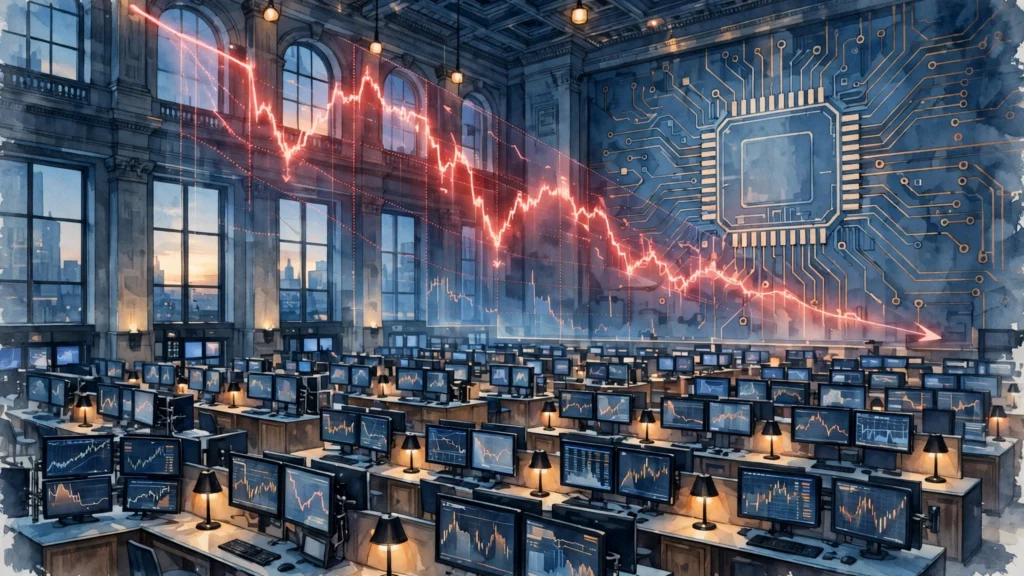
Tuesday told two stories at once. The blue-chip Dow rose about 423 points, or 0.85 percent, to close at 50,018.70, a sign that money was rotating into steadier parts of the market rather than leaving stocks altogether. The broader S&P 500 fell 0.50 percent to 7,201.09, and the technology-heavy Nasdaq Composite dropped 1.48 percent to 23,733.54, as the chip and artificial intelligence names that powered Monday's surge became the day's biggest losers. The split left Wall Street asking whether the artificial intelligence trade is cooling into a healthy pause, or whether Monday's rally was a brief interruption in a longer reckoning with high valuations and heavy spending.
Dow Jones Today: A Split Session on Wall Street
The dow jones today story only makes sense against the scale of Monday's rally. On Monday, November 23, the Dow surged 1,447.98 points, or 3.01 percent, to close at 49,595.31. The S&P 500 climbed 4.73 percent to 7,237.17, and the Nasdaq Composite jumped 6.51 percent to 24,089.56, with both indexes logging their largest one-day gains since April 2025. The trigger was Nvidia's announcement that its board had voted unanimously to reinstate Jensen Huang as chief executive, less than two weeks after he resigned, a reversal that President Donald Trump had personally pushed for and then celebrated.
Tuesday showed how quickly euphoria can give way to second thoughts. The Dow's gain to 50,018.70 meant the index not only held Monday's advance but pushed through the 50,000 mark, a round number traders watch closely. Yet the advance was narrow, driven by rotation into defensive and value names while the growth stocks that dominate the S&P 500 and the Nasdaq fell back. Small company stocks also held up better than the big technology names, suggesting investors were rearranging where their money sits rather than fleeing the market. Credit markets stayed firm, which traders read as another sign that Tuesday looked more like a sharp rotation than the start of a broad panic.
Nasdaq Today: Chip Stocks Lead the Retreat
The nasdaq today picture was dominated by the semiconductor companies that powered Monday's rally and were now giving much of it back. The iShares Semiconductor ETF plunged more than 8 percent at the close on Tuesday, while the VanEck Semiconductor ETF lost more than 7 percent, and the wider semiconductor group fell 7.9 percent. Memory chip makers, server companies and the cloud firms that rode Monday's wave were all lower, some sharply so, in a broad retreat across the infrastructure of artificial intelligence.
The selling spread across the Pacific overnight. Japan's SoftBank Group dropped 9.55 percent, Advantest plunged 12.54 percent, Tokyo Electron lost more than 10 percent, and Lasertec fell 10.45 percent. In South Korea, Samsung Electronics and SK Hynix fell 7.31 percent and 6.99 percent, while LG Innotek shed 6.68 percent. The scale of the Asian declines showed that the doubts about the artificial intelligence trade are not confined to American investors. Chipmakers in Tokyo and Seoul supply the memory and manufacturing equipment the whole boom depends on, and their shares are often the first place a change in sentiment shows up.
Nvidia Stock: Giving Back Monday's Surge
The nvidia stock story sits at the centre of the market, and Tuesday's decline must be measured against the scale of Monday's advance. Nvidia shares surged 31 percent on Monday after the board reinstated Huang, their best one-day percentage gain in more than 23 years, recovering nearly all the losses since his resignation was announced on November 12. The rally lifted the whole market, with the combined value of the seven largest technology companies rising about 1.65 trillion dollars in a single session.
On Tuesday, Nvidia fell 5.9 percent, giving back part of that gain and leaving the stock down roughly 25 percent for the month despite the rebound. The shares had fallen for seven straight sessions before Monday's announcement, and the rally did not erase the questions that drove the decline. Investors are still weighing the legal and political risks around the chief executive, who is due to sit for a closed-door interview with House committees on December 1 and testify publicly before the Senate Banking Committee on December 3, and whether the company's growth can keep pace with the expectations built into its share price.
Stock Futures Today: A Cautious Overnight Mood
The stock futures today picture reflects a market that is waiting rather than deciding. After Tuesday's close, futures tied to the Dow slipped 68 points, futures on the S&P 500 fell 0.2 percent, and Nasdaq 100 futures declined 0.3 percent. The moves were small, but they extended the day's theme: technology leading lower, the broader market holding up better, and nobody willing to make a large commitment before the morning's data. Later in the evening, futures drifted lower still, as the overnight mood in Asia fed back into American trading.
The caution is understandable given the calendar. Wednesday brings a pile-up of economic reports that would normally be spread across several days, compressed into one morning because the market closes Thursday for Thanksgiving and shuts early Friday. The reports include the October personal consumption expenditures price index, preliminary third-quarter gross domestic product figures, weekly jobless claims, durable goods orders, and personal income and spending data. Together, they will give investors their clearest picture yet of where prices, growth and the jobs market stand heading into the final weeks of the year.
Inflation Report: Wednesday's PCE Test
The inflation report due on Wednesday morning is the October personal consumption expenditures price index, known as PCE, the Federal Reserve's preferred gauge of inflation. Economists polled by Dow Jones expect the headline reading to rise 0.3 percent for the month and 3.8 percent from a year earlier. Analysts surveyed by Bloomberg expect the core PCE index, which strips out food and energy, to increase 0.3 percent month over month. The report is the last major inflation reading before the Federal Reserve's December policy meeting, giving it outsized importance in a week already short on trading days.
The number matters because inflation remains the biggest concern for American households, and because it shapes what the central bank does next. A reading in line with expectations would cool the argument that the Fed needs to tighten further, and could give buyers a reason to step back into technology shares after two days of selling. A hotter reading would do the opposite, lifting expectations for interest rates, pressuring growth stocks, and adding weight to worries about tariffs pushing import costs higher. The report arrives alongside the preliminary estimate of third-quarter gross domestic product, expected a touch above the previous 3.4 percent estimate, and the weekly jobless claims figures, arriving a day early because of the holiday.
Why Is the Stock Market Down Today?
The question of why is the stock market down today has a different answer depending on which part of the market is asked about, because Tuesday was not a uniform decline. The Dow rose. The S&P 500 and the Nasdaq fell. Chip stocks fell hardest of all. That split points to a rotation rather than a rout, with money moving out of the most expensive growth names into steadier corners of the market, a pattern that has defined much of the autumn.
Earnings have not settled the argument. Dell reported record revenue of 54.9 billion dollars in its fiscal third quarter, up 103 percent from a year earlier, with adjusted earnings of 9.45 dollars per share against a forecast of 6.61 dollars. Its artificial intelligence server revenue rose 291 percent to 22 billion dollars, and its order backlog hit a record 132.3 billion dollars. The company raised full-year revenue guidance to 202 billion dollars. The shares still fell nearly 12 percent, before recovering a little after hours. Ambarella told the other side of the story: revenue of 115.2 million dollars, earnings of 28 cents a share against the 32 cents expected, and fourth-quarter guidance of 70 to 75 million dollars, far below the 112 million Wall Street forecast. Chief executive Fermi Wang said customers cut outlooks because memory prices were rising and supply was tightening, and the shares lost more than 37 percent. Strong results did not save the shares, because in this market guidance matters more than the quarter, and guidance is where the doubts live.
What Happens Next
What happens next depends first on Wednesday morning's data. If the October PCE inflation report comes in as expected, with headline prices up 0.3 percent on the month and 3.8 percent on the year, the market may treat the last two days as a pause rather than a turn, and the rotation into the Dow's steadier names may broaden into a wider recovery. If the number comes in hot, pressure on technology is likely to build, expectations for the Federal Reserve's December meeting will shift, and the chip stocks that led the decline will be the first place investors look for further losses. The gross domestic product and jobless claims numbers arriving at the same time will either confirm an economy still growing, or complicate the picture.
For now, the market's message is one of patience wearing thin. Monday's rally showed how fast money can return when a single uncertainty is removed. Tuesday's sell-off showed how quickly it leaves when deeper questions remain unanswered. Wednesday's inflation report is the next chance for the numbers to speak, and Wall Street will be listening closely before the holiday quiet sets in.
Wednesday's Verdict: Hot Core, Then a Deep-V Recovery
The numbers came in almost exactly as forecast, and the market still fell apart in the morning. The Commerce Department reported on Wednesday that headline PCE rose 0.3 percent in October and 3.8 percent from a year earlier, matching expectations. Core PCE, which strips out food and energy, also rose 0.3 percent on the month, but its annual rate climbed to 3.3 percent, a tick above the 3.2 percent consensus and the highest since November 2023. Core PCE has now risen 0.3 percent for three straight months, and the annual rate is moving the wrong way, up from 3.1 percent in September.
The market's first reaction was brutal. Stocks plunged at the open as the hotter core reading collided with the administration's proposal for new tariffs on 14 trading partners and the AI sell-off that had already taken hold. The Dow shed 872 points, or 1.7 percent, in the morning, the S&P 500 sank 2.8 percent and the Nasdaq tumbled 4 percent, falling as much as 4.6 percent intraday. At the lows, roughly $3.6 trillion had been wiped from stocks, crypto and precious metals. The Nasdaq-100 briefly fell 20 percent from its record closing high, flirting with bear market territory. Nvidia fell another 5.1 percent in premarket trading, while AMD lost 6.5 percent, Micron 6 percent and Marvell 5.7 percent.
Then the market did something nobody in the morning expected. Bargain hunters and short-coverers drove a sharp afternoon rebound that clawed back almost everything. The Dow erased a 1,100-point loss to close up 164.25 points, or 0.33 percent, at 50,182.95. The S&P 500 finished down just 18.31 points, or 0.25 percent, at 7,182.78, after being down 3.2 percent intraday. The Nasdaq closed down 147.73 points, or 0.62 percent, at 23,585.80, after a 4.5 percent morning rout. The Russell 2000, the small-company index, added 0.7 percent to 2,704.06.
The rest of Wednesday's data pile added texture. Personal income climbed $201.8 billion, or 0.7 percent, in October, disposable income rose 0.8 percent, and personal spending advanced $63.8 billion, or 0.3 percent. Goods inflation cooled to 0.4 percent from 0.8 percent, and services eased to 0.3 percent from 0.4 percent. Asia followed overnight: Japan's Nikkei gained 1.6 percent and South Korea's index rose 1.9 percent.
What the Fed Does Next
The inflation report has settled one argument and sharpened another. The December rate decision is now treated as a done deal: markets price a 25-basis-point hike at the December 8-9 meeting as a certainty, with the CME FedWatch tool putting the odds at 97 percent, and a 63 percent chance of another increase in January.
The sharper argument is about 2027. Treasury yields fell after the release, and traders trimmed the odds of a third hike next year to about one in three, down from 50-50 the day before. The market is betting the Fed hikes twice and then stops, rather than starting a long tightening cycle. That is the bet the afternoon rebound was built on: inflation hot enough to force two hikes, but not so hot that the central bank has to keep going.
For investors, the lesson of the week is that the market can absorb a bad morning and still find buyers. Wednesday showed both sides of the AI trade in a single session: the morning's panic about debt-fueled spending and unproven returns, and the afternoon's conviction that the sell-off had gone too far. Whether the recovery holds into December depends on whether the companies at the center of the AI boom can show the returns investors are now demanding.
Source: CNBC