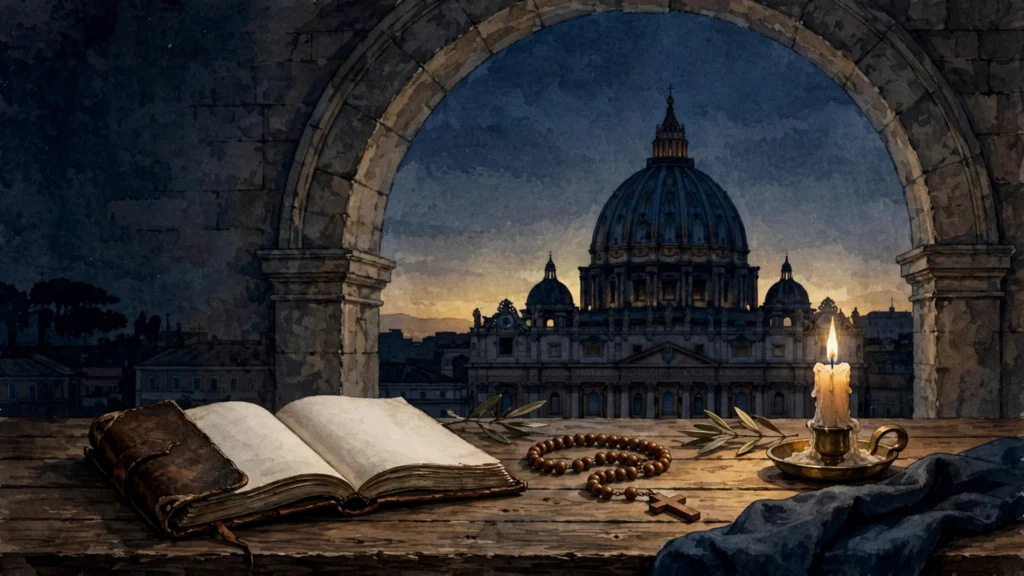
World News: Pope Francis Diaries Reveal Devil Visions
In the latest world news, the private diaries of the late Pope Francis have been published for the first time, offering an unusually intimate portrait of a pontiff who wrestled in private with visions of the devil, a two-year spiritual crisis tied to power, and the weight of leading the Catholic Church through years of reform. The 160-page volume, titled "The Private Diary of Pope Francis," was released on Tuesday, November 24, 2026, more than a year and a half after Francis died at 88. It was compiled and annotated by Cardinal Victor Manuel Fernandez, one of Francis's closest aides and a fellow Argentine, who arranged selected entries by theme and added his own commentary.
The diaries span nearly 32 years, from December 1992, when the future pope was an auxiliary bishop in Buenos Aires known as Jorge Mario Bergoglio, through August 2024, about eight months before his death. They contain little day-to-day Vatican politics. Instead, they focus on the inner life of a man who led the Church for 12 years: his prayers, his fears, his exhaustion, and his conviction that he had more than once come face to face with evil. The book also records his warm regard for his successor, Cardinal Robert Prevost, now Pope Leo XIV, whom Francis called an irreproachable man, a great pastor, and a generous missionary. The publication is a rare event: most recent popes directed that their personal papers be destroyed after their deaths, and the last pope whose diaries were published after his death was John XXIII, who died in 1963.
Breaking News: Three Encounters With the Devil
The most striking passages describe what Francis believed were encounters with the devil. In an entry from January 2021, written at the start of the spiritual crisis that would dominate the next two years of his life, Francis listed three occasions on which he believed he had seen the devil. Two took place while he was archbishop of Buenos Aires, one in a car on his way home and one in the choir loft during Mass. The third came after he had become pope, in a meeting with Vatican officials after his troubled 2018 visit to Chile.
Francis described the devil as having eyes of fire, calling them menacing and seductive at the same time. Writing about the first two encounters in an entry dated August 18, 2024, one of the last in the diary, he said he could not forget the figure's eyes. Of the third, he wrote that he saw the figure and heard a triumphant voice claiming to have obtained everything it wanted, that he could not forget the powerful raspiness of that voice, and that the Lord had given him a chance to leave the meeting, freeing him from it.
The diaries also record a vision of Hell. In an entry from June 2018, Francis wrote that he had seen the entrance to Hell the previous night, that he had peered inside for a moment, and that what he saw terrified him. He described it as a form of pagan seduction in full force, an apparent reference to the worship of idols, and wrote that he seized his rosary as a weapon and thanked the Lord for the help it gave him. In another passage from 2018, he wrote that a sense of self-sufficiency, and the belief that he could solve everything himself, had brought him to the gates of Hell.
Top News Stories Today: The Two-Year Crisis Over Power
At the heart of the book is the spiritual crisis Francis endured in 2021 and 2022, which Cardinal Fernandez describes as the worst trial that tormented the late pope. The crisis was not about doubt in the faith. It was about power: a temptation, or curiosity, as Francis himself called it, about what it meant to exercise power, and a growing sense of self-sufficiency fed by relentless activity and the pressure of governing a global Church of more than a billion people.
In a December 2022 entry, Francis wrote that the crisis was all mixed with governance issues, pressure over decisions he had to make, and a sense of aridity and desolation. Fernandez writes that Francis recognised it as the worst trial he had faced, and felt himself in a continual battle not to fall into demonic seduction. It coincided with intense pressure inside the Vatican, where his reform programme met open resistance from conservative cardinals who feared he would water down firm Church teaching.
The temptation Francis described was specific and painfully human: the pull toward using other people as instruments. In an entry dated December 30, 2022, he wrote that he refused the temptation to treat others like puppets. Fernandez recounts a scene from a meeting in 2023, when another bishop asked Francis why he had not dismissed an unnamed Vatican official who was speaking badly about him in public. After a long silence, Francis answered that he felt God did not want him to become a puppeteer who uses and manipulates people according to his own convenience, and that for this reason he preferred to let the official remain in his post.
That response captures the remedy Francis chose: greater humility and patience, even when it meant leaving in place officials whom others believed were undermining his papacy. As a Jesuit, he practised continuous spiritual discernment, examining whether he was working for his own interests or for the good of others. Feeling above the world through power, Fernandez writes, was for Francis the worst spiritual worldliness. That conviction shaped his papacy: he lived in a Vatican guesthouse rather than the grand papal apartments, wore plain black orthopedic shoes, and refused certain traditional papal vestments. Francis rarely took a day off, and in 2019 described himself as feeling exhausted.
Latest News From the Vatican: Chile and a Successor
Although the diaries offer few direct comments on the events of Francis's papacy, they do touch on the episode that caused him the deepest public damage: his handling of the clerical sexual abuse crisis in Chile. In January 2018, during a visit to Chile, Francis dismissed allegations against a bishop accused of covering up abuse by a priest, and his remarks were widely condemned. He later apologised and summoned all of Chile's bishops to Rome, where in an unprecedented move they offered their resignations together.
The diaries show how heavily the episode weighed on him years later. In a 2021 entry he wrote that he was devastated by the situation in Chile and by his exchange with journalists aboard the papal plane, adding that he had fallen off the cot, a phrase the book explains as meaning to suddenly wake up to something. It was hard for him to admit what had happened in Chile, he wrote, because he had not thought it was so serious. He later introduced reforms aimed at tackling clerical sexual abuse.
The book also reveals what Francis thought of the senior churchmen around him, including his successor. Francis had brought Cardinal Robert Prevost, an American, to the Vatican to lead the department responsible for appointing bishops, and according to Fernandez he called Prevost a great pastor, a generous missionary, and an irreproachable man. Prevost was elected pope in May 2025, weeks after Francis's death, and took the name Leo XIV. Francis was generous even to his critics: of Guinean Cardinal Robert Sarah, he said the cardinal had a refined spiritual sensitivity, and of German Cardinal Gerhard Muller, he said the cardinal seems aggressive, but he is a good man.
Francis recorded his own election with characteristic brevity. In a single entry in July 2013, more than four months after he became pontiff, he wrote simply that they had elected him pope on March 13. He had taken the name Francis, becoming the first pope from the Americas and the first Jesuit to hold the office. He died on Easter Monday, April 21, 2025, at 88, after being hospitalised with double pneumonia. His funeral, on April 26, 2025, in a packed St. Peter's Square, was attended by thousands of mourners, including heads of state from across the world.
News Today: Why Papal Diaries Are So Rare
The path from private notebook to published book is itself part of the story. Francis kept the diary intermittently in a small black-covered notebook that began life as a planning diary for 1992, writing 86 pages while he was in Argentina and 55 pages while he was pope. Fernandez does not reproduce the diary in full; he presents excerpts arranged by theme, with his own commentary. The volume was announced on October 5, 2026, when the Vatican Publishing House and the English-language publisher Image Books, an imprint of Penguin Random House, said it would be released in English and four other languages on November 24. The English edition was translated from the Spanish by Sister Bernadette Reis and annotated by Fernandez, who has headed the Vatican's Dicastery for the Doctrine of the Faith since 2023.
The decision to publish breaks with a long tradition of secrecy: for centuries, popes have treated their private papers as something to be destroyed, not read. John XXIII's "Journal of a Soul" became a spiritual classic after his death in 1963, and some papers of John Paul II were later made public despite his instruction that they be burned. Francis entrusted the notebook to Fernandez, a man he trusted deeply. That trust is what makes the book possible, and also what shapes it: readers see the diary through the eyes of an editor who knew Francis's mind and shared his reforming outlook.
What Happens Next
The book is now on sale internationally, with the English edition available in the United States and Canada through Image Books. In the coming days, theologians, historians, and ordinary readers will begin working through its 160 pages, and further passages are likely to be quoted and debated as the volume reaches a wider audience. The diaries will also be read against the early months of the papacy of Leo XIV, the successor Francis praised so warmly, as Catholics watch whether the new pope continues his predecessor's reforms.
For the Church, the publication raises a question that will outlast the news cycle: whether a pope's private spiritual writings belong to history or to the grave. Francis kept his diary for more than three decades and placed it in the hands of a man he trusted to decide what the world should see. The result shows the most public figure in the Catholic world at his most private: a man who believed he had looked into Hell and feared the seductions of his own power, and who answered that fear with humility.
Source: Reuters