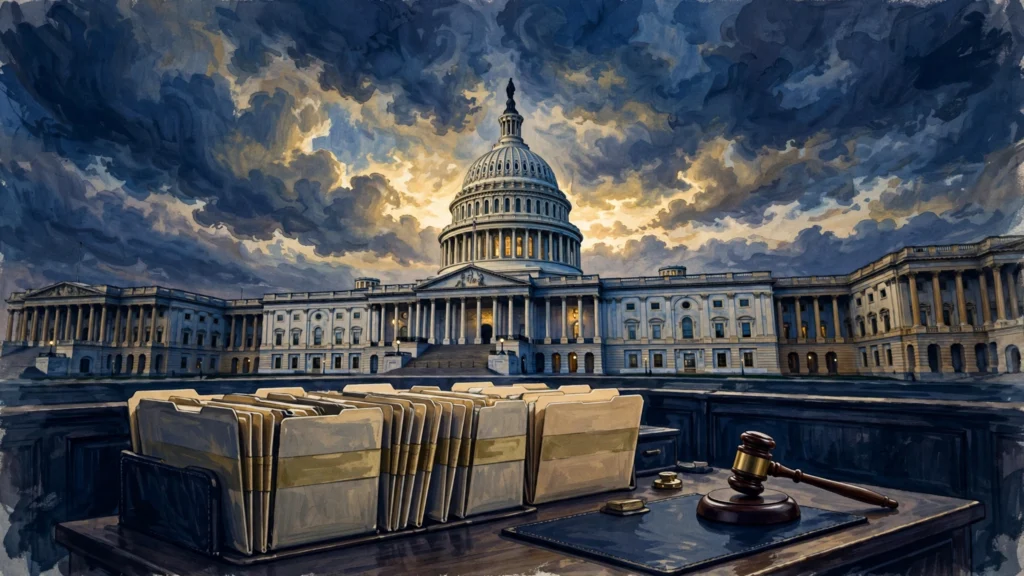
Trump News: Showdown With Congress Over Documents
The trump news out of Washington this week is a confrontation that has started before either side holds the ground it is fighting over. Democrats who will take control of Congress in January have accused the Trump administration of destroying government records and using disappearing messages to keep its work out of reach of future investigators, and they have sent a flurry of letters across the federal government demanding that officials preserve their documents and switch off auto-delete settings on encrypted messaging apps. The White House has answered that the Democrats are making claims without evidence, and that it sees no obligation to comply with their demands before the new Congress is sworn in. The standoff, reported by CNN, is already shaping up as the first major fight of the divided government that begins on January 3, and both sides are treating it as a contest that could end up in court.
At the centre of the dispute is a simple question with large consequences: what happens to the paper trail of a presidency in the weeks before its critics gain the power to demand it. Democrats are preparing far-reaching investigations into the Trump administration, and they fear that documents destroyed now will be gone by the time they hold committee gavels and subpoena power. The administration, for its part, says the Democrats are engaged in harassment dressed up as oversight, and that ranking members who do not yet chair committees cannot compel the executive branch to hand over anything. The letters flying between Capitol Hill and the White House this week are, in effect, the opening moves of a legal fight that will run through the first months of the new Congress.
White House News: The Preservation Letters
The most detailed salvo came from Representative Jamie Raskin of Maryland, the Democrat in line to chair the House Judiciary Committee when the new Congress convenes. In a series of preservation letters sent on Friday to the Department of Justice, the Federal Bureau of Investigation, the Department of Homeland Security, Immigration and Customs Enforcement and the Bureau of Prisons, Raskin raised concerns about the potential for document destruction across the agencies that will sit at the heart of Democratic oversight. The letters demanded that officials properly save documents and turn off auto-delete settings on encrypted messaging applications, and they warned that the destruction of records could draw serious consequences.
Raskin's language was blunt. He wrote in the letters that there is significant evidence that Trump administration officials have engaged in the widespread destruction, mutilation and concealment of government records, seemingly with the express purpose of circumventing federal record preservation laws. He added that the attempt to evade transparency extends to the highest levels of federal agencies, including top-ranking law enforcement officials. The letters did not merely ask agencies to keep their files in order. Raskin is also demanding that Attorney General Todd Blanche and other Trump officials open an inquiry into what documents may already have been deleted, and attempt to recover those records.
The letters pointed to a specific example that Raskin said illustrates the problem. He wrote that a Signal conversation between the general counsel of the FBI and an associate of Donald Trump Jr. appeared to have been set for messages to auto-delete after a week. According to Raskin, the conversation concerned a potential or ongoing investigation involving an individual wanted by federal authorities on health care fraud and related charges. The episode, he said, raises significant concerns that Justice Department and FBI officials are openly flouting federal law when it comes to the preservation of official government records. The committee declined to provide CNN with other examples of alleged document destruction, but Raskin described the Signal conversation as just one of many incidents already reported to the committee.
Other Democrats have raised similar alarms in their own letters. Representative Gregory Meeks warned earlier in the week of document destruction in his preservation letters, and specifically noted that Signal messages must be properly stored and not subject to automatic deletion. Congressional sources preparing investigations into Trump's construction projects around Washington told CNN that whistleblowers have warned that key paperwork has already been destroyed before Democrats take power. The picture emerging from the Democratic side is of a coordinated effort, spread across several committees, to put the administration on notice while there is still time to preserve what remains.
Congress: What the Law Requires
The legal backdrop to the fight is straightforward, even if its politics are not. By law, federal employees are required to preserve all records of their official work. They are allowed to use encrypted messaging applications like Signal, but they must correctly store the conversations in compliance with the law, so that the public record survives even when the messages themselves disappear from a phone. The Democrats' argument is that the administration is failing that test on a large scale, and that the use of auto-delete settings is a deliberate way of making sure the record does not survive.
Jim Secreto, who worked in the Obama White House Counsel's office on congressional investigations and compliance with the Presidential Records Act, told CNN that the preservation letters serve a purpose beyond the immediate demand. What the public is seeing in Congress with these document preservation letters, he said, is Congress drawing a line in the sand and maintaining a record so that if people do destroy records they could potentially be prosecuted in a future administration for obstruction of Congress. The letters, in his view, are as much about creating evidence for later as they are about stopping destruction now. It is the type of thing that a future Department of Justice could use as evidence in court of intent to destroy records, he added.
A Democratic source familiar with the effort put the same point more directly to CNN. We want them to be on notice that this behaviour is wrong, the source said. And if they are doing it, and especially if they continue doing it, we will draw inferences from your destruction of evidence. That is something that every litigant is familiar with, both in the civil and criminal context. The message is that the destruction of a document can itself become evidence, and that officials who delete records after receiving a preservation letter may find the deletion used against them.
Judiciary Committee staffers are planning to rely on whistleblowers and third parties to help them get the information they seek, and they are hoping that the preservation letters sent on Friday will put a stop to the use of Signal and auto-delete settings for official work by federal employees. The reliance on whistleblowers is a recognition of the limits of the Democrats' current position. They do not yet have the authority to compel document production with subpoena power, and until January they cannot force an agency to hand over a single file. What they can do is create a record of the demand, and hope that the warning itself changes behaviour inside the agencies.
Democratic Party News: The White House Pushback
The White House has pushed back hard, and its response has been as sweeping as the Democrats' accusations. White House Counsel Will Scharf sent letters earlier this week to Democratic committee leaders setting out the administration's position: no official has to comply with their demands to preserve or turn over documents and information because Democrats do not yet chair the committees. Scharf wrote that the purpose of the letters sent by Democrats is not legitimate oversight but to harass and aggrandize. He added that in the days since the November 3 election, several ranking members have sent letters to the executive branch demanding documents or information, and that some of these letters imply, without evidence, that thousands of United States government employees are conspiring to destroy documents in violation of the Federal Records Act.
A White House official told CNN that the administration complies with all federal record retention laws and regulations, and the agencies named in Raskin's letters offered similar assurances. A Justice Department official told CNN that the department follows all legal requirements for the management of federal records involving its official functions and decisions, adding that the department employees who work tirelessly to arrest and prosecute criminals will not be intimidated. A spokesperson for the Department of Homeland Security similarly said the department complies with all applicable federal laws, including as it relates to document retention, and that it responds to official correspondence through official channels.
The exchange has also produced a counter-letter of its own. On Thursday, Raskin received a preservation letter from US Attorney Aaron Reitz, who accused the Maryland Democrat of weaponizing his investigative efforts without a legislative purpose to go after Trump associates and the administration. The letter turns the Democrats' own tactic back on them, warning a future committee chairman that his own records and motives are under scrutiny. It is a sign of how quickly the fight has escalated from a dispute about filing cabinets into a contest over who gets to investigate whom, and on what terms.
Midterm Elections 2026: Why January 3 Matters
The reason this fight is happening now, weeks before the transfer of power, is the scale of the midterm result. Democrats won control of both chambers of Congress on November 3, taking the House with at least 258 seats and winning a Senate majority as well, in an election that delivered the largest midterm popular-vote margin since 1974. The new Congress takes its seats on January 3, and with it the Democrats gain the gavels, the subpoena power and the staff that turn oversight from a request into a demand. The preservation letters are, in that sense, a bridge between the election and the inauguration of the new Congress, an attempt to freeze the record in place during the weeks when the administration still answers to a Republican Congress.
The document fight is only one of several collisions building toward January. The government must be funded by December 11, and Republicans punted this year's appropriations bills to after the election, which means the lame-duck Congress will have to work with Democrats either to punt again or to pass bills funding the government until next fall. The fate of the Department of Homeland Security's funding is wrapped up in that negotiation, after Republicans tried to protect the administration's immigration policy by funding the department through the president's second term, a move Democrats will want to revisit once they take control.
The war in Iran is another front where the new balance of power will be tested. Trump wants Republicans to band together to exploit budget rules and write a 350 billion dollar check to the Pentagon without help from Democrats, while Democrats say they will try to use Pentagon funding to pressure the president to end the war. Forcing the president to abandon the war would be complicated, since the War Powers Act seemingly requires congressional approval for prolonged military action but the president has found ways around those provisions, and it would take 67 votes in the Senate to override a presidential veto. The Senate has already rejected a war powers resolution aimed at limiting the president's military authority, in a vote of 48 to 51 on November 19.
Air traffic control is a third test waiting in the wings. The shutdown that snarled American aviation showed that fixing the country's antiquated air traffic control system could hardly be more urgent, but the political conditions needed to modernise it look increasingly elusive, with the administration demanding tens of billions more in funding while newly empowered congressional Democrats warn there will be no blank check. Each of these fights will be sharper because of the document dispute, which has already convinced both sides that the other is acting in bad faith.
What Happens Next
The immediate question is whether the preservation letters change anything inside the agencies before January. The Democrats hope the letters put a stop to the use of Signal and auto-delete settings for official work, and that whistleblowers will come forward with evidence of what has already been lost. The administration's position suggests it will not volunteer cooperation before the new Congress is seated, and the letters from Scharf and Reitz indicate that the White House intends to fight the Democrats' oversight agenda on every front, including by questioning the legitimacy of the investigations themselves.
The longer question is what happens when the gavels change hands on January 3. Even though Democrats do not yet have the authority to compel document production, the preservation letters serve as a preview of what is to come, particularly if Democrats regain control of the White House in 2028. The letters create a record that a future Justice Department could use as evidence of intent, and they put every official who received one on notice that a deletion after the warning will be treated as deliberate. If the Democrats' investigations find that records were destroyed, the fight will move from Congress to the courts, where the question of obstruction and the scope of the Presidential Records Act will be argued in earnest.
For now, the showdown is a war of letters, fought in the open and in the language of the law. But the stakes are the record of a presidency, and the ability of the next Congress to hold it to account. The Democrats have drawn their line in the sand. The administration has said it will not step over it, because it does not recognise the line at all. January will show which side the law is on.
Stay with TrendSignal for the latest Trump news and fresh US news every day.
Source: CNN