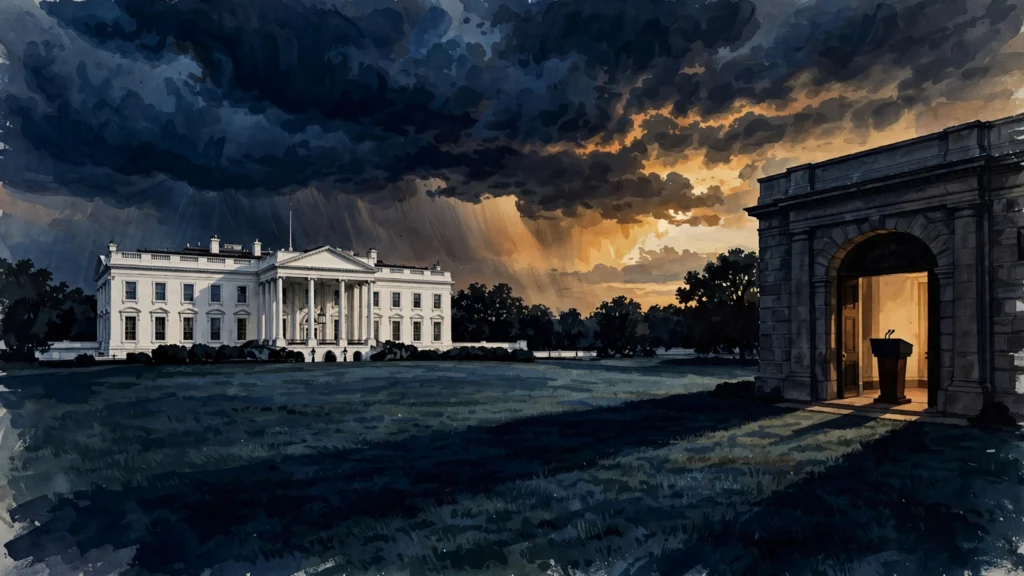
Trump Administration: Doubling Down After Midterm Losses
The Trump administration is not retreating after the midterm elections. President Donald Trump lost control of both chambers of Congress on November 3, watched his party suffer sweeping defeats in Senate races across deeply Republican states, and saw his approval rating sink below 35 percent. Yet when he returned from a swing through Asia and faced reporters for a 90-minute news conference on November 20, his message was defiance, not concession. He shrugged off the results, boasted about the reception he had received abroad, and made it plain that he intends to use every power of the presidency to frustrate the incoming Democratic Congress for the remaining two years of his term.
The tone of that appearance captured the strategy taking shape inside the White House. Trump told reporters that he had not been on the ballot and asked them to remember that. He introduced his new White House chief of staff, Stephen Miller, called him the most powerful man in the world, and even asked aloud whether Miller might one day run for president. It was the debut of a harder-edged team, assembled after a defeat, with a clear purpose: to hold the line against a Congress that is about to change hands, and to keep governing by presidential power where legislation is no longer possible.
Midterm Elections 2026: What Democrats Won
The scale of the Democratic victory on November 3 explains why the White House is bracing for confrontation. Democrats won control of both the House of Representatives and the Senate by wide margins, and they also scored wins in governors' races deep in Republican territory. The party flipped enough Republican-held House seats to win the chamber comfortably, and it was projected to win nearly every key battleground Senate race despite fighting on political terrain that strongly favored Republicans. Republican candidates lost Senate races in Texas, South Carolina, Kansas, Ohio and Iowa, states that Trump himself had carried by double digits in 2024 and where he had campaigned personally in the final weeks of the race.
Two results in particular underlined how far the political map moved. Texas had not elected a Democrat to the Senate since 1988, and Kansas had not done so since 1932, when Herbert Hoover was president. The outcome made Trump a lame duck in legislative terms for the final two years of his presidency, threatening the grip he has held on the Republican Party for the past decade, just as attention shifts to the 2028 race. Exit polls showed that most voters viewed the contest at least in part as a referendum on the White House, and Trump had embraced that framing, holding more than two dozen rallies in the closing stretch. His party still lost.
The new Congress will not be seated until January, but its leaders are already staking out their ground. Representative Hakeem Jeffries of New York, the House Democratic leader, is poised to become the next speaker of the House. Senator Chuck Schumer, the Senate Democratic leader, celebrated his party's gains and outlined lower health care costs and affordability as his party's priorities. In the House, Representative Robert Garcia of California is expected to become chairman of the Oversight Committee, and he has already told the White House to lawyer up. Investigations, hearings and possible impeachment proceedings against cabinet members are all on the table, and articles are already pending in the House to remove Pentagon chief Pete Hegseth.
Stephen Miller: The New White House Chief of Staff
The most visible sign of how Trump plans to meet that challenge is the man he has put in charge of his White House. Stephen Miller, the architect of the administration's mass deportation policy and one of its most combative voices, is the new White House chief of staff, the 33rd person to hold the job. Trump announced the appointment on November 6, and Miller replaced Susie Wiles, who had been the first woman to serve as White House chief of staff and has since returned to Trump's political operation. Miller took over the role on November 9 and made his first major public appearance in the job at the president's side on November 20.
Miller has been at Trump's side since the beginning, first as a speechwriter and surrogate, then as deputy chief of staff for policy and homeland security adviser, where he presided over the expansion of immigration enforcement and the use of aggressive deportation tactics. His promotion places the author of the administration's hardest-line policies at the center of its daily operations. At the November 20 news conference, Trump invited Miller to the podium near the end of the session, after Vice President JD Vance and Secretary of State Marco Rubio had spoken. "No president has done what he has done over the last two years," Miller said of Trump. "Under his leadership, the next two years are going to be the greatest two years in American history."
Trump, stepping back to the podium with a smile, replied that he did not think he could top that. The president then called Miller the most powerful man in the world and asked him, to laughter from the room, whether he wanted to run for president. The reaction from Democrats was swift. Jeffries, who will soon hold the speaker's gavel, told the New York Times that he could not envision sitting down with Miller, called him a stone-cold racist, and said he would refuse to deal with him. Trump defended his chief of staff the following day, and Democratic groups have seized on Miller as a fundraising target, casting him as the new face of the administration.
Trump News: The Four Levers of Power
Trump still has far-reaching power, and he laid out how he intends to use it. The first lever is his role as commander in chief. White House officials say he is considering whether to escalate the war in Iran, a conflict he initially predicted would take only weeks when it began on February 28 but which is now nearing the nine-month mark. Congressional Democrats are debating whether to risk a government shutdown by refusing to appropriate more money for the war, a difficult step to take while American troops are deployed in harm's way. Elizabeth Saunders, a political science professor at Columbia University, told USA TODAY that the power of the purse is very difficult to wield in wartime, and that Trump still has control over troop movements and military operations. Despite the Democrats' resounding midterm win, she said, they cannot do much to constrain the president's day-to-day foreign policy decisions.
The second lever is the veto, and the stroke of the pen. Trump dodged a question about whether he planned to meet with Jeffries, and instead offered an observation aimed at the incoming Democratic leaders. "You know, the president of the United States, meaning any president, has two extreme powers; one is the power of pardon and the other is the power of the veto," he said. With his signature, he added, a president can also issue executive orders. He predicted a long standoff of veto after veto, but said that after a month or so he would start offering terms: he would veto unless they agreed to this and that. At the same time, he said he was open to dealmaking, mentioning health care in particular: "If they want to get things done, I want to get things done, too."
Investigating the Investigators: Oversight Meets the Justice Department
The third lever is the fight over investigations themselves. Congressional Democrats are preparing to launch investigations of Trump, his administration and his family as soon as they gain the power to subpoena documents and convene hearings in January. Garcia has already released a dozen letters to Trump officials and family members demanding that they preserve documents that are likely to be subpoenaed, declaring that this is just the beginning. White House counsel Will Scharf immediately responded with a letter of his own, effectively dismissing the demands on the grounds that Democrats are still in the minority and therefore lack the authority to issue them. The White House has said it would cooperate with congressional oversight it sees as legitimate, but Trump has called the Democratic inquiries extortion and said he was ordering the Department of Justice to look into what he described as a criminal act.
Scharf had already warned Garcia that the administration might launch criminal probes into what he called abusive and capricious threats, writing that threats to officials designed to deter them from public service may cross the line into blatant criminality. Legal scholars describe that warning as a stretch, because the Constitution specifically protects lawmakers from criminal prosecution for official legislative acts connected to a legitimate legislative purpose. The fourth lever is the broadest: pushing the envelope of presidential power itself. During his second term Trump has sought to expand presidential powers, challenging and sometimes ignoring the traditional constraints of Congress, the courts and independent agencies, and that has led to a flood of lawsuits, court decisions and appeals, many of them reaching the Supreme Court.
Bob Bauer, who served as White House counsel during Obama's midterm reversal, told USA TODAY that Trump can continue to threaten or pursue weaponized use of the Department of Justice to punish enemies and reward friends, issue executive orders with immediate effect, and take unilateral actions in foreign and national security affairs on no basis other than his belief that he can or should be able to do as he pleases. Trump dismisses the criticism. "I have the right to do anything I want to do," he has said, asserting a sweeping interpretation of Article II of the Constitution. "I'm the president of the United States."
What Happens Next: A Democratic Congress Meets a Defiant White House
The next test comes in January, when the new Congress is seated and the balance of power changes in fact rather than in prospect. Democrats will be able to subpoena documents, drag administration officials to Capitol Hill for hearings, and conduct investigations with the full force of the legislative branch behind them. As Bauer put it, a solid Democratic majority can block judicial nominees, define the national policy agenda by passing legislation that requires the president to sign or veto, and exercise its oversight and investigative functions to pressure the administration. But he added that there was a significant qualification: no president's constitutional powers are small, and Trump's willingness to ignore legal constraints and longstanding norms makes him harder to check than his predecessors.
Stay with TrendSignal for fresh US news every day.
Source: USA Today