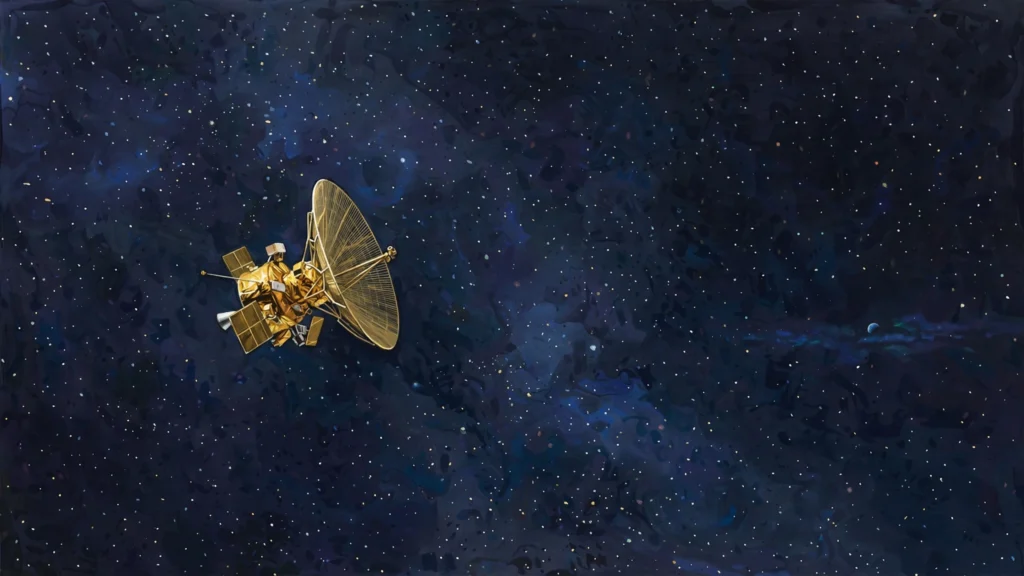
NASA News: Voyager 1 Goes Silent at One Light-Day
The nasa news from the edge of the solar system this week is a study in contrasts: a historic milestone reached in silence. On November 14, the Voyager 1 mission team became aware that the spacecraft had stopped sending science and engineering data. A NASA Deep Space Network antenna in Canberra, Australia, had locked on to the spacecraft and received its carrier signal, the steady radio tone that carries data from the probe to the ground, but the tone carried no data at all. Four days later, on November 18, Voyager 1 crossed one light-day from Earth, becoming the first human-made object ever to travel so far that a radio signal, moving at the speed of light, needs a full twenty-four hours to reach it. NASA confirmed the crossing on November 19, using the carrier signal and trajectory calculations, and celebrated the milestone at the Jet Propulsion Laboratory in California. The spacecraft that made history did so without a voice.
The twin facts define the moment. Voyager 1 is alive, its antenna still pointed at Earth and its transmitter still broadcasting, but it is not telling NASA anything about itself or about the space around it. The carrier signal proves that the probe's Attitude and Articulation Control computer is doing its job, holding the spacecraft steady and aimed home, and that its antenna and broadcast equipment still work. The absence of data points to the onboard computer that collects readings from the spacecraft's subsystems and formats them for transmission. Engineers are working to determine the cause and the next steps, and they have warned that the diagnosis may take weeks or longer, because every exchange with the probe now takes two full days.
Science News Today: What One Light-Day Means
One light-day is a distance measured in time. Light travels about 186,000 miles every second, and in a full day it covers roughly 16.1 billion miles, or 25.9 billion kilometres. That is how far Voyager 1 was from Earth when it crossed the mark at 10:16 a.m. UTC on Wednesday, November 18, or 5:16 a.m. Eastern time. At 2:16 a.m. Pacific time that morning, NASA's mission page placed the spacecraft about 16.094 billion miles from home. The distance is roughly 173 times the span between Earth and the Sun.
The crossing also set a new record for long-distance communication. A radio command leaves Earth and travels a full day to reach the probe, and any reply needs another day to come back, so a single round trip now takes forty-eight hours. That delay is not an abstraction for the mission team. It shapes every decision they make about the spacecraft, because a command sent today cannot be confirmed until the day after tomorrow, and a mistake cannot be corrected any faster. NASA will celebrate the milestone on November 19, a day after it was reached, once the signal arrives — a delay that illustrates the difficulty of operating a machine a full day of light travel away.
The milestone itself needed no telemetry to confirm. Engineers could establish the crossing without any new science or engineering data, because trajectory calculations built on years of measurements fix the spacecraft's position, and because Voyager 1 is travelling away from Earth at a consistent speed on a known trajectory and has no way to change its speed, no onboard fault could shift the date. The carrier signal narrowed the search for what went wrong, and the trajectory fixed the milestone. At the mark itself, the spacecraft registers no change in its surroundings.
Technology News: The Silence and What NASA Knows
The problem began on November 14, when the Canberra antenna locked on and found a bare carrier wave. The steady tone proved that a transmitter more than sixteen billion miles away was alive and still aimed at Earth, but the science readings and engineering status reports that normally ride on that wave had vanished. NASA disclosed the data loss on November 18, in a mission update that said engineers were working to determine the cause of the issue and the next steps. The presence of a carrier signal means the attitude control computer is doing its job and the broadcast equipment works. The lack of data suggests the issue is with the onboard computer responsible for collecting the data from the spacecraft's various subsystems and putting it into the right format to be transmitted.
The mission team is investigating whether the current issue is connected to a brief communications gap the spacecraft experienced in October, when the mission lost all contact with Voyager 1 for about forty-eight hours. That silence began on October 18, and the spacecraft eventually began communicating again with no intervention from the space agency. Engineers have so far determined that one group of thrusters went offline and their backups turned on, a swap that is programmed to occur automatically if the spacecraft's computers detect something wrong with the active thrusters. The automatic response, known as fault protection, puts the spacecraft in a safe, stable configuration and pauses normal operations while engineers diagnose the issue. It is not yet known whether the October episode and the November silence share a cause, and the team has not ruled out a connection.
There is a precedent for the current trouble, and it is guiding the search. In November 2023, almost exactly three years before the current silence began, Voyager 1 began sending back useless repeating patterns of ones and zeros instead of readable data. The team eventually determined that the issue stemmed from a small portion of corrupted memory in the flight data subsystem, one of the spacecraft's three onboard computers, and after a few months of troubleshooting engineers devised a software update that worked around the defective hardware. By June 2024, NASA was able to announce that the spacecraft was back in action. Operators listen daily but send commands weekly, so isolating the fault may take weeks.
Space: A 49-Year-Old Machine Running on Borrowed Power
Voyager 1 left Cape Canaveral on September 5, 1977, aboard a Titan IIIE-Centaur rocket, on a mission that was originally planned to last about five years. It will be half a century since the launch in 2027, and the spacecraft has outlived every expectation set for it, surviving on engineering that was designed in the 1970s and on power that declines a little every year. It draws electricity from three radioisotope thermoelectric generators that convert heat from decaying plutonium into current, and the supply shrinks steadily as the plutonium decays. Keeping the probe alive has become an exercise in triage, switching off instruments and heaters one by one to save enough power for the systems that matter most.
The triage has accelerated this year. NASA's instrument table, last updated on April 17, 2026, lists the cosmic ray instrument as shut down on February 25, 2025, and the low-energy charged particle instrument on April 17, 2026. Only two instruments remain switched on today, and one of them is the plasma wave subsystem, the instrument whose readings confirmed the spacecraft's crossing into interstellar space years ago. In early September 2026, engineers tried a subtler manoeuvre to stretch the remaining power, switching off three devices and activating three lower-power substitutes at the same moment, a swap designed to keep the spacecraft's essential functions running on a shrinking budget. Every fault is judged against that hard limit: there is no spare electricity for a workaround that costs energy the spacecraft does not have.
The age of the machine is the other half of the story. The Voyagers were built with an impressive amount of fault protection, and that protection has contributed to their extraordinary longevity, but glitches are understandable and likely in a spacecraft approaching its fiftieth year. The current silence is the latest test of a system that has been patched, coaxed and nursed through nearly five decades, and the engineers who maintain it have learned to be patient, because the spacecraft gives them no choice.
What Happens Next
The immediate work is diagnosis, and it will be slow. A radio wave, which is a form of invisible light, takes twenty-four hours to reach the probe, and any signal it sends takes twenty-four hours to reach Earth, so each step in the investigation consumes two days. The team will send commands and wait, listen for a response, and send the next command based on what comes back, or on what does not. The process that took months in 2023 could take as long this time, and NASA has been careful not to promise a quick fix.
The mood at the Jet Propulsion Laboratory, where the mission is run, is nonetheless upbeat. Suzanne Dodd, the project manager, was at Thursday's celebration of the light-day milestone, and she told reporters that the team has a very strong carrier signal and that she is confident it will not be too long before the spacecraft sends data back. Her confidence rests on the same evidence NASA cited in its update: the carrier wave proves the spacecraft is pointed at Earth and its transmitter works, which means the failure is confined to the part of the machine that gathers and formats data, and that is a problem the team has solved before. The spacecraft has gone quiet before and come back, most recently after the forty-eight-hour silence in October, when it resumed communicating with no intervention at all.
Whether Voyager 1 speaks again, and when, will be decided by the slow exchange of commands and replies across a light-day of empty space. If the data returns, the mission will continue its slow drift outward, sampling a region no other human-made object has reached. Either way, the milestone stands. On November 18, 2026, a machine built in the 1970s became the first object ever made by human hands to travel a full light-day from Earth, on a trajectory set nearly half a century ago. That is the achievement the week will be remembered for, whatever the silence turns out to mean.
Source: NASA