Pentagon News: Trump-Class Warships Cost $275 Billion
In the latest pentagon news from Washington, the cost of President Donald Trump's planned fleet of new battleships has become one of the most expensive arguments in American defense policy. A report from the Congressional Budget Office has put the price of building fifteen Trump-class warships at about 275 billion dollars, with the first ship alone estimated at 23.4 billion dollars. The figures have turned a presidential showpiece into a test of what the United States can afford, and with Democrats set to take control of Congress in January, the program's future is now openly in doubt.
The Guardian reported on the warning this week, drawing on the budget office's August assessment of a program that has grown far beyond its original description. When Trump unveiled the ships in December 2025, they were presented as the centerpiece of a new Golden Fleet, a return to the age of the battleship with modern weapons. Less than a year later, the independent cost estimate suggests the fleet would be the most expensive surface ship program in American history, with a single vessel costing nearly twice as much as the most expensive aircraft carrier ever built. The question now facing Congress is whether the ships are worth that price, or whether the money should go to the destroyers, submarines, and carriers the Navy already struggles to build on time.
The story of the Trump-class begins at Mar-a-Lago. On December 22, 2025, Trump stood between easels holding renderings of futuristic, nuclear-armed warships and announced a new class of large surface combatants that would carry his name. He said the ships would bristle with lasers, electromagnetic railguns, and hypersonic missiles, and he said they would be built in about two and a half years. The Navy had announced the class a day earlier, on December 21, describing it as the Trump class and naming the first vessel the USS Defiant. The initial announcement spoke of two ships, followed by eight more. By the following month, at a Navy symposium, the plan had grown to fifteen ships over thirty years, with as many as twenty-five possible in total.
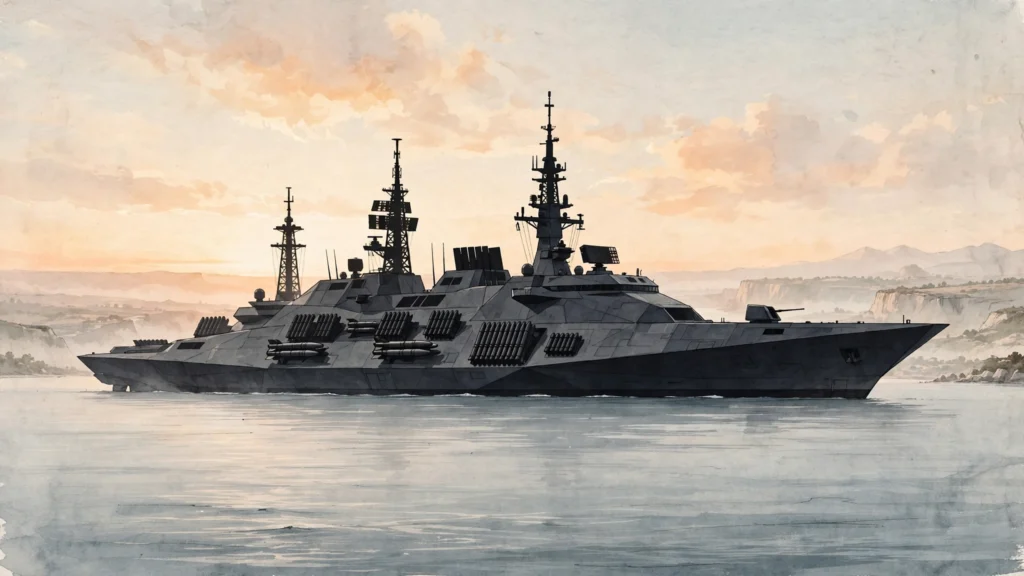
The ships as described would be unlike anything the Navy operates today. They would displace about 35,000 tons, roughly four times the size of an Arleigh Burke-class destroyer and close to the size of the historic Iowa-class battleships that last served in the early 1990s. They would carry 128 vertical launch cells for missiles plus twelve larger launchers for hypersonic weapons, along with nuclear-armed cruise missiles, high-energy lasers, an electromagnetic railgun, and close-in defensive weapons. The Navy has described the design, designated BBG(X), as the most heavily armed warship it will ever have built. The ships are intended to carry more weapons than existing destroyers, launch large hypersonic missiles against distant targets, coordinate naval operations and air defenses, and replace the command capabilities lost as the older Ticonderoga-class cruisers retire.
Trump Administration: The Price Keeps Climbing
The cost of that ambition has climbed at every step. Early discussion of the ships, before the formal announcement, put the price at about 4 billion dollars per vessel. The Navy's own estimate later placed the first ship at 15.1 billion dollars, with the next two at about 10.2 billion dollars each, but those figures assumed conventional propulsion. In May 2026, when the Navy published its annual thirty-year shipbuilding plan, it confirmed that the new battleships would be nuclear powered, a decision that added substantially to the up-front cost. The Congressional Budget Office then published its own analysis on August 5, 2026, and the numbers were far higher than the Navy's. The budget office estimated the first ship at 23.4 billion dollars, with each of the following fourteen vessels averaging about 18 billion dollars, bringing the fifteen-ship program to approximately 275 billion dollars.
The comparison that has done the most damage to the program is with the aircraft carrier. The Ford-class nuclear-powered aircraft carrier, currently the most expensive warship in the world, costs roughly 13 billion dollars to procure. The first Trump-class ship would cost nearly twice that, despite being smaller than a carrier. The budget office noted that the first battleship would cost about as much as one Ford-class carrier plus one Columbia-class ballistic missile submarine, the two most expensive vessel classes the Navy has ever made. The office also calculated the trade-off in destroyers: the Navy could buy about five Arleigh Burke-class destroyers for the price of one proposed battleship, and when measured in missile capacity, one battleship's 128 launch cells compare with 480 cells across six destroyers that cost roughly the same amount.
The schedule has slipped alongside the price. The Navy's shipbuilding plan calls for procuring the fifteen ships between 2028 and 2056, with the first vessel not expected to enter service until 2036 and delivery estimated around 2034. Keel laying for the first ship is projected for 2028 or 2029 at the earliest. Trump had said the ships would be built in about two and a half years, but the Navy's own timeline stretches more than a decade from announcement to service.
The industrial problem is as serious as the financial one. Only two American companies build large surface combatants for the Navy, and both are fully contracted. Only two shipyards are qualified to build nuclear-powered vessels, and there is only one supplier of naval reactors, with capacity already heavily committed to aircraft carriers and submarines. The budget office warned that the Navy's projection for shipbuilding activity is so large that it is likely to strain the industrial base, and the long-range plan calls for increasing large combatant production by 60 percent by 2035. Shipyard workforce shortages and rising costs are already straining established programs, including Arleigh Burke destroyers, frigates, and large uncrewed surface vessels. Critics of the program argue that adding a battleship class on top of that workload risks disrupting the carrier and submarine schedules the Navy cannot afford to miss.
Midterm Elections 2026: Democrats Target the Program
The political ground shifted under the program in November. Democrats won decisive victories in the midterm elections and will take control of both the House and the Senate in January, giving them leverage over defense authorizations, appropriations, and committee leadership that they did not have when the battleship was announced. The warship, which the Navy has said would be the most expensive in its fleet, is now one of the Democrats' prime targets in the Pentagon's historic 1.5 trillion dollar budget request, a package that includes a 1.1 trillion dollar standard budget, a separate 350 billion dollar reconciliation package, and a 67 billion dollar request to pay for the Iran war and National Guard deployments.
Representative Adam Smith, a Democrat from Washington state who is seeking to become chairman of the House Armed Services Committee in January, has made the battleship a symbol of what he considers misplaced priorities. In a letter to Democratic colleagues, Smith wrote that the country needs an appropriate mix of high-end survivable systems and lower-cost attritable capabilities, meaning cheaper uncrewed platforms whose loss in battle would be acceptable, and not a fleet of nuclear-powered battleships as proposed by the president. After the budget office published its report in August, Smith called the program an ill-conceived vanity project. Representative Seth Moulton, a Democrat from Massachusetts, went further during a June hearing, calling the ship the most expensive sitting duck in world history.
The funding fight has already begun in the Senate. The Senate Appropriations Committee's proposed fiscal 2027 defense spending bill would eliminate 1 billion dollars requested for advanced procurement of the battleship and 836.9 million dollars for research, development, and preliminary design, according to Naval News. The Navy had requested 1 billion dollars to begin work on the battleship as part of the Pentagon's standard 1.1 trillion dollar request. The administration proposed 65.8 billion dollars for shipbuilding in its 2027 budget, including initial funding for the Golden Fleet, but the appropriators' move would strip the battleship's near-term money almost entirely. The House has also acted: its version of the fiscal 2027 defense authorization bill includes a provision, Section 131, that would block any work on the USS Defiant until the Navy certifies that key weapon systems are sufficiently mature.
Retired Rear Admiral Mark Montgomery, speaking to the military technology website The War Zone, summed up the program's predicament after the election. Given the midterm election results, he said, the battleship program is now aground and taking on water. The Times of London reached a similar conclusion, reporting that with Democrats soon to take charge of the House and Senate, the Golden Dome missile shield and the golden fleet of nuclear-powered battleships look set to be axed or at least starved of funds to make progress unsustainable.
White House News: The Case for the Battleship
The administration and the program's supporters have not conceded the argument. Their case starts with the destroyer fleet. Backers of the new warship argue that the Navy's existing Arleigh Burke-class destroyers do not have the space for more missile-launching tubes and modern weapons, such as hypersonic and electronic weapons, and that a larger hull is the only way to carry the weapons the Navy says it needs for a war with a peer adversary. The battleship, in this telling, is not a vanity project but a response to a real capability gap, a ship large enough to carry the missiles, sensors, and command facilities that smaller vessels cannot fit.
The second argument is industrial. The administration has presented the Golden Fleet as a way to revive an American shipbuilding sector that has fallen far behind China in overall production capacity. Navy Secretary John Phelan has pushed for open competition among shipyards such as Huntington Ingalls and General Dynamics in order to scale construction cost-effectively and avoid the delays that have plagued programs like the Littoral Combat Ship and the Constellation-class frigate. The White House has argued that a large, sustained shipbuilding program would force investment in yards, workers, and suppliers that the country needs whether or not the battleship itself is the right ship.
The third argument is about China and the balance of naval power. The ships are intended to restore visible maritime superiority over China and Russia, and the administration has framed them as a statement that the United States will not accept second place at sea. Trump insisted his Golden Fleet shipbuilding program would produce a warship one hundred times more powerful than any battleship ever built, a claim that his critics treat as characteristic exaggeration but that captures the political purpose of the program: a ship that looks as powerful as the country it represents.
The critics have answers for each of those points. On capability, they note that the railgun technology at the heart of the design is unproven, using electricity to propel a projectile dozens of miles at up to seven times the speed of sound, and that the Navy previously abandoned the railgun program after years of work. On the industrial argument, they point out that the shipyards are already at capacity and that adding a new class risks delaying the carriers and submarines that matter most. The last battleship class the Navy operated, the Iowa class, was decommissioned in March 1992, when the USS Missouri left service, and critics say there was a reason no more were ordered.
What Happens Next: A Budget Fight in January
The immediate future of the Trump-class will be decided in the budget process that begins when the new Congress takes its seats in January. The Senate appropriators have already signaled their intent by proposing to strip the program's near-term funding, and the House Armed Services Committee under Democratic leadership is expected to take a skeptical view of the authorization as well. The Pentagon's overall request of 1.5 trillion dollars, which the war secretary, Pete Hegseth, is seeking for next year, is already considered by Democrats to be far in excess of reality, and the battleship is the easiest large target inside it.
The administration still has cards to play. The program has supporters in Congress, including Republicans who see shipbuilding jobs in their districts and defense analysts who believe the Navy genuinely needs a larger surface combatant. A Republican-controlled House Armed Services Committee previously required the Navy secretary to report on how the battleship program would avoid disrupting carrier and submarine production, with a report due no later than March 1, 2027. The Navy could also scale the program down, building fewer ships or deferring the most expensive systems, to bring the price into a range Congress will accept.
What the program cannot do is escape the arithmetic. At 23.4 billion dollars for the first ship and 18 billion dollars for each one after it, the Trump-class is the most expensive warship the United States has ever tried to build, and it arrives at a moment when the Navy is already struggling to deliver the ships it has promised. The Golden Dome missile shield faces the same problem on a larger scale, with the Pentagon estimating 185 billion dollars up to 2035 and the budget office estimating 1.2 trillion dollars over twenty years. The midterm elections gave the program's critics the votes to act on their doubts, and the funding bills now moving through Congress will show whether the battleship survives as a ship, shrinks into a study, or disappears into the history of ambitious defense programs that cost too much to build.
Source: The Guardian