Pete Hegseth News: Secret Memo Restricts Canada Defense Ties
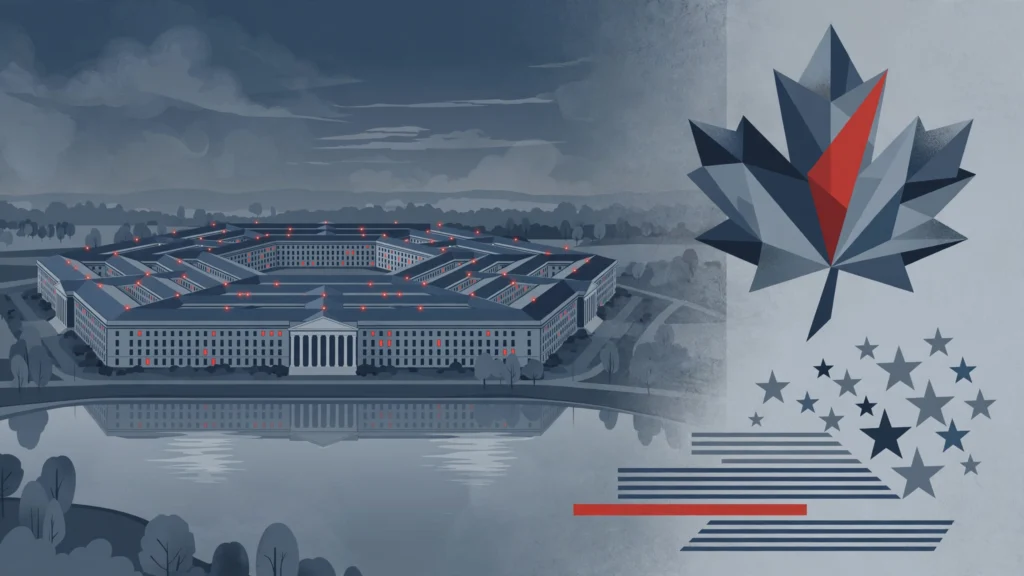
In the latest pete hegseth news from Washington, Defense Secretary Pete Hegseth has imposed new restrictions on the defense relationship between the United States and Canada through a classified memorandum circulated last week, according to a report published Friday by The Washington Post. The newspaper said the guidance had not previously been reported and cited American officials familiar with the directive, who spoke on the condition that they not be named because the matter is sensitive. The Post said it had not reviewed the classified memo itself, and the Pentagon has not publicly identified which military programs or activities the new restrictions will touch.
The report lands at a moment when the relationship between the two neighbors is already under unusual strain. The United States and Canada have been each other's closest defense partners for generations, sharing the longest undefended border in the world, a joint command for North American air defense, and membership in the NATO alliance and the Five Eyes intelligence partnership. That history is precisely why the memo has drawn so much attention: a quiet administrative directive, issued in secret and described only by anonymous officials, is now the latest step in a confrontation that has already covered trade, tariffs, defense spending, and the president's repeated suggestion that Canada should join the United States as its fifty-first state.
What the restrictions will mean in practice is still unclear. The Pentagon has confirmed the broad direction of the policy while declining to spell out its details. The White House, asked about the report, referred questions to the Pentagon, and the Canadian Embassy in Washington did not respond to the newspaper's request for comment.
Pete Hegseth News: What the Secret Memo Actually Does
The core of the story is simple to state and hard to measure. Hegseth issued guidance last week that narrows the scope of military cooperation between the United States and Canada, according to officials familiar with the directive. The memo is classified, which means its precise terms are not available to the public, to reporters, or, apparently, to many of the officials who would normally explain a policy change of this kind. The Post reported the existence of the directive and its general thrust, but not its text, and the War Department has not filled in the blanks.
One American official who spoke to the newspaper was blunt about how the decision would land in Ottawa. The restrictions, the official said, were sure to be seen as a slap in the face to the Canadians, and they raise questions about how the two militaries' interaction will be curtailed. That phrasing matters, because it suggests the officials describing the memo expect the reaction in Canada to be political as well as practical. A bureaucratic adjustment to cooperation would not normally be described that way. A gesture meant to send a message would.
The Pentagon's public response did not dispute the report. Sean Parnell, a spokesman for Hegseth, said the department was taking steps to ensure that its engagements with Canada advance tangible American defense objectives and ultimately support what he called a reinvigorated defense relationship. In the same statement, Parnell said the department was prioritizing opportunities for bilateral cooperation that strengthen the defense of the two homelands and the shared hemisphere, while supporting Canada's ability to meet its NATO obligations. The language is carefully chosen: it presents the restrictions not as a rupture but as a rebalancing, a way of making sure that cooperation with Canada serves American interests first.
That framing leaves the most important question unanswered. The directive raises obvious questions about joint military exercises, training exchanges, defense planning, and other forms of day-to-day cooperation between the two armed forces, but there is no confirmation that any of those specific activities has been restricted. The memo's classified status means the public cannot check the Pentagon's account against the document, and the department has not said which programs fall inside the new limits and which fall outside them. Until it does, allies, lawmakers, and the Canadian government are left to read between the lines of a statement that says a great deal about intent and very little about scope.
Pentagon News: What Stays Untouched — NORAD, NATO, and Intelligence
There are, however, clear limits to what the memo does, and the Pentagon has been explicit about them. According to Parnell, the guidance will not affect defense intelligence sharing between the two countries. It will not affect how the American and Canadian militaries work together through the NATO alliance, which also includes European allies. And it will not affect the bilateral North American Aerospace Defense Command, known as NORAD, the joint command that monitors and defends the airspace over both countries and provides maritime warnings.
Those carve-outs are significant, because they cover the parts of the relationship that matter most to the defense of the continent itself. NORAD is a genuinely joint enterprise: American and Canadian officers work side by side at its headquarters in Colorado, watching the skies and the maritime approaches of both nations around the clock. Intelligence sharing, meanwhile, runs through channels built over decades, including the Five Eyes partnership that also includes Britain, Australia, and New Zealand. The Pentagon's insistence that both remain untouched suggests that the memo is aimed at the discretionary edges of the relationship — the exchanges, visits, planning sessions, and cooperative programs that are useful but not essential to immediate security — rather than at the core machinery of continental defense.
The Pentagon's carve-outs also raise a question about the memo's real purpose. If the most important forms of cooperation are untouched, then the restrictions are aimed at something else: at sending a signal and applying pressure. That reading fits the administration's broader approach to its allies, which has consistently tied American support to measurable spending and to visible deference to American priorities.
Pentagon News: The Defense Board Already Suspended
The memo does not arrive out of nowhere. It follows an earlier Pentagon decision to suspend American participation in the Permanent Joint Board on Defense, a bilateral advisory body established in 1940 to coordinate continental security between the two countries. The board is one of the oldest institutions of the American-Canadian defense relationship, created in the early years of the Second World War, when the two governments first agreed to plan the defense of North America together. Suspending participation in it was itself a striking step, and the Pentagon at the time accused Canada of failing to make sufficient progress toward its defense commitments.
That earlier decision sets a pattern. The administration's complaints about Canada's defense effort have been consistent and public, and they have escalated from words to institutional consequences. In September, Hegseth met with Canadian Defense Minister David McGuinty and emphasized the importance of Canada meeting its increased spending commitments and strengthening its military capabilities. The meeting was presented as a routine discussion between counterparts, but the message was unmistakable: Washington expected more from Ottawa, and it expected it soon.
The pattern continued this week at the Halifax International Security Forum, the annual gathering of defense officials, lawmakers, and analysts in Nova Scotia. The Trump administration barred Pentagon officials from attending the forum under restrictions imposed in 2025 on participation in think tank events, a break with the practice of previous Republican and Democratic administrations, which had regularly sent senior military officials, including defense secretaries, to the conference. A bipartisan delegation of American lawmakers attended this year's gathering anyway, but the absence of the Pentagon was conspicuous.
The forum's president, Peter Van Praagh, warned on Friday that the world could no longer count on the United States as a predictable leader of democratic nations. Without the United States as a predictable leader, he said, people, institutions, and countries are looking for a new course, a North Star. No single country can replace the heft of the United States, he added, but maintaining those ideals is up to all of them. McGuinty, speaking at the same forum, warned that longstanding international security arrangements were undergoing fundamental changes. Institutions like NATO have always been vital to collective security, he said. They just cannot be our only way of working together. Those days are over.
The two speeches, delivered on the same day the memo became public, captured the mood in Halifax: an alliance system built on American predictability is being asked to imagine a future in which that predictability can no longer be assumed. The memo is one more piece of evidence for that argument, and the forum is where the argument is being made in public.
White House News: A Trade War That Came First
The defense tensions follow a sharp deterioration in trade relations since President Donald Trump returned to office in January 2025. The administration has imposed tariffs on Canadian steel, aluminum, automobiles, and other products, arguing that the measures protect American workers, manufacturers, and national security interests. The White House has also cited concerns about fentanyl trafficking across the northern border and Canada's trade barriers, particularly protections for its dairy industry. Administration officials maintain that Canada's policies disadvantage American exporters and that tariffs provide leverage to secure fairer trading arrangements.
Canada has responded with retaliatory tariffs and accused Washington of undermining a longstanding economic partnership. Canadian Prime Minister Mark Carney has sought stronger economic and security relationships with Europe, China, and other partners to reduce Canada's dependence on the United States, a strategy that has become the defining feature of his government's foreign policy. The search for alternatives is not theoretical: it involves real negotiations, real agreements, and a real reorientation of a trading relationship that has been built around the American market for generations.
The friction has not stayed confined to trade policy. Days before the memo became public, Hegseth posted an image from a Canadian cadet training branch showing a young cadet receiving an award, accompanied by a Canadian flag emoji and the caption "this is real." The post was widely interpreted as mocking the cadet's appearance and the Canadian military. McGuinty described it as below the dignity of the office. Carney added that any renewal of trade discussions would require the United States to cease what he called memes, shade, and tough talk and adopt a serious approach. The Pentagon responded that the post speaks for itself, offering no further comment. The episode was small in itself, but it fed the same sense in Ottawa that the relationship is being conducted in a register — public, personal, and deliberately provocative — that previous administrations avoided.
The trade dispute and the defense memo are formally separate, but they are part of the same argument. The administration's position, in both cases, is that Canada has treated American businesses unfairly while failing to contribute enough to its own defense. Canada's position is that the two countries built something valuable together over decades and that Washington is now dismantling it piece by piece.
Trump Administration: Annexation Talk and the Fifty-First State
Hanging over all of it is the president's repeated suggestion that Canada should become the fifty-first American state. Canadian officials said initially that they thought Trump was speaking in jest, but the president has doubled down on the talk repeatedly, and Canadian leaders have firmly rejected it. Carney eventually told Trump during an Oval Office meeting in May 2025 that Canada is not for sale and will not be for sale, ever. Trump acknowledged then that Canada was stepping up militarily, a concession that seemed, briefly, to lower the temperature.
It did not last. Trump renewed his criticism of Canada on Friday, following a meeting with Carney in China. For some reason they feel emboldened, he told reporters at the White House. We cannot let them feel that way anymore. The remark was aimed at Canada's search for partners beyond the United States, and it captured the administration's frustration with a neighbor that is responding to American pressure by looking elsewhere.
The annexation talk, the tariffs, the cadet post, and now the classified memo form a pattern that is hard to miss. Each step on its own can be explained away — a joke, a negotiating tactic, a social media post, a bureaucratic adjustment. Taken together, they amount to a sustained campaign of pressure on a country that has been, for most of living memory, America's closest and least complicated ally. Whether that campaign is a strategy or a series of impulses is a question the memo does not answer, but it is the question that will shape how Canada responds.
US Politics: What Canada Has Actually Done on Defense
The administration's central complaint is that Canada has not carried its share of the defense burden, and on the numbers there is a history to the argument. Canada lagged behind NATO's defense spending targets for years, and American officials in both parties have pressed Ottawa to spend more. But the recent record is more complicated than the complaint suggests. Canada announced earlier this year that it had reached NATO's previous defense spending target of two percent of gross domestic product, and Carney said in March that Canada had boosted its defense spending to that level. NATO members have since agreed to a broader goal of spending five percent of GDP on defense and related security needs by 2035, a target that will test every member of the alliance, including the United States.
The deeper history cuts against the idea that Canada is a free rider. The two countries are founding members of NATO, organized in the aftermath of the Second World War, and they coordinate daily at NORAD headquarters in Colorado to protect the skies and maritime boundaries of both nations. Canadian troops have fought alongside American forces in several conflicts, including Afghanistan, where 158 Canadian service members were killed. The two countries share a border of 5,525 miles, the longest international boundary in the world, and they have maintained close military and intelligence ties for decades.
None of that history makes the current dispute disappear, but it does explain why the memo has been received in Canada as something more than a policy adjustment. For a country that has sent its soldiers to fight and die alongside Americans, a secret directive restricting cooperation — delivered without warning and described by an American official as a slap in the face — reads as a judgment on the relationship itself. The Pentagon's insistence that intelligence sharing, NORAD, and NATO cooperation are unaffected may be technically accurate, but it does not address the political message the memo sends, and in diplomacy the message is often the policy.
What Happens Next: A Relationship Being Redefined
The first question is how Canada will respond. Carney has already made his strategy clear: deepen ties with Europe, China, and other partners, reduce dependence on the United States, and insist that Canada will not be bullied into concessions. The memo gives that strategy new urgency, and it may accelerate decisions — on weapons procurement, on intelligence partnerships, on trade — that were already moving in that direction. Canada has also sought to reduce its reliance on American weapons, a shift that would have been unthinkable a few years ago and now looks like a deliberate policy.
The third question is what happens to the institutions that have held the relationship together. The Permanent Joint Board on Defense is already suspended. The Pentagon is absent from Halifax. The memo restricts cooperation in ways that have not been specified. Each step weakens a different piece of the architecture, and the architecture was built on the assumption that both sides wanted it to last. If that assumption no longer holds, the two countries will need something to replace it, and neither side has said what that might be.
For now, the most honest description of the situation is that a secret memo has made a public argument. The argument is about what the United States expects from Canada, what Canada owes the alliance, and whether a partnership built over eighty years can survive a president who treats it as a transaction. The memo does not settle that argument. It escalates it, and it does so in the dark, where the ally it targets cannot see the terms. That is why the story matters, and why the reaction in Ottawa — and in Halifax, and in the capitals of the other Five Eyes countries — will be watched so closely in the days ahead.
Source: The Washington Post