Trump News: Arch Block Extended as Families Object
In the latest trump news from Washington, the legal fight over President Donald Trump's planned 250-foot triumphal arch has reached a new stage, and the families of the men and women buried at Arlington National Cemetery are at the center of it. A federal judge on Wednesday extended her order blocking construction through December 3, as lawsuits pile up from the Kennedy family, Vietnam veterans, and the governments of Washington, D.C. and Virginia. On the same day, the Justice Department asked the judge to throw the Kennedys out of the case, arguing that the family has no legal right to challenge a monument it says would cast a shadow over the graves of a president and two senators.
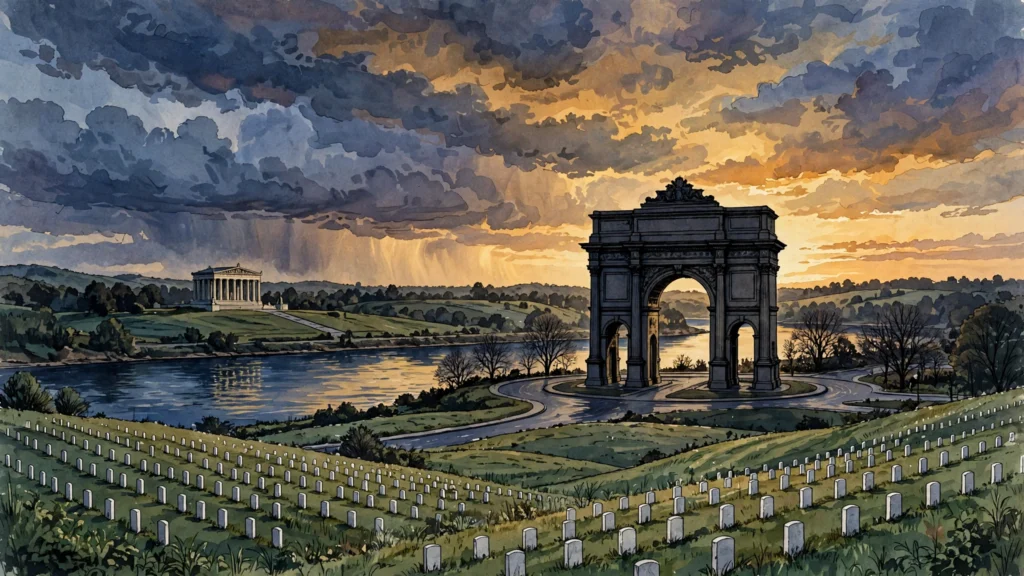
The arch would stand in Memorial Circle, the grassy traffic circle at the Virginia end of the Arlington Memorial Bridge, between the Lincoln Memorial and Arlington National Cemetery, the final resting place of more than 400,000 service members, veterans and their relatives. For the families of the fallen, the question is not abstract: the arch would loom over the ground where their loved ones are buried, and where 24 to 27 funerals are held every weekday.
Trump Administration: The Arch the White House Wants
The Trump administration describes the arch as a tribute to the nation's 250th birthday and to the troops, modeled on the Arc de Triomphe in Paris and rising 250 feet, about as tall as a 25-story office building. At that height it would stand more than twice as tall as the Lincoln Memorial, topped with gold statues and its own eternal flame. The plan also includes an open-air observation deck that would tower 161 feet above the surrounding landscape, a feature that was not in the original design and has become a separate source of anger for military families.
Trump has also described the arch as a working military asset. Speaking on November 2 at an event about improvements to the Lincoln Memorial Reflecting Pool, he said the structure could house drones and snipers. The White House has said the arch will enhance the visitor experience at Arlington National Cemetery for veterans, the families of the fallen, and all Americans alike. Construction, by the administration's own estimate, would involve 20-hour work days at the edge of a cemetery where funerals take place every weekday.
White House News: A Year of Approvals, Then a Judge Stepped In
The administration pushed the arch through the federal approvals process over the past year, and the pace quickened sharply this month. The National Capital Planning Commission gave the project its final green light late on Thursday, November 5, and officials had said they could break ground in Memorial Circle that same day. Within moments of the late-night approval, District Court Judge Tanya Chutkan stepped in with an order blocking construction for two weeks. Her order was initially set to expire on Thursday, November 19, but on Wednesday she extended it through December 3.
One of the main arguments against the arch is that it cannot lawfully be built without congressional approval, which the Trump administration has not sought and has said it does not need. The administration maintains that the project is justified by a century-old authorization for two never-built columns at the same location. That reasoning did not convince the judge. Writing last week, Chutkan said of the columns argument that merely to state it is to reveal its flaws.
Kennedy Family: Nine Relatives Join the Fight
The most personal challenge to the arch arrived on Tuesday, November 10, hours before Veterans Day, when nine members of the Kennedy family asked a federal judge to block the project. The plaintiffs include children of Senator Robert F. Kennedy and Ethel Kennedy and a son of Senator Edward M. Kennedy, all three of whom are buried at Arlington National Cemetery.
The family's 27-page filing argues that the arch would obstruct the view between the Lincoln Memorial and the cemetery and permanently cast shadows over the graves of servicemen and women, including the Kennedy gravesites. Rory Kennedy and Maxwell Kennedy said in a statement that a towering arch casting shadows across the graves of their father, mother and uncles, and of so many who served, would also cast a shadow over democratic principles. The filing says the arch constitutes nothing less than a permanent denigration of the Kennedy gravesites.
President Kennedy himself visited the cemetery and stood where he is now buried, and the vista looking back toward the District was one of his favorites. Looking out, he remarked that he could stay there forever. Its eternal flame has burned since his funeral in November 1963. A Washington Post analysis cited in the filing found the arch would darken John F. Kennedy's memorial on 50 days of the year and briefly block the eternal flame on almost half of those days, and the Kennedys said they often visit their family's graves in the morning, exactly when the shadows would be most pronounced.
DOJ News: The Justice Department Says the Kennedys Cannot Sue
On Wednesday, the Justice Department urged the Washington federal judge to reject the Kennedy family's request to join the legal fight, arguing in a filing in the U.S. District Court for the District of Columbia that the family has no right to intervene. Government lawyers argued that the family's claimed injuries are entirely visual and emotional, and as a result do not give them a basis to sue. The brief added that trees already cast shadows on the gravesite, and that the difference between that shade and the arch's is the family's distaste for the arch.
The Justice Department also argued that the family's interests are already represented by a group of Vietnam War veterans, who have argued that the arch will impede symbolic views between the cemetery and the Lincoln Memorial. And it pointed to a recent Supreme Court order finding that a historic preservationist likely cannot challenge Trump's project to build a new White House ballroom. Max Kennedy, one of Robert Kennedy's sons, told NPR that his family is acting to protect Arlington National Cemetery from the arbitrary, capricious vanity of one man, and that if the arch is a great idea, it should be brought before Congress, follow the rules and get approved.
Supreme Court: The Ballroom Precedent Hanging Over the Case
The Supreme Court now casts a long shadow over the arch fight, even though the justices have not yet touched the case. The administration wants the case thrown out because the plaintiffs lack standing, the same reasoning the Supreme Court used in the White House ballroom dispute. But Chutkan has said that Washington, D.C. and Virginia likely do have standing, given the financial and logistical harms they would suffer.
The case, Lemmon v. Trump, combines two lawsuits: one brought earlier this year by three Vietnam War veterans and an architectural historian, and another filed late last month by the governments of D.C. and Virginia. The Arlington County Board has also sued in Virginia, and experts told NPR this week that the future of the arch will likely be up to the Supreme Court.
Pentagon News: A Retired General Warns of a Security Risk
While the lawyers argue over standing, the veterans who started the case have been pressing for a more permanent ban, and this week they added a striking new voice. In a 10-page declaration filed Tuesday, retired U.S. Army Brigadier General Steven Anderson warned that the arch would actually endanger national security, not strengthen it. He wrote that storing ammunition in a tourist attraction would constitute a tremendous risk, and that launching drones in that area, especially so close to Washington's airport, poses clear hazards to civilians.
Anderson argued that the arch would degrade security in the National Capital Region by placing a high-payoff target for enemies just a few meters from a major road network and the traffic circle that surrounds the arch. His declaration undercuts the administration's late-stage claim that the structure would serve a military purpose, and the plan that won final approval contained no details about national security at all.
US Politics: Families of the Fallen Call the Arch a Spectacle
The most forceful objections to the arch have come from veterans and the relatives of the fallen. Some of the sharpest criticism concerns the observation deck, which would give visitors a bird's-eye view of the cemetery grounds, potentially allowing tourists to watch the more than two dozen funerals conducted there each weekday. Gold Star families and veterans who spoke to CNN said they find the deck intrusive, and their words have been blunt.
Andrea Nachman, whose husband is buried at Arlington, said the deck is not what military families would want, calling the grounds very private and adding that families are not a sideshow. Ashley Bernardi, a Gold Star daughter, said an observation deck sends the message that these funerals are a spectacle, and asked what guidelines would be put in place to ensure that these very sacred services are protected. The White House says the arch will enhance the visitor experience at Arlington, but the families have said the opposite in protests at Memorial Circle, in tens of thousands of written comments, and in nearly nine hours of public testimony.
One of the veterans suing, 83-year-old Shaun Byrnes of Virginia, told NPR that the great monuments to the best presidents in Washington were all built after those men had passed away, by citizens honoring them, and that the current arch does not check any of those boxes. He said he is thinking of friends he lost who were never recovered. Veterans have also said that if Trump, who received five draft deferments during the Vietnam War, really wants to honor their service, he would stop cutting resources for them.
Congress: The Approval That Was Never Sought
At the heart of the legal fight are two federal statutes. The Commemorative Works Act sets out the process for creating new memorials in Washington, and Title 40 of the U.S. Code, Section 8106, forbids construction of any building or structure on federal reservations in Washington without the approval of Congress. Opponents of the arch say both laws were ignored, and a member of the Kennedy family wrote in The Atlantic this week that building the arch is illegal for exactly that reason.
Democrats have vowed to use their forthcoming majority in Congress to block Trump's construction projects and investigate potential wrongdoing, and the arch is on that list along with the White House ballroom and the Kennedy Center. But experts told NPR that given Trump's veto power, Congress is better positioned to fight through oversight hearings and funding restrictions than through new laws.
What Happens Next: December 3 and the Road to the Supreme Court
The immediate question is what Judge Chutkan does when her extended order expires on December 3. Until then, no construction can begin, and the administration cannot break ground in Memorial Circle as it had planned on the night of November 5.
Whatever Chutkan decides, the case is widely expected to keep climbing. For the families who visit Arlington's hills each morning, the answer matters in the most concrete way possible: whether the sun still reaches the graves of the people they came to remember.
Source: NPR