White House News: Trump’s Two Very Different Asia Summits
In the latest white house news, President Donald Trump spent this week calling every leader he met a friend, and meaning it differently each time. His three-day Asia trip, which began in Manila on Tuesday, November 17, carried him from a no-frills hotel conference room in the Philippine capital to a marble-floored resort in the southern Chinese city of Shenzhen, and the two meetings he held along the way could hardly have looked more different. In the first, he sat with the leaders of Japan, Australia and India, the longtime democratic partners of the Quad. In the second, he sat with the leaders of China and Russia, the two powers the United States has treated as rivals for a generation. Trump effusively described all of these leaders as friends, but the two gatherings on the same whirlwind trip reflect the president's varied approaches at a time when the world order is shifting.
The contrast was the story of the week. "The Quad, comprising four democracies that uphold the rule of law, represents the post-World War II international order," said Ken Moriyasu, a senior fellow focused on Asia at the Hudson Institute. "The trilateral, meanwhile, raises the prospect of a very different order, one in which three great powers stand above the rest, recognize each other's spheres of influence and refrain from interfering in each other's core interests." Trump embraced both, and called everyone involved his friend, and the question now is which of those two visions the president actually intends to build.
The Quad: Four Friends Around a Blue-Clothed Table
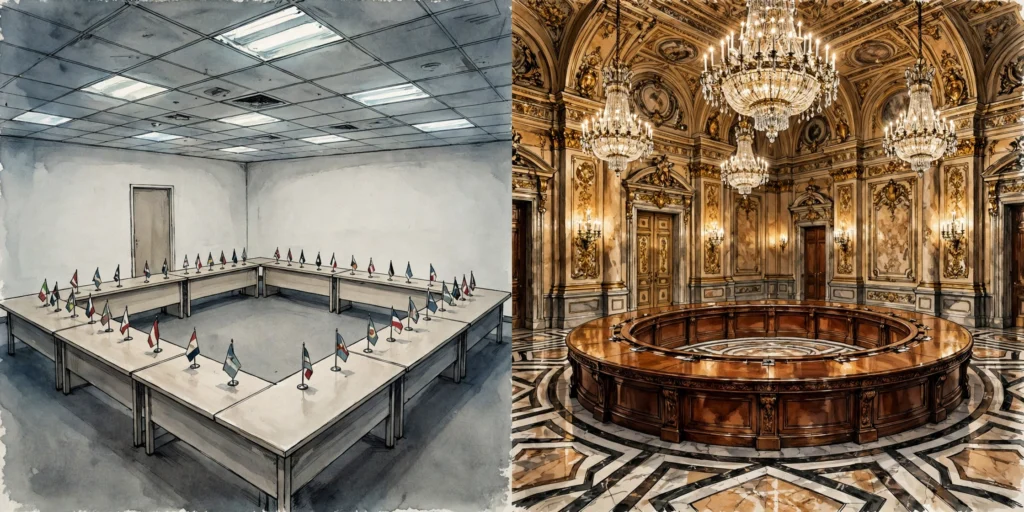
The Quad meeting was the plainer of the two by a long distance. In a no-frills hotel conference room in the Philippine capital on Tuesday, Trump sat down with Japanese Prime Minister Sanae Takaichi, Indian Prime Minister Narendra Modi and Australian Prime Minister Anthony Albanese. Covered in blue cloth, four long tables formed the appropriate shape of a quadrilateral, with each government taking one side. The leaders were flanked by their Cabinet members. Before the meeting, the four leaders took a photo together, and Trump took questions from reporters and joked around with his counterparts, in a scene that felt informal, crowded and unscripted.
Calling the leaders "friends of mine," Trump turned to Albanese and patted him on the back, as the Australian premier nodded. Trump then threw his thumb toward Modi and joked, "And by the way, he's a very tough man," before pointing to Takaichi and saying, "and she may be even tougher." Modi didn't crack a smile, but Takaichi chuckled. Trump turned back to Albanese: "And we? We're OK, too," to which the Australian laughed. Moments earlier, Modi, apparently impatient, had gestured to end the press conference to no avail as Trump kept taking questions.
In Manila, Trump said at the Quad meeting that "we're all friends" and suggested that the leaders from Japan, Australia and India can reach him directly. "We talk a lot when they have a problem, when they have difficulty, when they want to tell me something, my phone is always open and the Oval Office is always open to you," Trump said. Talking to reporters, Trump praised his fellow Quad leaders, calling them "phenomenal people." "And they're friends of mine, so that helps," the president said. The warmth was real, and it was also strategic: the Quad, a partnership of four democracies meant to counter China, is the framework through which Washington organizes its closest partners in the Indo-Pacific.
The meeting had substance behind the bonhomie. The joint press release from the Quad leaders called the group "a force for good and a partnership of action, committed to peace, stability, and prosperity" and laid out areas for cooperation, including artificial intelligence, cybersecurity and maritime surveillance. Trump also met Philippine President Ferdinand Marcos Jr. during the Manila stop, and reports from the trip said he announced a trade deal with the Philippines and expanded defense cooperation with the longtime American ally, which has been grappling with Beijing's growing assertiveness in the South China Sea.
The Trilateral: Marble, Chandeliers and a Ring-Shaped Table
The scene was much grander but far less spontaneous two days later when Trump joined Putin and Xi at a massive ring-shaped table with a burst of pink flowers in the middle at a state-owned resort in Shenzhen, China. The room was spacious with marble flooring, crystal chandeliers and jade sculptures. Three leaders were alone at the table, seated some distance from one another. Xi read from a prepared script, with hardly any expression on his face. Putin looked at the documents in front of him, while Trump sat back with a slight smile on the opposite end of the table. The trilateral was choreographed down to the seating, and the choreographer was Xi, the host, who called on Putin and Trump to speak in turn.
The warmth of the greeting was striking even before the meeting began. On Thursday, Trump described Xi and Putin similarly to his Quad partners, addressing both as his "friend." At the airport in Shenzhen, Trump got a rare greeting from Xi and even an unusual hug from the Chinese leader, who met him on the red carpet with a military band playing and dancers chanting "warm welcome" in Mandarin. At a welcoming ceremony for the Asia-Pacific Economic Cooperation grouping, Putin joined Xi and Trump on stage. He and Trump shook hands and held each other briefly by the arm, with Xi looking on and smiling.
At the trilateral meeting itself, Trump argued that differences among countries should not forestall talks. "Too often, past leaders avoided talking to nations with whom they had disagreements. And, uh, we feel the opposite," Trump said. Before the three-way session, Trump and Putin had already met one on one, and the war in Ukraine dominated that meeting, according to Kremlin foreign policy aide Yuri Ushakov, who said the leaders also discussed two-way ties and their upcoming joint meeting with Xi. The White House had cautioned in advance that the trilateral itself was the start of a conversation rather than a negotiation.
Two Statements, Two Visions of World Order
The documents the two meetings produced were as different as the rooms they were signed in. While the Quad statement was substantive and reflective of the alignment of the four nations, the trilateral statement was largely symbolic. The Chinese, American and Russian governments issued a statement committing to reforming the United Nations, planning to increase petroleum supplies and affirming opposition to nuclear wars. It was the first written statement the three leaders have ever produced together, and it offered more detail than expected, said Edgard Kagan, a former American ambassador to Malaysia now at the Center for Strategic and International Studies. With language about nuclear weapons and future dialogue, "it is a major concession by China," Kagan said.
The difference in the two statements captured the difference in the two orders they represent. The Quad's statement described a partnership of democracies working together on shared problems, from artificial intelligence to maritime surveillance, and it read like the work of governments that already agree on the rules and want to enforce them together. The trilateral statement, by contrast, read like the work of three great powers agreeing to talk to each other while reserving the right to disagree about nearly everything else, from Ukraine to Iran to Taiwan to trade.
For the countries watching from outside both rooms, the distinction matters enormously. The Quad's members are treaty allies and close partners of the United States, and the group's expansion into technology and security cooperation gives Washington a network it can rely on in a crisis. The trilateral's members include the two countries the United States has spent the past decade treating as its principal rivals, and the meeting gave both of them something they wanted: for Xi, recognition as the host and convener of a great-power gathering, and for Putin, a seat at a table with the world's two most powerful leaders, presenting Russia as standing on equal terms with them despite an economy far smaller than either.
What Happens Next
The limits of the week's diplomacy became clear within hours of the Shenzhen meeting ending. Russia launched a massive overnight missile and drone attack on Ukraine that killed at least five people, damaged three bridges over the Dnipro river in Kyiv and knocked out power across several districts, hours after Putin had sat with Trump and Xi for talks billed as a force for peace. European leaders, who were excluded from the Shenzhen talks, dismissed the gathering openly: German Chancellor Friedrich Merz called it a "photo op" at a meeting of more than 30 European heads of state and government in Berlin, where the coalition of the willing gathered to discuss support for Ukraine.
The Manila meeting, by contrast, left behind a work program. The Quad's commitments on artificial intelligence, cybersecurity and maritime surveillance give the four governments concrete tasks to carry out in the months ahead, and the trade and defense announcements from the Philippines stop give Washington something measurable to point to. The two meetings also set up the next round of diplomacy: the Shenzhen session was the fourth encounter between Trump and Xi in a single year, following a summit in South Korea and reciprocal visits to Beijing and Washington, and Xi is expected to attend the G20 summit in Florida a month later, where further meetings for 2027 are expected to be scheduled.
What to watch now is whether either vision hardens into policy. The White House will have to decide whether the nuclear dialogue Trump wants with China and Russia ever begins in earnest, whether the Quad's technology and security cooperation produces results that allies can see, and whether the president's personal approach, calling every leader a friend and keeping his phone open to all of them, can bridge the gap between two orders that point in opposite directions. The Asia trip showed that Trump is comfortable in both rooms, and that he believes talking to everyone is better than talking to no one. The coming months will show whether being friends with everyone is a strategy, or only a style.
Source: Associated Press