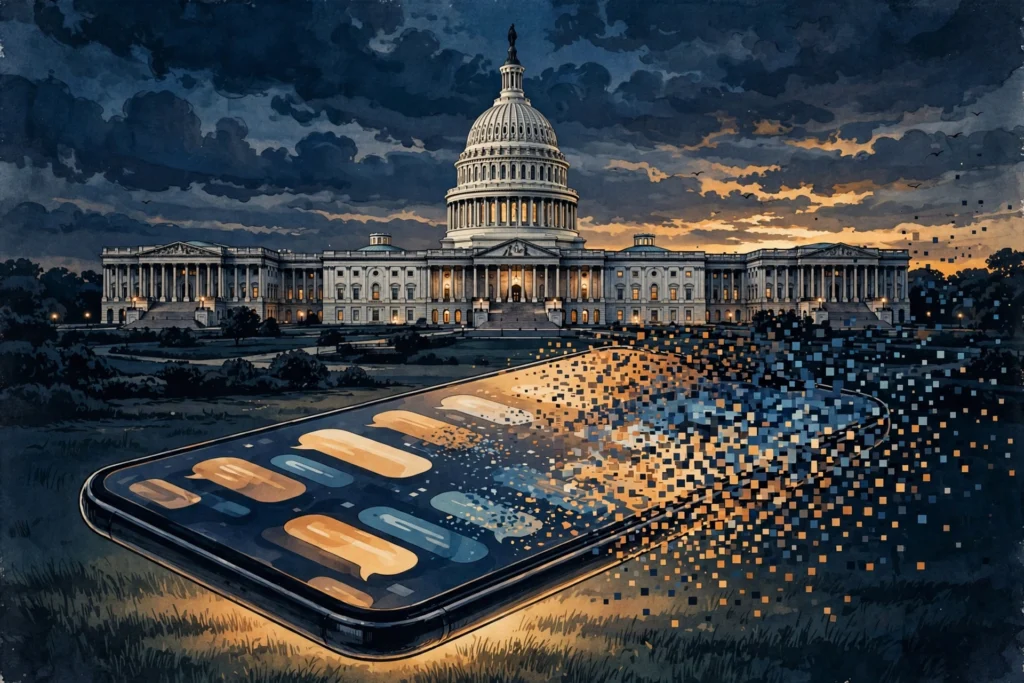
Trump Administration Signal Use Draws Raskin Warning
In the latest trump administration records fight, Democrats in Congress have opened a new front against the White House, accusing senior officials of using disappearing messages to keep their work out of the history books. Representative Jamie Raskin, the Maryland Democrat in line to chair the House Judiciary Committee, sent a series of preservation letters on Friday to five of the government's most powerful law enforcement agencies, demanding that they save their documents and switch off the auto-delete settings on encrypted messaging apps. The letters went to the Department of Justice, the Federal Bureau of Investigation, the Department of Homeland Security, Immigration and Customs Enforcement and the Bureau of Prisons, and they landed as a formal warning: if records are being destroyed now, Democrats intend to treat that destruction as evidence later.
The dispute is not a small procedural squabble. It is the opening move in a confrontation that will shape the next two years of American politics, because it is about who controls the record of what the government did. Democrats won control of Congress in the November 3 midterm elections, and they take the committee gavels in January. Until then they cannot compel the administration to hand over a single document. What they can do, and what Raskin did on Friday, is put the administration on notice in writing, creating a paper trail that investigators and prosecutors could use for years to come. The White House has answered that it sees no obligation to comply with demands from lawmakers who do not yet chair the committees, and it says the claims of document destruction are being made without evidence. Between those two positions sits a question that now has the makings of a legal fight: whether the use of an encrypted app with messages set to vanish amounts to breaking the law.
Trump Administration: The Signal Chat at the Centre of the Dispute
At the heart of Raskin's letters is a single episode that, in his telling, shows the problem in miniature. According to the letters, a Signal conversation between the general counsel of the FBI and an associate of Donald Trump Jr. appeared to have been set so that its messages would automatically delete after a week. Raskin said the conversation concerned a potential or ongoing investigation involving a person wanted by federal authorities on health care fraud and related charges. He described the episode as just one of many that had already been reported to his committee, and he argued that it raised serious concerns that Justice Department and FBI officials were, in his words, openly flouting federal law on the preservation of official government records.
The details matter because they go to the question of intent. Signal is a legitimate encrypted messaging app, widely used by journalists, officials and ordinary people, and using it is not itself unlawful. What federal records law requires is that official business conducted on any platform be preserved. The Federal Records Act obliges agencies to keep records of their work so that Congress, the courts and the public can later examine what was decided and why. A message set to disappear after seven days cannot be retrieved, filed or subpoenaed. When the conversation involves a senior FBI lawyer and an associate of the president's son, and when it touches on a live federal investigation, the decision to let it vanish looks, to Democrats, like a deliberate choice to place the discussion beyond the reach of oversight.
Raskin's letters frame the pattern as extending to the highest levels of federal agencies, including top-ranking law enforcement officials. He wrote that there was significant evidence officials had engaged in the widespread destruction, mutilation and concealment of government records, seemingly with the express purpose of getting around federal record preservation laws. That is a sweeping charge, and the White House has rejected it outright. But the specific example Raskin chose to highlight — the FBI general counsel's chat — gives the accusation a concrete anchor, and it is the example Democrats are likely to return to again and again when they begin holding hearings in the new year.
DOJ News: What the Preservation Letters Demand
The letters themselves do two things. First, they demand that the agencies preserve their documents, a standard instruction in congressional oversight that carries legal weight once it is given in writing. Second, they demand that officials turn off auto-delete settings on encrypted messaging applications used for official work. Committee staffers hope the letters sent on Friday will bring the use of Signal and disappearing messages for government business to a halt, even before Democrats gain the power to enforce their demands with subpoenas.
Raskin went further than a simple instruction to preserve records. He is also demanding that Attorney General Todd Blanche and other Trump officials open an inquiry into what documents may already have been deleted, and attempt to recover those records. That demand puts the Justice Department in an awkward position: it is being asked to investigate the disappearance of records inside its own ranks, including inside the FBI, which sits within the department. Whether Blanche agrees to any such inquiry, and what form it would take, is one of the first tests of how the administration intends to handle the confrontation.
The letters also serve a second purpose, one that has less to do with the present and more to do with the future. A Democratic source familiar with the strategy told CNN that the point was to put officials on notice that the behaviour was wrong, and that if it continued, Democrats would draw adverse inferences from the destruction of evidence — the same kind of inference that courts and litigants draw when a party destroys documents it was obliged to keep. The letters are, in that sense, as much about building a case for later as they are about stopping the practice now. They create a dated, written record that officials were warned, and that warning could matter a great deal if a future Justice Department ever has to decide whether records were destroyed deliberately.
White House News: The Administration Pushes Back
The White House has not accepted any of this. A White House official told CNN that the administration complies with all federal record retention laws and regulations, a flat denial that anything improper is taking place. The administration's broader position, set out in letters from White House Counsel Will Scharf earlier this week, is that Democratic demands carry no legal force at all until the new Congress is seated. Scharf wrote to Democratic committee leaders that no official has to comply with demands to preserve or turn over documents and information because Democrats do not yet chair the committees, according to a copy of the letter obtained by CNN.
Scharf's language was blunt. He said the purpose of the letters sent by Democrats was not legitimate oversight but to harass and aggrandize, and he argued that the letters implied, without evidence, that thousands of government employees were conspiring to destroy documents in violation of the Federal Records Act. His letters were sent in the days since the November 3 election, as Democratic ranking members began sending their own demands across the executive branch, and they amount to a declaration that the White House will not cooperate with a Congress it does not yet have to answer to.
The pushback has taken a more personal turn as well. On Thursday, Raskin received a preservation letter of his own, sent by US Attorney Aaron Reitz, who accused the Maryland Democrat of weaponizing his investigative efforts without a legislative purpose in order to go after Trump associates and the administration. The exchange of letters — Democrats demanding preservation from the administration, and a Trump-appointed prosecutor demanding preservation from a leading Democrat — captures the symmetry of a fight in which both sides are now building paper trails against each other. It also signals that the administration intends to treat Democratic oversight not as a constitutional duty to be accommodated, but as a political attack to be resisted.
Democratic Party News: Why January Changes Everything
The calendar is what gives this fight its urgency. Democrats do not yet hold the gavels, and they do not yet have subpoena power. In January, that changes. Raskin is expected to take the chair of the House Judiciary Committee, and his colleagues will take the chairs of the other oversight committees, giving them the power to compel testimony and documents, to hold hearings in public, and to refer matters for prosecution. The preservation letters sent on Friday are a preview of the investigations to come, and the administration knows it.
That is why the question of what survives until January matters so much. If messages set to auto-delete vanish in the meantime, the evidence Democrats hope to examine may no longer exist when they finally have the power to demand it. Judiciary Committee staffers plan to rely on whistleblowers and third parties to help them obtain the information they seek, according to CNN, which suggests they are already preparing for the possibility that the official record will have gaps. Whistleblowers inside agencies, and outside parties who received or saw the messages, may become the most important sources for reconstructing conversations that were designed to leave no trace.
The stakes extend beyond the next Congress. Jim Secreto, who worked in the Obama White House Counsel's office on congressional investigations and compliance with the Presidential Records Act, told CNN that the preservation letters were Congress drawing a line in the sand and maintaining a record so that if people destroyed records they could potentially be prosecuted in a future administration for obstruction of Congress. He added that a future Justice Department could use the letters as evidence in court of an intent to destroy records. In other words, the letters are not only about the coming hearings. They are about keeping open the possibility of accountability years from now, including if Democrats regain the White House in 2028.
Midterm Elections 2026: How the Signal Fight Started
The dispute over disappearing messages did not begin this week. It has its roots in one of the most embarrassing episodes of the administration's first year. In March 2025, it emerged that top Trump officials had used a Signal group chat to discuss sensitive military strikes against militants in Yemen, and that the editor of The Atlantic had been added to the chat by mistake, receiving the plans in real time. The incident, which became known as Signalgate, drew condemnation from Democrats and from national security experts, and it prompted a resolution in the House condemning the use of an unauthorised method of communication for highly sensitive military information.
The resolution, H. Res. 265, argued that the discussions had taken place outside secure government facilities and had not been properly recorded, in violation of federal records laws. It demanded an investigation and insisted that classified discussions take place only inside a Sensitive Compartmented Information Facility, the kind of secure room built to prevent exactly this sort of exposure. The resolution did not pass into law, but it established the framework Democrats have used ever since: that the use of Signal for official business is not merely a security risk, but a records problem, because messages that vanish cannot be preserved, audited or produced to Congress.
The pattern continued beyond the Yemen chat. In April 2025, Reuters reported that Elon Musk's government efficiency team, known as DOGE, was using Signal to communicate, according to a person with direct knowledge of the matter, potentially violating federal record-keeping rules because messages could be set to disappear. A federal judge had already ordered DOGE in March to begin handing over records to the watchdog group Citizens for Responsibility and Ethics in Washington, citing the operation's unusual secrecy, including its use of Signal. The Pentagon's inspector general also examined the defence secretary's handling of operational information in the Yemen chat, concluding that it had created risks for American service members and military missions. Each episode added to a record that Democrats now cite as evidence of a habit, not an accident.
Trump News: What Happens Next in the Records Fight
The immediate question is whether anything changes before January. CNN has reached out to the Justice Department and the Department of Homeland Security for comment on Raskin's letters, and the responses from those agencies will be the first indication of whether the administration intends to adjust its practices or to hold its ground. If officials quietly switch off auto-delete settings and begin preserving their messages, the letters will have achieved their purpose without a fight. If they do not, Democrats will arrive in January with a documented refusal to cooperate, and with the argument that the refusal itself is evidence of intent.
The second question is what the recovery effort produces. Raskin's demand that the attorney general open an inquiry into deleted documents, and attempt to recover them, will test whether the Justice Department is willing to investigate its own conduct. Messages deleted from Signal are, by design, extremely difficult to recover, but investigators can seek copies from other participants in a conversation, from devices that were backed up, and from the records of the agencies involved. Whether any such effort is made, and what it finds, will shape the first hearings of the new Congress.
The third question is the longest-term one. The preservation letters, the White House counsel's replies, and the prosecutor's letter to Raskin together form a written record of a standoff that both sides expect to continue for years. Democrats believe they are building the foundation for investigations that will run through the next Congress and potentially into a future administration. The White House believes it is resisting an illegitimate campaign of harassment. Neither side is likely to back down, and the fight over a messaging app's disappearing messages has become, in the end, a fight over the most basic question in American government: whether the people who run the country can be made to show their work.
Source: CNN