Iran War News: GAO Says US Munitions Running Low
In the latest iran war news, the war with Iran has made a long-running American problem significantly worse. A congressionally mandated report from the Government Accountability Office, released on Thursday, finds that the conflict has deepened a persistent shortfall of key munitions in the Pentagon's arsenal, and that the Defence Department still has no overarching plan to rebuild its depleted stockpiles. The report directly contradicts repeated assurances from President Donald Trump, Defence Secretary Pete Hegseth and other senior officials, who have insisted that there are no shortages. The watchdog's verdict is blunt: the department lacks a strategy linking weapons purchases and spending to military requirements, and no single office has been given clear responsibility for fixing the problem. The result, the report warns, is a military that is spending money on weapons it may not need in sufficient quantities while failing to replenish the ones it is running short of.
The findings land at a sensitive moment for the administration. The war, which the Trump administration initiated in concert with Israel and which has become known by the operational name Epic Fury, has placed extraordinary demands on the most sophisticated weapons in the American inventory, the missile defence systems used to intercept Iranian ballistic missiles and protect American forces and their allies across the Middle East. The cost of the war had already climbed to an estimated 48.3 billion dollars as of November 13, according to figures cited by the Associated Press from Arthur Miller, a senior Pentagon budget official. Now the Government Accountability Office has put a number on the other side of the ledger: the weapons themselves, and the industrial base that makes them, are not keeping up.
Iran War News: What the Watchdog Found
The report, titled "DOD Munitions: Planning and Leadership Needed to Address Persistent Shortages" and numbered GAO-27-109420, runs to 28 pages in its public form. It is the unclassified version of a classified report the watchdog delivered to Congress on September 24, with material the Pentagon deemed classified or sensitive removed, including trends in munitions inventories, the persistent shortfalls themselves, and how those shortfalls have affected the department's support for its war plans. Even with those details stripped out, the conclusions are stark. The report states plainly that the 2026 conflict with Iran has heightened the importance of addressing munitions stockpile and industrial base challenges, and its director, Diana Moldafsky, told the Washington Post in an email that the office's research found the Iran war had exacerbated shortfalls that were already persistent in recent years.
The central finding is that the Pentagon has no plan. The department depends on three separate strategy documents that touch on munitions: a 2016 plan for the conventional ammunition industrial base, the 2023 National Defence Industrial Strategy, and a 2025 Army plan to modernise its ammunition plants. According to the watchdog's analysis, none of them ties munitions production and funding to the inventory levels the military says it needs to fight a war. Officials from the Joint Staff, the United States Indo-Pacific Command, the Office of the Secretary of Defence, and the Air Force, Army, Navy and Marine Corps all told auditors the same thing: the department has no overarching plan to address its munitions challenges. In the report's own words, without a plan the department and the services can be reactive to global events rather than driven by total munitions requirements, buying and building in response to the latest crisis instead of working from a clear picture of what the country needs.
The report gives a concrete example of the problem. The Army has sharply increased production of 155-millimetre artillery shells, the workhorse round of modern land warfare, in response to shortages made worse by American support for allies and partners. But that increase, the watchdog found, was not driven by a need to address the department's total munitions requirement. It was a response to an immediate pressure, not part of a considered plan. Without a plan with long-term goals, strategies and measures of progress, the report warned, the Pentagon risks failing to fix persistently low munitions inventories, or investing in munitions that are projected to exceed the total requirement. A plan could also guide how the department spends the at least 25 billion dollars Congress appropriated in 2025 for munitions in Public Law 119-21, the reconciliation law, money that is currently being spent without the strategic framework the watchdog says it requires.
Pentagon News: The Missiles Running Low
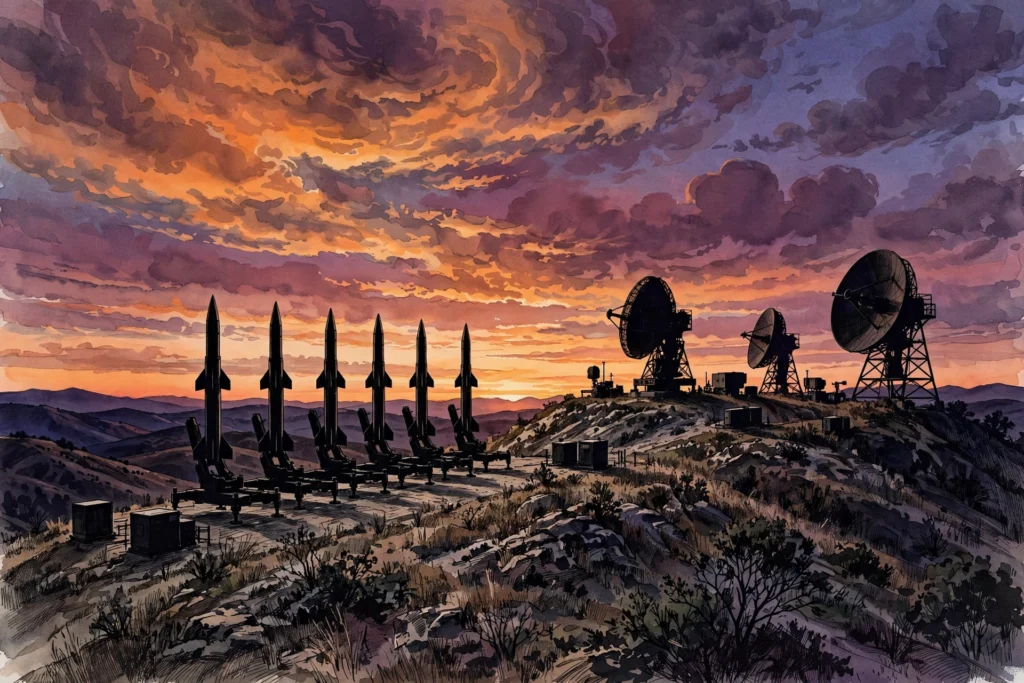
The weapons at the heart of the report are the most advanced and expensive in the American arsenal, and the ones the Iran war has consumed fastest. Among those facing significant inventory pressures are Patriot air defence missiles, Terminal High Altitude Area Defence, or THAAD, interceptors, Tomahawk cruise missiles, and 155-millimetre artillery shells. The Iran war has placed particularly heavy demands on the sophisticated missile defence systems used to intercept Iranian ballistic missiles, the shield that protected American forces and allies in the Middle East from retaliatory strikes.
The scale of the consumption is striking. According to estimates cited by the International Institute for Strategic Studies, American forces fired approximately 1,060 to 1,430 Patriot interceptors and 190 to 290 THAAD interceptors during the first 39 days of the conflict, consuming substantial portions of their estimated prewar inventories. The United States also fired at least 1,000 Tomahawk cruise missiles during that period, according to the same institute. Those are not numbers that can be replaced quickly. The Wall Street Journal reported that replenishing Patriot missiles has been slowed by shortages of the specialised materials used in their rocket motors, with each advanced interceptor taking roughly two years to manufacture. A weapon fired in a single night over the Middle East can take two years to replace, and the arithmetic of that gap is the core of the watchdog's concern.
The strain is not confined to the newest weapons. At his Senate Armed Services Committee confirmation hearing on Tuesday, the acting Navy Secretary, Hung Cao, said the Navy had recoded and fired munitions previously classified as unserviceable during the Iran war, according to Navy Times. The detail is a small window into the pressure the services are under: when stocks run low, the military reaches for weapons it had previously written off. It is also a reminder that the shortage is not an abstraction debated in reports, but a practical constraint that commanders are already working around in the field.
Ukraine War News: The Other Drain on Stockpiles
The Iran war did not create the munitions problem, and the report is careful to say so. The shortages it documents are persistent, the product of years in which the Pentagon's inventory of key weapons has run below the levels its own plans require. The other great drain on those stocks has been Ukraine, where the war against Russia has consumed artillery shells at a rate not seen in Europe for decades. The Army's expansion of 155-millimetre shell production was driven in large part by that demand, and by the American military assistance sent to Kyiv, and the report notes that the effort to increase output was not based on an assessment of the Pentagon's total ammunition requirements. Two wars, in two different theatres, have been drawing on the same industrial base, and the base has not grown fast enough to keep up with either of them, let alone both.
That history matters because it undercuts any suggestion that the problem is temporary, or that it will disappear when the fighting in the Middle East ends. The watchdog found that the department has struggled with ammunition shortages for years, and that the war against Iran added pressure to an already strained supply system. The industrial base that makes these weapons, the government-owned ammunition plants and the private contractors that supply them, cannot be expanded overnight, and the specialised materials and skilled labour required for advanced interceptors are in short supply around the world. Rebuilding the inventories will require, in the assessment of analysts who have studied the report, a multi-year commitment and a significant expansion of the industrial base, not a single budget cycle or a one-off purchase.
Trump Administration: Assurances Versus the Audit
The report's findings sit in direct tension with what the administration has been saying. President Trump, Defence Secretary Hegseth and other senior officials have repeatedly disputed media reports detailing how the Iran war has depleted the stockpile of Tomahawk cruise missiles, Patriot interceptors and other advanced munitions, insisting that the arsenal is in good shape. The watchdog's director was direct in her response. Her office's research found that the Iran war exacerbated munitions shortfalls, Moldafsky said, and she described those shortfalls as persistent in recent years. The report itself does not address the comments made by Trump and Hegseth, and it does not disclose the number of key munitions that remain in the arsenal, because the Pentagon deemed the release of such information classified or sensitive. But its conclusions speak for themselves, and they are difficult to square with the administration's public position.
The Pentagon's response to the report was telling. The department did not dispute the findings, but it publicly brushed the report off as the work of an outside body, a dismissal that sits oddly with the fact that the Government Accountability Office is Congress's own watchdog, conducting a review that the House Armed Services Committee itself requested. Quietly, according to the Washington Post, the Pentagon agreed to the report's recommendations, accepting the need to create a central office, tighten the tracking of munitions, and set timelines for shoring up supplies, while keeping the actual stockpile levels classified. The public dismissal and the private acceptance tell their own story about how the administration wants the issue to be seen, and how seriously it takes the findings behind closed doors.
No One in Charge: The Leadership Gap
Beyond the absence of a plan, the report identifies a second, equally basic problem: nobody is in charge. Responsibility for munitions is diffused across many entities, including acquisition offices, an industrial base office, an Army-led ammunition programme office, and each service's own programme offices, such as the Navy's Tomahawk Weapon System Program Office. Several working groups coordinate on the issue, but the watchdog found that they do not have decision-making authority or empowered leaders who can be held accountable for rebuilding stockpiles. Service officials told auditors that without an office with dedicated leadership to address munitions challenges, it may be difficult to realise progress in addressing munitions shortages at any level.
The department did try to create a coordinating body. The under secretary of defence for acquisition and sustainment set up a Munitions Acceleration Council in July 2025 to speed missile production, but according to a senior official quoted in the report, the council had no formal signed charter as of November 2026, more than a year after it was created. A council without a charter is a meeting, not an institution, and the report's treatment of it captures the wider pattern: activity without authority, coordination without accountability.
The same pattern shows up in the department's data. The watchdog examined the Munitions Readiness Initiative, the department-wide tool that senior leaders, including the secretary of defence, use for a near real-time view of munitions stocks. Under a 2022 memorandum, the tool replaced the old practice of requesting inventory data from each service by hand, a process officials said could take several days. It draws on 37 Defence Department data sources, some of them updated manually, and it is supposed to tell the people running the department what weapons are available in the event of a conflict. But the Pentagon has not regularly reconciled the tool's numbers against the services' own authoritative inventory systems, and a senior acquisition official told the watchdog the office was reluctant to impose additional responsibilities on the services. The department also built the system without a data management plan or a data dictionary documenting how the four services' different munitions identifiers are combined. Without those steps, the watchdog concluded, decision-makers who use the tool cannot ensure that it is providing the most accurate view of current munitions inventory to determine which munitions are available in the event of a conflict.
What Happens Next: Four Recommendations and a Deadline
The report makes four recommendations. The first is that the secretary of defence, in consultation with the chairman of the Joint Chiefs of Staff and the military department secretaries, develop an overarching munitions plan with long-term goals, strategies and metrics. The second is that the department name an office with the authority to carry out that plan. The third is that it set regular timelines for reconciling inventory data. And the fourth is that the department's chief digital and artificial intelligence officer write a data management plan for the inventory tool. According to the report, the department concurred with the first three recommendations. It partially concurred with the fourth, saying the acquisition and sustainment office should lead the data plan as the subject-matter expert, and the watchdog said it agreed, but that the chief digital and artificial intelligence officer should still take part.
The review was requested by the House Armed Services Committee in a report accompanying the fiscal 2025 defence authorisation bill, and the watchdog addressed its findings to the committee's chairman, Mike Rogers, and its ranking member, Adam Smith. Auditors carried out the work from September 2024 to September 2026, visiting Indo-Pacific Command in Hawaii as well as the McAlester, Holston and Radford Army ammunition plants and the Letterkenny Munitions Centre. The watchdog said it has separate work under way on the Army's efforts to modernise its government-owned munitions plants, and plans to report on it next year.
The report arrives in the same week that the Senate rejected a resolution to block the president from striking Iran, a vote that underlined how firmly the administration's war policy is backed in Congress, at least for now. But the watchdog's findings raise a question that no vote can settle: whether the country has the weapons to sustain the policy it has chosen. The administration has committed itself to a war that consumes its most advanced munitions at a rate its factories cannot match, and its own watchdog has now said, in plain terms, that there is no plan to close the gap. The recommendations are on the table, and the department has accepted most of them. The test now is whether acceptance turns into action, and how long the stockpiles can hold out while it does.
Source: The Washington Post