Artificial Intelligence News: Trump Rejects Global AI Rules
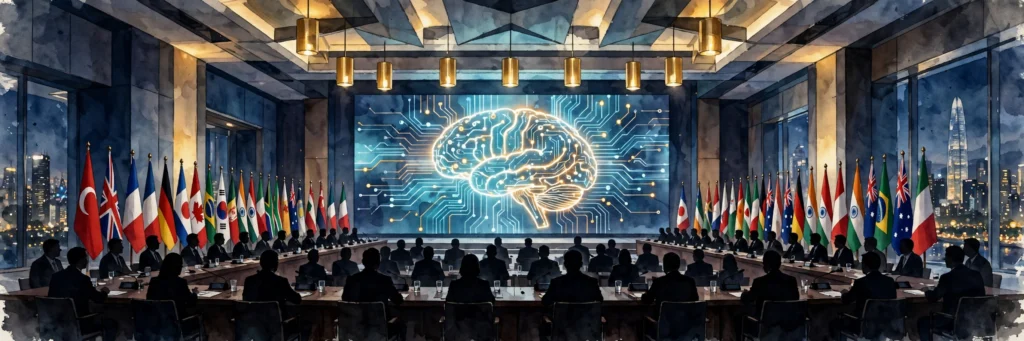
In the latest artificial intelligence news from Asia, President Donald Trump used his address to the Asia-Pacific Economic Cooperation leaders' meeting in Shenzhen on Thursday to draw a firm line against any international effort to regulate artificial intelligence. Speaking at the leaders' plenary session of the 33rd APEC Economic Leaders' Meeting, Trump said the United States would not accept outside rules that try to control or slow the technology, which he calls superintelligence, or SI. The remarks landed in the heart of the Chinese technology industry, in front of leaders from across the Pacific region, and they set up a direct contrast with the vision of closer international cooperation that Chinese President Xi Jinping had offered earlier in the week.
Trump's message was short and direct. He described superintelligence as the greatest technological transformation since the Industrial Revolution, said Americans invented it, and said the United States is proud to lead the world in it. "We oppose any form of globalist regulation or anything to control or stifle SI, and we won't allow that to happen," he told the room. At the same time, he admitted that the technology is not without danger. "It's almost completely good, but it's got some bad elements, so we have to be very careful in managing those bad elements," he said, adding that the world has to watch the technology closely, be careful with it, and cherish it. No new policy, executive order or agreement was announced alongside the remarks, and the White House had not posted a transcript of the plenary address at the time of writing.
The speech matters because of where and when it was given. Trump was speaking on Chinese soil, at a summit hosted by the world's other great AI power, only hours before he was due to sit down with Xi and Russian President Vladimir Putin for a three-way meeting his team has described as historic. The APEC appearance was the public centrepiece of a trip that has already produced a Philippines trade deal, a tariff truce with China, and a week of hard-edged moves on the chips that power advanced AI systems. By using the plenary to reject global rules, Trump was telling the region's leaders that Washington intends to set its own course on AI, even as it tightens its grip on the hardware the technology depends on.
What Trump Told APEC Leaders About AI
The ai news out of Shenzhen began with Trump's framing of the technology itself. He told the leaders that the United States is proud to be the world leader in superintelligence, that Americans invented it, and that it is unleashing extraordinary prosperity and growth for people all around the globe. "So we do not want to do anything to destroy the tremendous potential of this technology," he said. "It's superintelligence, that's what it is, but we have to watch it. We have to be careful. We have to cherish it."
That pairing, pride in American leadership and a warning against outside restraint, ran through the whole address. Trump also used the speech to highlight the performance of the United States economy and to describe America as a Pacific power that has been engaged in the region for hundreds of years, saying Washington would keep working for growth, stability and peace in Asia. He told the gathering he was looking forward to the trilateral meeting with Xi and Putin later on Thursday, a session expected to cover trade, Ukraine, Iran and nuclear weapons as well as artificial intelligence.
The choice of the word superintelligence was deliberate. Trump has been rebranding artificial intelligence as SI for months, a shorthand that presents the technology as something larger and more consequential than the chatbots and software tools most people associate with AI. In his address to the United Nations in September, he said he would not stifle the growth of a technology he described as bigger than the Industrial Revolution, adding that Washington would only encourage superintelligence and would not rein it in. The APEC speech carried the same message to a room full of the leaders whose countries would be most affected by it.
Xi Jinping's Rival Vision: Cooperation, Not Control
The technology news from Shenzhen is best understood as a contest between two visions, because Xi had used the same summit to argue the opposite case only days earlier. Opening the APEC CEO Summit earlier in the week, Xi called for greater international cooperation in artificial intelligence and the digital economy, along with fewer barriers to trade and investment. He announced 20 million dollars in support for APEC projects and a new research centre in Shenzhen focused on the Asia-Pacific region, presenting China as a defender of open trade and shared rules.
Xi has also argued that AI should remain under human control, a position he has repeated in meetings with American leaders, including during his visit to the White House earlier in the year. The contrast could hardly be sharper. Where Xi offers cooperation and shared governance, Trump offers competition and national control. Where Xi speaks of managing AI together, Trump speaks of protecting American leadership from rules written anywhere else.
The two leaders had, by Trump's own account, spent much of their time together talking about the subject. Trump told Fox News that he and Xi spent a whole dinner on Wednesday talking about artificial intelligence, and the technology was expected to feature again in their bilateral meeting and in the three-way session with Putin. Trump was also expected to press Xi to release two detained Americans, according to CBS News reporting, a reminder that the AI debate is taking place inside a relationship crowded with other disputes, from trade to detained citizens.
Semiconductor Chip News: The Export Rules Behind the Rhetoric
The semiconductor chip news behind the speeches helps explain why the argument over rules has become so sharp. Shortly before the summit, Washington tightened its limits on China's access to advanced AI chips, including restrictions on renting computing power from data centres in third countries. The new rule targets data centres outside the United States that serve Chinese-headquartered companies, giving them 90 days to obtain American export licences. Companies in Thailand, Malaysia, Singapore, Indonesia and Brazil must now apply for licences before buying advanced chips.
The move comes amid a scandal at Nvidia, the company whose chips power most of the world's advanced AI systems. Its chief executive, Jensen Huang, resigned on November 12, and the company's board ruled out his return on its November 17 earnings call, with finance chief Colette Kress named interim chief executive. The leadership crisis has been tied to alleged diversion of chips to China, an issue that has kept the question of who gets access to advanced hardware at the centre of the summit. Trump said he referred to Huang's situation briefly in his talks with Xi.
The result is an American approach with two sides that can look contradictory from the outside. On the one hand, Washington resists shared global rules on how AI systems are built and used. On the other, it is tightening its own controls on who can buy the hardware needed to build them. The data center news follows the same pattern: the administration is comfortable using export controls and licensing to shape the AI landscape, but it does not want an international body, or any other government, telling American companies how fast they may move.
Trump's Shifting Stance on AI Safeguards
The APEC speech was the latest turn in a stance that has shifted several times in the space of two months. In a post on Truth Social on September 14, Trump dismissed warnings about the dangers of artificial intelligence as a hoax and insisted the United States must push forward to maintain its leadership over China. A month later, on October 30, he signed an executive order aimed at limiting the ability of individual American states to regulate AI, arguing that a patchwork of state rules would stifle the industry in its race with China.
"If they had to get 50 different approvals from 50 different states, you can forget it because it's impossible to do," Trump said in the Oval Office when he signed the order, which he said was designed to sustain and enhance American global AI dominance through a minimally burdensome national policy framework. The order directs Attorney General Pam Bondi to create an AI Litigation Task Force within 30 days whose sole responsibility is to challenge state AI laws, and it asks Commerce Secretary Howard Lutnick to identify state laws that require AI models to alter their truthful outputs. White House AI adviser David Sacks and science office director Michael Kratsios were told to prepare recommendations for a federal law that would pre-empt state rules, though Sacks said the administration would push back only on the most onerous examples of state regulation and not on child safety measures.
Then, in an interview broadcast on CBS's 60 Minutes on November 11, Trump sounded more open to safeguards than he had before. "I don't mind guardrails," he said, but added that he did not want the United States put in a deep second position in AI development behind China, which he said has no comparable restrictions. He also played down concerns that AI could pose an existential threat, saying the risks were not nearly as real as some suggest and can be managed. The shift in tone came after the midterm elections, in which candidates in several races had addressed concerns about data centre construction, rising electricity costs and the technology's effects on jobs.
Two days later, at a White House meeting with leaders of the AI industry, Trump announced a voluntary agreement covering internal and external assessments of AI systems. Anthropic chief executive Dario Amodei, OpenAI president Greg Brockman, Amazon founder Jeff Bezos, Elon Musk, Microsoft chief executive Satya Nadella, Meta chief executive Mark Zuckerberg and Palantir chief executive Alex Karp were among the executives involved. "I believe we are witnessing remarkable self-regulation. They realize the necessity of self-policing," Trump told reporters, adding that the government already has regulation through the Department of Justice and the FBI. "I will never hinder the advancement of a technology that will surpass the Industrial Revolution," he said at the launch of an AI chatbot named America.gov, designed to help Americans navigate government services. "We cannot stifle it, and we are leading by a significant margin." He also warned that continued opposition to AI development could push the work overseas.
Treasury Secretary Scott Bessent added another layer to the administration's position in an interview with Axios published on Saturday. Bessent called warnings about existential risks from prominent AI figures alarmist and unhelpful, and said the industry should police itself and produce its own solutions. Asked about AI executives who have called for regulation, he replied: "Well, then they should slow down." Bessent also said the United States would seek a bilateral notification system with China aimed at reducing uncertainty, sharing warnings about serious incidents and helping both governments respond before an AI problem escalates. The two sides are expected to meet in two months in Shenzhen to discuss the mechanism further.
Why the Global AI Regulation Debate Matters
The debate Trump stepped into at APEC is a real one, and other governments are moving in the opposite direction from Washington. Australia is planning a dedicated AI regulator, and there are calls in Britain for binding rules on the most powerful systems. Inside the United States, states such as California keep pushing their own measures, including mandatory safety standards that would give officials emergency shutdown power over risky models. The American position, as Trump stated it in Shenzhen, is that national rules and voluntary steps should come first, and that no binding international framework should be allowed to slow American companies down.
The industry itself is divided. In September, Amodei, OpenAI chief Sam Altman and Musk called for the industry to slow the development of its most advanced models, citing growing risks for humanity. Microsoft co-founder Bill Gates warned the technology was powerful enough to cause a billion deaths and called for government regulation. Amodei later presented a three-step framework for regulating the pace of development so safety measures could catch up, describing the rivalry between American and Chinese AI companies as the toughest dilemma in setting what he called a speed limit on the technology. Two researchers at the safety and research firm Anthropic resigned and issued warnings of their own, and Amodei discussed the issue on CBS's Face the Nation.
Trump has rejected that case almost from the start, and his APEC speech was the most public version of the rejection yet. By delivering it in Shenzhen, in front of the leaders of the region where the competition is fiercest, he was making the argument where it would be heard most clearly: the United States will compete on AI, it will control the chips, and it will not let an international rulebook set the pace.
What Happens Next
The immediate test of that position comes later on Thursday, when Trump, Xi and Putin sit down together in Shenzhen. Trade is on the table, since the tariff truce between the United States and China expires on January 10, and artificial intelligence is expected to feature in the talks alongside Ukraine, Iran and nuclear weapons. Earlier reports said the United States and China have discussed a channel to share information when AI systems misbehave, and if that moves forward it would be a rare piece of practical cooperation despite the public split on rules. Watchers will be looking for any joint statement on AI safety or incident sharing when the meeting ends.
Beyond Thursday, the picture is one of parallel tracks rather than a single settlement. Expect American AI rules to keep coming from Washington agencies and individual states, not from an international treaty, while the administration continues to tighten export controls on the chips and computing power that make advanced AI possible. Businesses operating across borders should plan for different AI rules in different regions rather than one global standard. And the tension over chips is likely to keep shaping the prices and availability of AI computing, just as the argument over rules keeps shaping the politics of the technology itself. No law or rule came out of the Shenzhen speech, but it confirmed, in the plainest terms yet, that the United States intends to keep setting its own AI rules, and to defend that choice on the world stage.
Source: Bloomberg