Trump News Today: Xi’s Surprise Tarmac Hug in Shenzhen
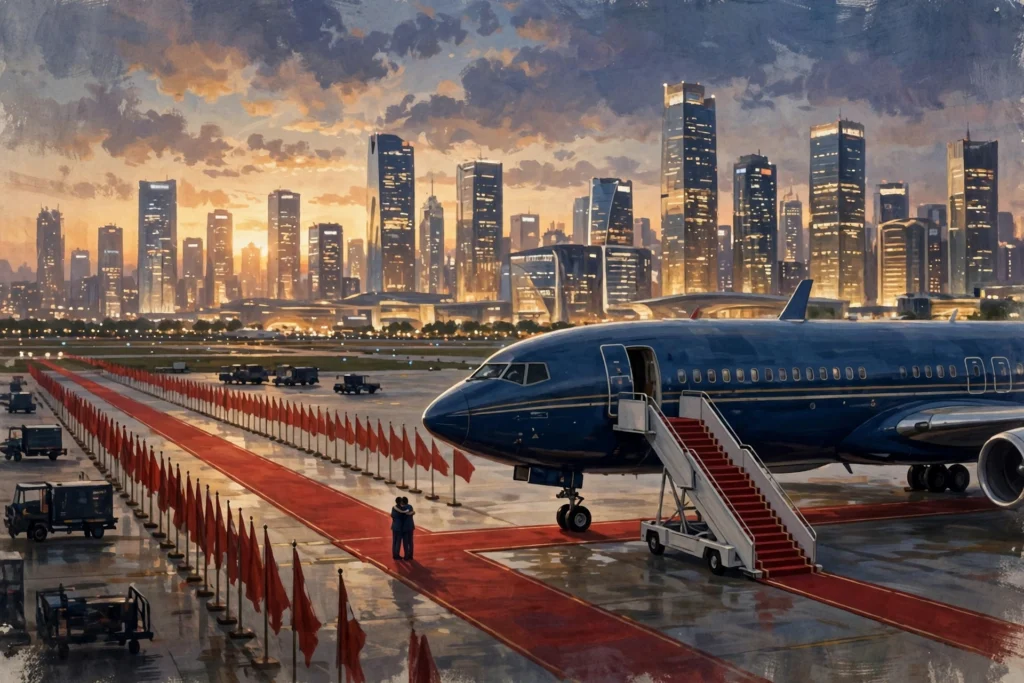
The trump news today out of Asia is a single image: two leaders embracing on an airport runway. Chinese President Xi Jinping made a surprise appearance to greet President Donald Trump on the tarmac as he arrived in China on Wednesday, and the two men hugged at the foot of the stairs to Air Force One. The welcome at Shenzhen Bao'an International Airport was not on any published schedule. Trump had flown in from Manila for the annual Asia-Pacific Economic Cooperation summit. Photographs of the embrace travelled around the world within minutes.
The surprise was the point. Visiting leaders are normally received by a senior official and meet the Chinese president later. Xi did not wait. He came to the airport himself, a gesture that reciprocated the respect Trump had shown him in September, when Trump personally greeted Xi at Joint Base Andrews outside Washington. That was the first time an American president had personally greeted a visiting foreign leader at the airport since 1962. Now Xi has answered in kind ahead of the first three-way meeting of the leaders of the United States, China and Russia.
A Surprise on the Tarmac in Shenzhen
Trump arrived in Shenzhen, the southern boomtown hosting this year's APEC conference, for a summit that will be followed on Thursday by the historic trilateral meeting with Xi and Russian President Vladimir Putin. The city of eighteen million is China's technology capital, and the agenda runs from trade to nuclear weapons and the war in Ukraine. Trump arrived talking about the welcome waiting for him rather than the hard bargaining ahead. "I am the guest of President Xi and I hear we're going to have quite a landing," he told reporters before departing Manila. "It's going to be a beautiful thing."
Xi's unannounced appearance set the tone for everything that follows. The APEC summit runs through Thursday, with Xi delivering a speech on Wednesday and hosting a grand banquet for the visiting leaders in central Shenzhen. Thursday's meetings take place in a state villa about ten kilometres north, in the hills above the city. But the week's most memorable image may already have been taken, on the runway.
The contrast with Putin's arrival was hard to miss. Putin, who arrived in Shenzhen overnight, was greeted at the airport by Xi's chief of staff, Cai Qi, the fifth-ranking official in the Communist Party. That is the standard treatment. Trump got the president himself, waiting at the foot of the stairs. The difference in protocol was a message in itself.
A Gesture Returned: The September Welcome at Andrews
To understand why it matters, recall Washington on September 23. Trump, joined by First Lady Melania Trump, travelled in person to Joint Base Andrews in Maryland to greet Xi and his wife, Peng Liyuan, as they arrived for a three-day state visit. Xi's aircraft touched down at 5:39 in the evening, and the reception was elaborate: a red carpet roughly a hundred feet long, a 21-person honour cordon, and an Air Force musical ensemble. Two B-1 Lancer bombers roared overhead during the anthem, and a 21-gun salute followed.
The gesture was also historically rare. American presidents generally receive visiting leaders at the White House, and airport greetings have become exceedingly rare outside visits by popes. The last comparable welcome at Andrews dated to President John F. Kennedy in 1962, when he personally greeted British Prime Minister Harold Macmillan. It was the first such greeting at Joint Base Andrews in 64 years. The ceremony launched a three-day state visit, Xi's first formal visit to Washington in more than a decade, and the two sides announced an extension of their trade truce through January 10, confirmed by Treasury Secretary Scott Bessent.
The September ceremony also carried a sting for Trump. Xi had not made the same gesture when Trump visited Beijing in May, when the American president was received in the usual formal fashion. Critics in Washington argued that Trump had given away a rare honour without receiving one in return. The Shenzhen greeting settles that account. Xi has now done for Trump what Trump did for him, in the same style, at the foot of the aircraft stairs, in front of the cameras.
Why the Welcome Matters
Protocol is never just protocol when the two most powerful countries in the world are involved. Every detail of a state arrival is negotiated in advance. Xi's decision to greet Trump at the airport signals that China wants this week to be remembered as a moment of personal rapport, not only as a round of hard bargaining over tariffs and technology. It also signals confidence: a leader who is worried about how a summit will go does not usually open it with a hug.
The welcome also fits a relationship that has become unusually personal. This is the fourth encounter between Trump and Xi in a single year, and Trump has become the first American president to travel to China twice in one year. The trump administration has made personal diplomacy the centrepiece of its foreign policy, and the Shenzhen greeting is the clearest expression yet of that approach: the belief that the chemistry between leaders matters more than the briefing books. There is a domestic calculation too: this is Trump's first trip abroad since his party's heavy defeat in the midterm elections, and a warm public welcome from Xi is the kind of image that travels well.
Putin's Arrival and the "Unshakeable" Bond
The third member of Thursday's trilateral was already in Shenzhen. Putin arrived overnight and was received by Cai Qi, but his meeting with Xi produced its own striking language. "My old friend, it's symbolic that this is our 50th personal meeting," Xi told the Russian president, according to reports of the encounter. Xi added that relations between Moscow and Beijing were as "unshakeable as a mountain," a phrase carried by Russian state media. Putin said he expects Thursday's meeting with Trump and Xi to deliver "a big potential benefit."
The two leaders had already made their positions clear at the APEC CEO Summit on Wednesday. Xi told business executives that openness brings progress while isolation leads to backwardness. Putin called Western powers former hegemons and argued that years of sanctions had backfired and made Russia stronger. The trump tariffs that have defined Trump's economic policy are the central tension at a summit whose founding purpose is open trade. China's trade surplus has topped one trillion dollars for a second straight year, and the trade truce Trump and Xi reached last year hangs over the Thursday meeting.
What Thursday's Trilateral Meeting Will Decide
Thursday's formal agenda is dominated by two subjects: nuclear weapons and the war in Ukraine. Trump said he plans to talk about limiting nuclear weapons, urgent because the last nuclear arms treaty between the United States and Russia expired in February. The White House has dampened expectations, describing the session as the start of a conversation and stressing that no deal is expected from a single sitting. The white house news out of the trip has carried that caution, even as Trump has talked about reshaping world affairs through force of personality.
On Ukraine, Trump has gone further than his own aides. Before the trip, his aides had said the war in Ukraine would not be part of the meeting, but the president said on Tuesday that the deaths of tens of thousands of Russian troops every month had created an opening. "I think it's very close to getting it done," Trump said. "We're going to have a good meeting on that." The war that began with Russia's invasion in 2022 continues to grind on into its fourth year. Analysts are not expecting substantive breakthroughs, and the gap between Trump's optimism and his advisers' caution is one of the trip's defining tensions. The ukraine war news will be measured on Thursday not by what is promised, but by what is actually agreed. The war involving the United States, Israel and Iran will also be on the table, while on Taiwan Trump said he does not plan to bring up the island China claims as its own, although he expects Xi to raise it.
Trade, Tariffs and the Chip Fight in the Background
The sharpest edge of the technology argument arrived just two days before the summit. On Monday, the Commerce Department issued an interim final rule designed to close a loophole: Chinese companies that cannot buy the most advanced AI chips directly have been renting computing power from data centres in other countries. The new rule requires a licence to export AI chips and servers to any data centre that may provide computing power to companies in China or other restricted countries. It takes effect on Thursday, the same day as the trilateral meeting.
The chip fight has a human face as well. Trump's technology industry ally Jensen Huang was recently removed as chief executive of Nvidia after he admitted to an affair with a woman alleged to be an agent of the Chinese government. Beijing has denied that she was a spy, yet the affair raised concerns about China's access to Nvidia computer chips. Asked why the United States had not been more aggressive in cutting off China's access to advanced computer chips, Trump said there were differences of opinion inside his administration and that "We have a very good relationship with China, and you don't want to insult them." The Shenzhen greeting is the latest evidence of that relationship.
What Happens Next
Trump takes part in the APEC summit on Thursday, then holds his meeting with Xi and Putin, before returning to the United States. The bilateral meeting and the three-way session are both scheduled for Thursday, and there are several things to watch when the leaders emerge: whether they extend the trade truce; whether the nuclear discussion produces anything concrete; what is said about Ukraine and the war involving the United States, Israel and Iran; and the tone the three leaders strike in public. The donald trump latest news from Shenzhen will be judged by those answers, not by the warmth of the welcome.
Whatever happens on Thursday, the week in Shenzhen has already changed the terms of the argument. The trilateral summit was historic before anyone spoke, and the greeting on the runway was the moment the gamble became real. If the unscripted approach produces even a modest understanding on nuclear arms or Ukraine, Trump will claim a legacy-defining success. If it produces only photographs and warm words, the critics who warned that personal chemistry cannot substitute for preparation will say they were right. Either way, the hug at the foot of the stairs to Air Force One will be the image that defines the trip.
Source: New York Post