Trump News: Xi and Putin Blast Sanctions at APEC
The trump news out of Shenzhen on Wednesday carried a blunt message for Washington, delivered hours before President Donald Trump was due to land in China. Chinese President Xi Jinping and Russian President Vladimir Putin took turns at the Asia-Pacific Economic Cooperation summit to attack Western trade protectionism and sanctions, presenting themselves as defenders of open trade on the eve of the first three-way meeting between the leaders of the United States, China and Russia. Xi told business executives that openness brings progress while isolation leads to backwardness, pledging that China would cut tariffs, open its markets wider and defend the global trading system. Putin followed with a sharper message, calling Western powers former hegemons, describing Europe as in humiliating decline, and arguing that years of sanctions had backfired and made Russia stronger.
The timing was deliberate. Trump was travelling from Manila, where he had spent two days at the Association of Southeast Asian Nations summit, and he was due to join the other APEC leaders later on Wednesday. The three men are scheduled to meet on the sidelines on Thursday, in a session Beijing has described as being of groundbreaking significance. The agenda is expected to range across Russia's war in Ukraine, the war involving the United States, Israel and Iran, trade, artificial intelligence and nuclear weapons, and it comes after the last nuclear arms treaty between the United States and Russia expired in February, leaving the two biggest arsenals without formal limits.
Xi Champions Free Trade as Donald Trump Heads to Shenzhen
Xi delivered his address as the keynote speech at the opening ceremony of the 2026 APEC CEO Summit, the business gathering that runs alongside the leaders' meeting in Shenzhen, the southern Chinese technology hub hosting this year's summit. His message was built around a single contrast: China as the guardian of an open, rules-based trading order, and the United States as a country that has turned toward protecting its own markets. He did not name Trump or the United States directly, but the target was unmistakable. Trump's America First approach, built on tariff increases and a more assertive foreign policy, runs directly against APEC's long-standing aim of eventually forming a free trade zone around the Pacific Rim.
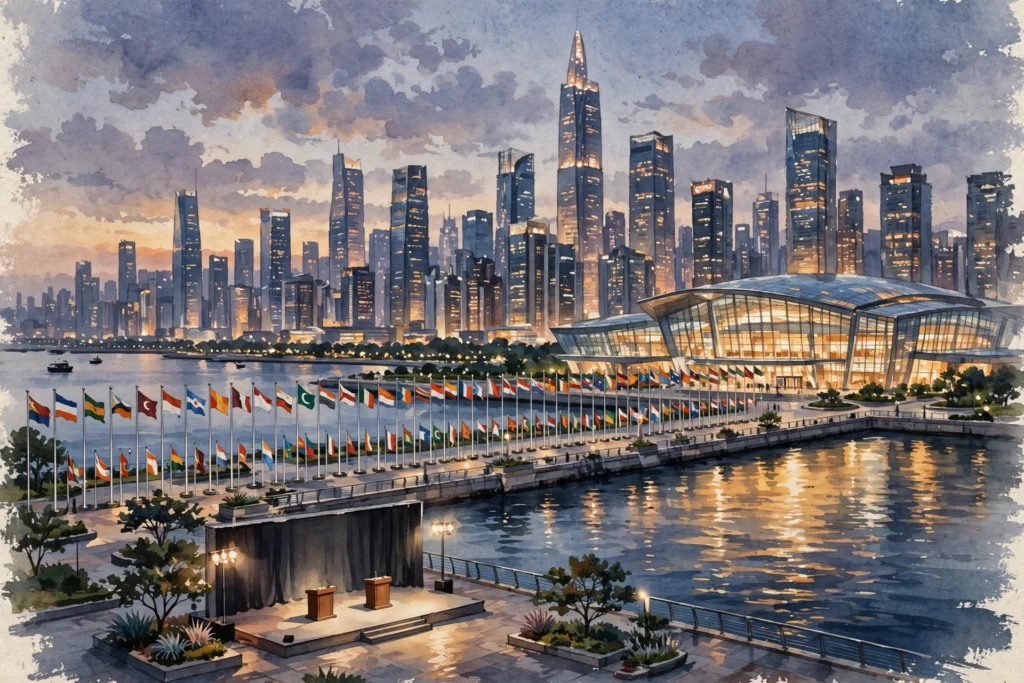
The Chinese president told the audience that countries must firmly uphold the rules-based multilateral trading system with the World Trade Organization at its core, support free and open trade and investment, and keep global industrial and supply chains stable and running smoothly. He promised that China would not only cut tariffs and expand market access but would go a step further, carrying out reform in challenging areas such as rules, regulation and standards, and he identified the creation of a Free Trade Area of the Asia-Pacific as a key task. The pitch landed against a striking backdrop: China's trade surplus is on track to exceed one trillion dollars for a second year in a row. The summit was also a showcase for the host city, transformed over four decades from a fishing village into a skyscraper-studded centre for export manufacturing and technology, and Xi said China would continue to invest in its industrial complex and develop new technologies that would also benefit other countries.
Putin Calls the West Former Hegemons and Says Sanctions Backfired
Putin took the stage after Xi, and his speech was aimed at a different grievance. Where Xi spoke about trade rules and market access, Putin spoke about power and punishment, and about a sanctions regime that he said had failed. He described Western powers as former hegemons, arguing that the countries which imposed sanctions after his invasion of Ukraine are in decline and that their tools of economic coercion no longer work. He said Europe was in a humiliating decline, and he argued that the anti-Russian sanctions imposed after the invasion had backfired, making his country stronger rather than weaker.
His central claim was that sanctions, tariffs and export restrictions may still exert a certain deterrent effect, but they are incapable of halting growth, let alone crushing the economies of competitors. It was a direct challenge to the logic of the Western sanctions regime, delivered the day after Ukraine destroyed part of the Kerch Bridge linking mainland Russia to occupied Crimea. The speech also carried a warning for Thursday. The trump administration has kept sanctions and export controls at the centre of its approach to both Russia and China, and Putin's argument that those weapons have already been tested and failed is the argument he will bring to the table with Trump.
New US Chip Curbs Set the Backdrop for the Talks
Xi's remarks came just two days after Washington announced a further tightening of the rules governing China's access to advanced American computer chips. On Monday, the Commerce Department's Bureau of Industry and Security issued an interim final rule designed to close a loophole in the existing export controls: Chinese companies that cannot buy the most advanced AI chips directly have been renting computing power from data centres in other countries, effectively reaching the same hardware through the cloud. The new rule requires a licence to export, re-export or transfer AI chips and servers to any data centre, anywhere in the world, if it may provide computing power to companies in China or other restricted countries.
The rule sets its threshold at twelve million total processing performance, the export-control measure of computing power, which works out to roughly the maximum computing power of about seven hundred and fifty of Nvidia's H100 chips. It covers indirect access through go-betweens and brokers, and it requires operators to examine the direct and indirect ownership of their customers. Data centres already providing that much computing power to Chinese-owned firms have ninety days to obtain a licence. The rule also adds new licensing requirements for chip exports to Malaysia, Singapore, Indonesia, Thailand and Brazil, and it formally rescinds the Biden administration's AI Diffusion Rule from January 2025. Written at the direction of the Treasury Department and the National Security Council, it takes effect when it appears in the Federal Register, scheduled for Thursday. Its context is a scandal that has engulfed Nvidia: Jensen Huang resigned as chief executive on November 12 after revelations of an affair with a woman suspected by American intelligence of working for China, a former executive of a Singapore-based data centre company called Megaspeed that bought thousands of Nvidia chips for data centres in Malaysia. Treasury Secretary Scott Bessent said on television last week that he wanted to cut off Megaspeed's access, and Beijing has pledged to retaliate against the new restrictions.
Kerch Bridge Strike Raises the Stakes on Ukraine
The other event hanging over the Shenzhen meeting is the destruction of part of the Kerch Bridge, the nineteen-kilometre road and rail crossing over the Kerch Strait that links southern Russia to the Crimean peninsula. Ukrainian forces struck the bridge overnight on Monday into Tuesday, in the second attack on the crossing in two days. One of the metal arches and a section of the roadway were completely destroyed, the road section was put out of action with no vehicle able to cross, and the fallen span dropped into the strait's only shipping channel, blocking traffic between the Sea of Azov and the Black Sea. The railway section was left standing but damaged, although rail service resumed on one track on Tuesday.
President Volodymyr Zelensky said the strike was the seventh stage of an operation carried out over several weeks, developed and coordinated by the Security Service of Ukraine together with the General Staff of the Armed Forces. He said the attack used only domestically produced weapons: Palianytsia drones struck the road section, while Neptune cruise missiles, Ruta drones and FP-5 Flamingo long-range drones struck the railway section. It was the most successful Ukrainian attack on the bridge since the war began, following earlier strikes in October 2022, July 2023 and June 2025, and it came a day after Russia damaged two bridges across the Dnipro river in Kyiv. Russia promised repairs, the Kremlin said the bridge would be rebuilt, and a criminal case was opened. But the loss of the road span forces Russian forces to rely on the overland route through occupied southern Ukraine to supply Crimea, and the strike landed days before Putin was due to sit down with Trump and Xi, a demonstration of Ukrainian military strength at the moment when concerns are growing that the gathering could add pressure on the war-ravaged country in peace talks. The bridge, opened by Putin himself in 2018, has enormous symbolic value as well as military importance.
Iran War News and Ukraine War News on the Agenda
The white house news broke on Friday, November 13, when officials confirmed that Trump, Xi and Putin would hold their first trilateral meeting on the sidelines of the APEC summit in Shenzhen, with the talks focused on nuclear non-proliferation and the war involving the United States, Israel and Iran also on the agenda. The Kremlin confirmed the following day that the three countries had agreed to hold the summit, and Beijing has confirmed that Xi will chair the APEC Economic Leaders' Meeting across the two days of the summit. The three countries control most of the world's nuclear weapons, and the meeting comes after the last treaty limiting the arsenals of the United States and Russia expired in February.
The reporting around the meeting suggests the conversation will range well beyond nuclear weapons. Russia's war in Ukraine and the war involving the United States, Israel and Iran are both expected to be discussed, along with trade, artificial intelligence and nuclear weapons. The meeting has drawn comparisons with the 1945 Yalta Conference, where the United States, Britain and the Soviet Union formalised spheres of influence and set the stage for the postwar order, a comparison that has alarmed smaller countries that fear great-power deals imposed over their heads. Officials on all sides have been quick to dampen expectations: the White House has described the session as the start of a conversation rather than the place where a deal is struck, and one American official has said expectations of a breakthrough are low. That caution is understandable, since the meeting has no precedent and no agreed agenda beyond nuclear stockpiles. But the fact of the meeting itself is significant. No American president has ever attempted a three-way summit with the leaders of China and Russia, and holding it in Shenzhen, on Chinese soil, at a summit China is hosting, gives Xi a home advantage that will not be lost on anyone watching.
Trade, Tariffs and the APEC Free-Trade Goal
The trump tariffs that have defined Trump's second-term economic policy are the central tension at a summit whose founding purpose is open trade. APEC brings together twenty-one economies from around the Pacific Rim, and its long-term aim is the eventual formation of a Pacific Rim free trade zone. The tariff news out of Washington has run in the opposite direction all year, with higher American duties on Chinese goods and on goods from allies and partners alike, and the friction over those duties is now leading to realignments among other trading partners, as countries hedge between the two largest economies. That tension is the context for Xi's speech, and for the trade truce that hangs over the Thursday meeting. Trump and Xi reached a trade truce last year after a series of tariff escalations, and Trump's emphasis on friendly relations with Xi has raised the possibility that the truce could be extended when the two men meet. No extension has been announced, and the new chip restrictions suggest the harder edges of the relationship are still sharpening. A truce extension would give businesses on both sides a measure of stability; a breakdown would send the tariff fight into a new and more damaging phase. Xi's pitch to APEC's members was that China offers stability, open markets and a commitment to the rules of the system, while the United States offers tariffs and uncertainty, a reversal of the roles the two countries played a decade ago.
What Happens Next
The next forty-eight hours will determine whether the speeches in Shenzhen were a prelude to progress or a warning of stalemate. Donald Trump was due to arrive in China on Wednesday evening and join the other APEC leaders for the summit's main sessions, and the APEC Economic Leaders' Meeting runs across Wednesday and Thursday. The bilateral meeting between Trump and Xi and the three-way session with Putin are both scheduled for Thursday. There are several things to watch: whether the leaders agree to extend the trade truce, and whether the chip restrictions become a bargaining chip or a point of rupture; whether the nuclear discussion produces anything concrete, or remains the start of a conversation; what, if anything, is said about Ukraine and the war involving the United States, Israel and Iran; and the tone the three leaders strike when they emerge. Whatever happens on Thursday, the week in Shenzhen has already changed the terms of the argument, and the trilateral summit was historic before anyone spoke.
Source: Reuters