Trump News: Trump Praises Marcos Family in Manila
The trump news out of Manila on Tuesday night was not a trade announcement or a defence pact. It was a toast, or something close to one, in which President Donald Trump stood at a gala dinner of Southeast Asian leaders and praised the parents of his host, Philippine President Ferdinand "Bongbong" Marcos Jr., calling them great people and crediting them with their son's good genetics. The remark reached back across four decades of Philippine history to a family whose name is still one of the most charged in the country's politics: Ferdinand Marcos, the strongman deposed in a popular uprising in 1986, and his wife Imelda, the former first lady who is now 97 and who knew Trump in New York long before either man held the offices they hold today. It was the kind of personal, unscripted moment that has defined Trump's diplomacy for a decade, and it landed in a city where the Marcos name still divides opinion between those who remember the dictatorship and those who voted the family back into the palace.
The dinner was the formal centrepiece of Trump's first evening in the Philippines, the opening stop of a three-day Asia trip that will take him from Manila to Shenzhen in China for a summit with Chinese President Xi Jinping and Russian President Vladimir Putin. He had arrived in the Philippine capital late on Tuesday afternoon, landing at Ninoy Aquino International Airport at 5:30 p.m. local time, and within hours he was sitting down with the leaders of the Quad grouping, taking part in a special summit with the United States and ASEAN, and then attending the gala dinner hosted by Marcos. What made the praise notable was not its length but its subject: a family whose return to power is one of the most remarkable political comebacks in modern Asian history, honoured by an American president in the very palace from which it was driven out.
What Trump Said at the ASEAN Dinner
The remark itself was short, delivered as a personal aside rather than a prepared statement. "I just don't want to date myself, but I knew your parents very well. And they were great," Trump said, addressing Marcos Jr. at the dinner. "I believe in genetics. And they did a good job. You have very good genetics, I can tell you that." The words were reported by The Washington Post from the dinner, and other accounts of the evening carried the same exchange, noting that Trump spoke at a gala dinner of ASEAN leaders hosted by Marcos on Tuesday. The setting mattered: the dinner brought together the heads of state and government gathered in Manila for the 49th ASEAN summit, and Trump's tribute to his host's parents was delivered in front of them all.
The praise was not a one-off flourish. It was consistent with what Trump has said about the Marcos family before. The last time the two leaders met face to face, in July 2025 in Washington, Trump offered a similar verdict. "Great family, great family legacy and highly respected in his country," he told Marcos Jr. then, according to The Washington Post. The repetition matters, because it shows the dinner remark was not a slip or a passing pleasantry. It was the president's settled view of the family, expressed twice in sixteen months, in two capitals, in front of two very different audiences. The first time it was said in the White House; the second time it was said in Manila, in the city where the family's story began and where its critics are loudest. That Trump chose the gala dinner to praise the family, rather than simply to thank his host, was a choice, and it was heard as one.
Donald Trump Latest News: A Friendship That Goes Back Decades
The most striking part of the dinner remark was the claim behind it: that Trump knew the Marcos parents very well. That is not a diplomatic courtesy. It is a statement about a real relationship, and it has a history that stretches back to New York in the 1990s, when Imelda Marcos and Trump moved in the same social circles and attended parties together. Imelda, who is 97, was then the exiled widow of a deposed dictator, living in the long shadow of the family's fall; Trump was a New York property developer whose name was already a fixture of the city's tabloid culture. That the two knew each other at all is a reminder of how small the world of wealth and celebrity can be, and of how long the threads of Trump's personal history run.
The connection has survived the decades and the changes of fortune on both sides. When Marcos Jr. called Trump to congratulate him on his election victory in November 2024, Trump asked after Imelda, according to the younger Marcos. "My mother is really his friend, he knows my mother very well," Marcos said, relaying the conversation. It is the kind of personal exchange that rarely makes the official record of a call, and it suggests a relationship maintained across the years through the families themselves. The White House has not hidden the personal note in the visit. Before the trip, officials were arranging a possible brief reunion in Malacanang between Trump and Imelda, if she was well enough and if her doctors approved, and it was noted that she now uses a wheelchair. The fact that such a meeting was even contemplated, for a 97-year-old former first lady who has not held office in forty years, says something about how Trump views the relationship. He does not treat the Marcos family as history to be handled at arm's length. He treats it as a living connection, and one he was willing to make time for in the middle of a tightly scheduled state visit.
The Marcos Family Legacy: Dictatorship, Exile and Return
To understand why the praise drew so much attention, it is necessary to understand what the Marcos name means in the Philippines. Ferdinand E. Marcos ruled the Philippines for twenty years, and for much of that time he ruled as a dictator, having imposed martial law and concentrated power in his own hands. He was ousted in 1986 by a nonviolent popular uprising, the People Power revolution, after an election whose result was widely seen as fraudulent. He died in exile in Hawaii, without facing trial on American criminal charges that he had plundered the Philippine Treasury. Years later, a court found his estate liable for torture, summary executions and disappearances carried out under his rule. His wife Imelda, famed for a lavish lifestyle that included a vast shoe collection, became a symbol of the family's excess, and the billions the family was said to have taken from the country became a byword for corruption.
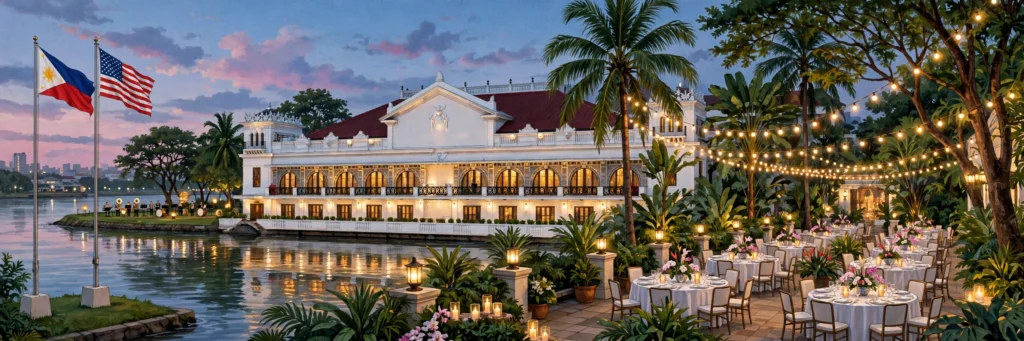
For decades after 1986, that legacy was treated as an obstacle to the family's political ambitions, something to be explained away or quietly set aside. The younger Marcos spent years working to rehabilitate the family's image, and in 2022 he won the presidency, completing a return to power that few would have predicted when his father was flown out of the country in the night. He now governs from Malacanang Palace, the presidential residence that was also his childhood home, and he hosted Trump there this week as the head of a government that the United States counts among its oldest treaty allies in Asia. The palace itself is part of the story: it is the building from which his father ruled, the building from which the family fled, and the building to which the son returned as president. That Trump praised the family inside that palace added a layer of symbolism that no one in the room could have missed.
The rehabilitation has not erased the history, and it has not silenced the critics. The protests that have accompanied Trump's visit are, in part, a protest against the Marcos family's return and against the alliance with Washington that the younger Marcos has embraced. The demonstrations, which ran into their fifth day as Trump arrived, drew about 1,500 people to a downtown square in Manila, where they waved red flags, held a streamer reading "Resist U.S. war and plunder," and prepared to burn an effigy of the American president. The praise Trump offered at the dinner, in that context, was not only a personal remark. It was a public embrace of a family whose critics see its return as a betrayal of the revolution that removed it.
Trump News: The Wednesday Reunion at Malacanang
If the dinner remark was the first act of the story, the second act came on Wednesday morning, when the reunion that had been described as only a possibility actually happened. Trump began his day in Manila with a welcome ceremony at Malacanang, where he was received by rows of troops and a brass band, and then sat down to lunch with Marcos Jr. at the presidential palace. Marcos noted that he had sent fast food from the Philippine chain Jollibee to the American delegation for a late-night snack on Tuesday, and complimented Trump for "working very hard." Trump, for his part, praised the bond between the two countries and the interior decoration of the palace itself. "Our people share common history, common values, common interests, common architectural tastes," he said. "I love what you've done here."
Then came the meeting that had been in doubt. Trump had a short reunion with Imelda Marcos, the former first lady and mother of the current president, in what the Associated Press described as a brief encounter during the visit. Trump called her "always the most beautiful," and the 97-year-old matriarch appeared to hand him a gift, according to a video posted by the White House. The details are few, and the video is short, but the fact of the meeting is now established: the two old acquaintances from the New York party scene of the 1990s met again in the palace in Manila, thirty years later, with one of them now the president of the United States and the other the mother of the president of the Philippines. It was the meeting the White House had said might happen if Imelda was well enough, and it happened.
The bilateral meeting that followed produced a trade deal, which Trump announced after the talks, alongside defence and energy cooperation. The trade figures that frame the relationship are worth noting, because they show how much the partnership has changed. The American trade deficit in goods with the Philippines has risen under Trump, climbing from 4.9 billion dollars in 2024 to 12.8 billion dollars during the first nine months of this year, according to the Census Bureau. The numbers are a reminder that the alliance is not only a matter of sentiment or shared history. It is a commercial relationship with real stakes, and the praise Trump offered the family was delivered in the middle of a negotiation about what that relationship is worth.
US Politics: Why the Praise Drew Attention
The praise drew attention for reasons that go beyond the words themselves, and the reaction has focused on what the remark says about Trump's view of the world. The New York Times, in its account of the visit, noted that Trump has a well-known affinity for autocratic leaders, and the Marcos praise fits a pattern his critics have long pointed to: a willingness to speak warmly about strongmen and their families, and to treat personal relationships as a legitimate basis for diplomacy. The elder Marcos was not merely a controversial figure. He was a dictator who ruled by martial law, whose government was found liable for torture and killings, and whose family was accused of plundering the treasury on a vast scale. To call him great, and to credit his genes, is to offer a verdict on that history, and it is a verdict that many Filipinos, and many Americans, would dispute.
There is also a domestic political dimension, and it is one that will be read in Washington as well as in Manila. Trump is travelling abroad for the first time since his party suffered significant losses in the midterm elections, and the trip has been presented as a demonstration that the administration remains active on the world stage. The praise for the Marcos family, delivered at a dinner of foreign leaders, is part of that demonstration, and it is also a reminder that the president's diplomacy is personal in a way his predecessors' rarely was. He does not hide his friendships, and he does not apologise for them. The remark about Imelda, and the reunion that followed, were not accidents of scheduling. They were the product of a relationship the president has maintained for decades, and of a view of the Marcos family that he has now stated publicly, twice, in two capitals.
The visit has also drawn criticism of a different kind. Critics have accused the Philippine government of papering over urban poverty to present a polished face to visitors, with a slum cleanup ordered before Trump's arrival that drew complaints from residents and activists. The criticism is not about the praise, and it is not about the Marcos family. It is about the cost of hosting a state visit, and about who pays it. But it belongs in the same picture, because it shows that the visit was not universally welcomed, and that the warmth of the reception inside the palace stood in contrast to the anger outside it. The protesters in the square and the residents of the cleared neighbourhoods are part of the story too, and their view of the visit is very different from the one expressed at the dinner.
What Happens Next
The Manila leg of the trip is now over. Trump departed on Wednesday afternoon for Shenzhen, where he will take part in the Asia-Pacific Economic Cooperation summit on November 18 and 19 and hold a trilateral meeting with Xi Jinping and Vladimir Putin, at which he has said he plans to discuss limiting nuclear weapons and bringing an end to the war in Ukraine. He has also said a meeting with North Korean leader Kim Jong Un could potentially take place, although no such meeting has been confirmed. The praise for the Marcos family will not be the subject of those talks, and it is unlikely to be mentioned again in Shenzhen. But it will travel with the president, as part of the record of a trip that has already produced more than its share of unscripted moments.
For the Philippines, the visit ends with a relationship that is visibly closer than it was a week ago, and with a public endorsement from the American president that the Marcos family will not soon forget. The trade deal, the defence cooperation and the energy discussions are the substance of the visit, and they will be judged on their results. The praise is something else: a personal statement, delivered in public, about a family whose history is still contested. It will be remembered in Manila long after the details of the trade deal have faded, because it touched on the question that has defined Philippine politics for forty years, which is what the Marcos name means and whether the family's return to power is a restoration or a reckoning. Trump has given his answer. The Philippines, as ever, will give its own.
Source: The Washington Post