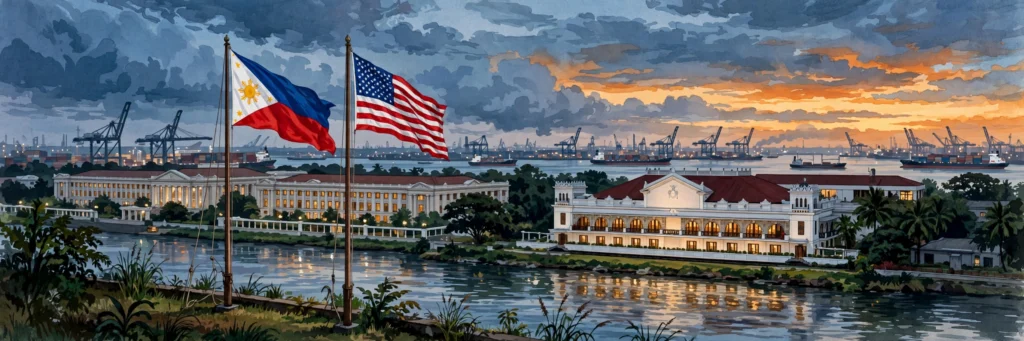
Trump Tariffs: Philippines Trade Deal Announced in Manila
The trump tariffs story took a new turn in Manila on Wednesday, when President Donald Trump announced that the United States and the Philippines had reached what he called a very big trade deal. Speaking alongside Philippine President Ferdinand Marcos Jr during his state visit to the Philippine capital, Trump described the agreement as a magnificent deal that would be fair to both sides, and paired the announcement with a sweeping package of defence and energy cooperation that ranged from more than five billion dollars in approved arms sales to a possible civilian nuclear project and a role for Manila in a planned natural gas export venture in Alaska.
The announcement came at the end of a bilateral meeting at Malacanang Palace, the presidential residence in Manila, on the second day of a three-day Asia trip that had already produced a trade statement with Thailand and the first meeting of Quad leaders in more than two years. It also landed against a very specific piece of unfinished business: a 12.5 percent American tariff on Philippine exports that Manila has been pressing Washington to reduce, and that the two leaders had been expected to discuss face to face. Whether the new deal changes that tariff, and by how much, was not spelled out in the first accounts of the meeting, and no formal text of the agreement had been published when the news broke.
That gap between a presidential announcement and a published deal is familiar territory for this administration's trade policy. Trump has now announced a string of framework agreements with trading partners in the months since he launched his tariff campaign, several of them unveiled on social media or in remarks beside a visiting leader, with the fine print following days or weeks later, if at all. What is already clear is that the president used the visit to bind trade, defence and energy into a single package, and to present the Philippines, America's oldest treaty ally in Asia, as a showcase for the kind of relationship he wants to build across the region.
What Trump Announced in Manila
The core of the announcement was the trade deal itself. Trump told reporters that the two countries had concluded their negotiations, using the same celebratory language he has used for earlier agreements, and he framed the outcome as a win for both sides rather than a one-sided American victory. The Times of India, reporting from Manila, said Trump had announced a very big trade deal with the Philippines alongside plans to expand defence, nuclear energy and broader energy cooperation, and quoted him describing the agreement as a magnificent deal that would be fair to both sides. Reuters, in its own account of the meeting, reported that Trump told Marcos the United States was expanding defence cooperation with its treaty ally and could also work with Manila on a major civilian nuclear energy project.
The defence element was the most concrete part of the package. Trump said Washington had expanded military support for the Philippines and had approved more than five billion dollars in arms sales to its ally, a figure that underlines how central the security relationship has become as both countries watch China's activity in the South China Sea. The Philippines sits at the centre of some of the most contested waters in the world, and the United States has been deepening its military footprint there, including through expanded access to Philippine bases and joint exercises.
The nuclear proposal was the most surprising element. Trump raised the possibility of the Philippines adopting American technology for its first modern nuclear project, and suggested the two countries could do something very big together in the field. For the Philippines to embrace American technology in its first modern nuclear project would underscore the strength of the important relationship, and we are probably going to do something very big to do with nuclear, he said, according to Reuters. A civilian nuclear programme built on American technology would be a major strategic and commercial undertaking, tying the two countries together for decades, but it would also require years of regulatory work, financing and construction before a single reactor came online.
Energy cooperation extended beyond nuclear power. Trump said the Philippines could become a partner in a planned natural gas export project in Alaska, adding that discussions on wider energy cooperation were already under way. The Philippines would be a very natural partner in this effort, he said. We are working on that. The Alaska project, a long-discussed plan to export liquefied natural gas from the state's North Slope to Asian markets, has been a recurring theme of the administration's energy diplomacy, and bringing Manila in as a buyer or partner would give the project a new anchor customer in Southeast Asia while giving the Philippines a new source of gas for its power plants.
Tariff News: The 12.5% Duty Behind the Talks
The trade deal was announced against the backdrop of a tariff dispute that has been hanging over the relationship since the summer. Washington imposed a 12.5 percent duty on Philippine exports on July 24, after an investigation by the Office of the United States Trade Representative concluded that Manila had not done enough to prevent imports made with forced labour from entering the country. The duty was imposed under Section 301 of the Trade Act of 1974, the same trade-remedy law the administration has used to justify a series of tariffs, and it replaced an earlier levy of 10 percent.
The Department of Trade and Industry has estimated that about 34 percent of the country's exports to the United States, worth roughly 6.25 billion dollars on 2025 figures, are subject to the 12.5 percent rate, while about 11.98 billion dollars of exports are exempt. The shipments most exposed to the duty are Philippine-made leather and travel goods, apparel, footwear and toys. Indonesia and Malaysia, which had already banned forced-labour imports or committed to do so in trade agreements with Washington, received a lower rate of 10 percent, while the Philippines landed in the 12.5 percent group alongside Singapore, Thailand and Vietnam.
Manila has been pushing for relief since the duty took effect. The Philippine government issued a joint administrative order in July that created an interagency committee, led by the trade department, to receive, evaluate and investigate complaints about imported goods produced through forced labour and to prevent their entry, and it delivered the order to American officials as evidence that it was acting on Washington's concerns. Trade Secretary Cristina Roque said on Monday, two days before the meeting, that the tariff would be discussed when the two leaders sat down together, and she made no secret of the direction Manila wanted the conversation to go. Of course my wish is to bring down the tariffs, she said. We want to expand the exports to the US and to all other markets globally. Asked what message the Philippines would bring to the talks, she declined to give details, saying she could not disclose it and that it was best to wait for November 18.
That is the context in which the new deal must be read. If the agreement includes a reduction in the 12.5 percent rate, it would be a tangible win for Marcos, who has faced pressure at home to show that the alliance with Washington delivers economic benefits as well as security guarantees. The first reports of the meeting did not say whether the rate had changed, and the White House had not published a fact sheet setting out the terms. Until it does, the most honest description of the deal is that the two presidents say they have reached one, and that the details, including the tariff treatment of Philippine goods, are still to be confirmed.
Trump Administration: A July Framework and a Changed Landscape
The Manila announcement is not the first trade deal Trump has struck with the Philippines this year. In July, after a meeting with Marcos at the White House, the president announced a framework agreement under which the United States would impose a 19 percent tariff on Philippine goods, down from the 20 percent rate he had threatened to apply from August 1, while the Philippines would open its market to American products with zero tariffs. It was a beautiful visit, and we concluded our Trade Deal, Trump wrote on his social media platform at the time. The agreement was described as the fifth struck over the past three months, and it was presented as evidence that the administration's tariff threats were producing concessions from trading partners.
The July framework, however, was overtaken by events. The United States Supreme Court ruled in February that Trump had exceeded his authority by imposing reciprocal tariffs under the International Emergency Economic Powers Act, the emergency-powers law the administration had used as the legal basis for its sweeping tariff campaign. The ruling forced the administration to rebuild its tariff architecture on other legal foundations, and one of the tools it turned to was the Section 301 investigation process, which allows tariffs to be imposed in response to unfair trade practices. The forced-labour investigation that produced the 12.5 percent duty on Philippine goods was part of that shift, and it meant that by the time Trump arrived in Manila, the tariff landscape looked very different from the one that had framed the July announcement.
The underlying economics of the relationship give both sides reasons to want a deal. The United States ran a goods trade deficit of about five billion dollars with the Philippines last year, with total trade between the two countries reaching about 23.5 billion dollars, according to figures cited when the July framework was announced. The Philippines is a much smaller economy than the giants of Asian trade, but it is a significant supplier of electronics, garments and agricultural products to the American market, and it is a growing buyer of American farm goods, machinery and, increasingly, defence equipment. For the administration, a deal with Manila is also a demonstration that its tariff strategy can produce agreements with friendly countries, not only confrontations with rivals.
The pattern of announcing first and publishing later has drawn criticism from trade analysts, who point out that framework deals without published texts leave businesses guessing about the rules they will actually face. The July announcement was followed by uncertainty about whether anything had been formally signed, and the same question hangs over the Manila deal. The test, as ever, will be whether a written agreement appears, and whether it changes the tariff rate that Philippine exporters actually pay.
White House News: Why Manila Matters Now
The timing of the visit matters as much as its content. Manila was the first stop on a three-day Asia trip and the president's first overseas destination since his party suffered significant losses in the midterm elections, according to the Times of India. The trip was designed to show that the administration remains active on the world stage despite its domestic setbacks, and to lock in a series of trade and security arrangements before the president moves on to China. Trump arrived in Manila on Tuesday afternoon, landing at Ninoy Aquino International Airport at 5:30 p.m. local time, and within hours he was sitting down with the leaders of the Quad, the grouping of the United States, India, Japan and Australia, for their first leaders' summit since September 2024.
The Quad meeting set the tone for the trip. The four leaders discussed critical mineral supply chains, the safety of commercial shipping lanes and the development of artificial intelligence, and the president announced that the group would conduct an exercise featuring maritime patrol aircraft and launch an accelerator to speed the development of artificial intelligence. The gathering was the first Quad summit of Trump's second term and the first ever held in a country that is not itself a member of the grouping, and it was followed by a special summit with the leaders of the Association of Southeast Asian Nations.
The Philippines is the natural centrepiece for that message. It is the oldest American treaty ally in Asia, bound to Washington by a mutual defence treaty that dates back to 1951, and it is the Southeast Asian country most directly exposed to Chinese pressure in the South China Sea, where Beijing's coast guard and maritime militia regularly confront Philippine vessels around disputed reefs and shoals. Successive Philippine governments have wrestled with how to balance the alliance with Washington against the economic pull of China, and Marcos has tilted firmly towards the United States, expanding American access to Philippine military bases and speaking openly about the threat from Beijing. A trade deal, an arms package and a nuclear partnership are the economic and technological complement to that strategic choice.
The trip also produced a second trade announcement on Tuesday, when Trump signed a joint trade statement with Thailand on the sidelines of the ASEAN summit in Manila. Under that statement, Thailand would eliminate all tariffs on American exports and remove substantial non-tariff barriers on American vehicles, medical devices, pharmaceuticals, ethanol and poultry, while purchasing an estimated 2.6 billion dollars in additional American agricultural products. Trump said he looked forward to finalising the details of a formal agreement in the coming weeks. The Thailand statement and the Philippines deal, announced within a day of each other, suggest an administration trying to rack up quick trade wins across Southeast Asia in a single swing through the region.
There was also a sharper edge to the president's remarks in Manila. Speaking alongside Marcos, Trump described Venezuela as an American acquisition and pitched the energy partnership with the Philippines in the same appearance, according to the Hindu BusinessLine, a reminder that the president's foreign policy combines deal-making with a blunt assertion of American power. The comment, made in passing during a visit focused on Asia, underlined how the administration's approach to Latin America and its approach to the Indo-Pacific are cut from the same cloth: energy, trade and security treated as a single negotiation.
What Happens Next
The immediate question is whether the White House publishes a written account of the deal. The administration has sometimes followed its trade announcements with a fact sheet setting out tariff rates, market-access commitments and implementation dates, and sometimes it has not, leaving the details to be worked out by trade officials in the weeks that follow. Philippine officials have said they will disclose the outcome of the discussions after the meeting, and Trade Secretary Roque's earlier promise to reveal the results on November 18 suggests that more information should emerge quickly. Until it does, exporters, importers and investors will be left to parse the president's remarks for clues about what has actually been agreed.
The tariff question is the one to watch. If the deal cuts the 12.5 percent duty, whether to the 10 percent rate enjoyed by Indonesia and Malaysia or lower, it would be a concrete benefit for the Philippine exporters who have been paying the higher rate since July. If the rate is unchanged, the deal will be judged on its other elements: the arms sales, the nuclear project and the Alaska gas partnership, all of which are real commitments but none of which puts money directly into the pockets of the garment workers and leather-goods makers who bear the cost of the tariff. The Department of Trade and Industry's figures make the stakes plain: more than six billion dollars of exports are caught by the duty, and the difference between 12.5 percent and 10 percent is real money for the firms that pay it.
Beyond Manila, the trip moves on to Shenzhen in China, where Trump is due to attend the Asia-Pacific Economic Cooperation summit on November 18 and 19, hold bilateral talks with Chinese President Xi Jinping, and take part in a three-way meeting with Xi and Russian President Vladimir Putin on nuclear arms control. He has also said a meeting with North Korean leader Kim Jong Un could potentially take place. The Philippines deal will be presented there as evidence that the president arrives in China with momentum, having secured agreements with two Southeast Asian partners in two days. Whether that momentum survives contact with the far harder negotiations in Shenzhen is another question, and it is one that will be answered in the days ahead.
For the Philippines, the visit ends with a relationship that is visibly closer than it was a week ago, but with the central commercial question still open. The alliance has been reaffirmed, the defence ties have been deepened, and the door has been opened to nuclear and energy cooperation that could reshape the country's power sector. The next few days, when the White House and the Philippine government publish whatever they have agreed, will tell the travelling public, the exporters and the markets whether the magnificent deal announced in Manila is a turning point in the tariff dispute, or another framework waiting for its fine print.
Source: NBC News