Trump Administration: FAA Signed Off on Repair Work
The trump administration's account of the nationwide ground stop that paralysed American air travel last Friday has been thrown into doubt by a new report that the Federal Aviation Administration itself oversaw, tested and signed off on the repair work now blamed for the outage. A Federal Aviation Administration official was supervising a contractor in rural Arkansas as he switched vital air traffic communications lines from an old copper-wire network to a new fibre-optic one, and the official tested the finished product and approved the work, according to a person close to the investigation who spoke to The Washington Post. Just eight minutes later, the radio network serving much of the country's air traffic control centres began to falter, and the agency ordered a rare nationwide ground stop that halted departures across the United States for about four and a half hours.
The disclosure changes the shape of a story that, until now, has been told largely as a tale of contractor failure. Transportation Secretary Sean P. Duffy has repeatedly said the ground stop was caused by work carried out by L3Harris Technologies, the contractor hired to modernise the FAA's communications backbone, at a remote facility in El Dorado, Arkansas. On Saturday, Duffy said the agency was working out whether the cause was "incompetence" by L3Harris or a faulty router. But the person close to the investigation told the Post that Duffy's characterisations were "inflammatory" and "insulting" and overlooked the FAA's prominent role in the work performed in Arkansas. The precise cause of the communications outage remains a mystery, the person said, speaking on condition of anonymity to discuss sensitive matters they were not authorised to talk about.
The scale of what happened on Friday, November 13, explains why the question of who approved the work matters so much. The ground stop was the longest nationwide halt to American air travel since the September 11, 2001 attacks, and the first nationwide halt since January 2023. The FAA issued the order at 3:54 p.m. Eastern time, with more than 3,500 aircraft already in the sky, and lifted it at about 8:15 p.m. FAA Administrator Bryan Bedford said roughly 9,000 to 10,000 flights were cancelled on Friday and about 12,000 scheduled flights were unable to take off. More than 9,000 flights were delayed and 827 were diverted, and the disruption spilled into the weekend, with more than 12,500 cancellations counted across the two days and nearly 1.5 million passengers affected. The stop came just days before the Thanksgiving travel rush, the busiest flying period of the year, and it turned a routine Friday afternoon into a national test of a system that officials on both sides of the argument now agree is running on equipment decades old.
What Happened in El Dorado, Arkansas
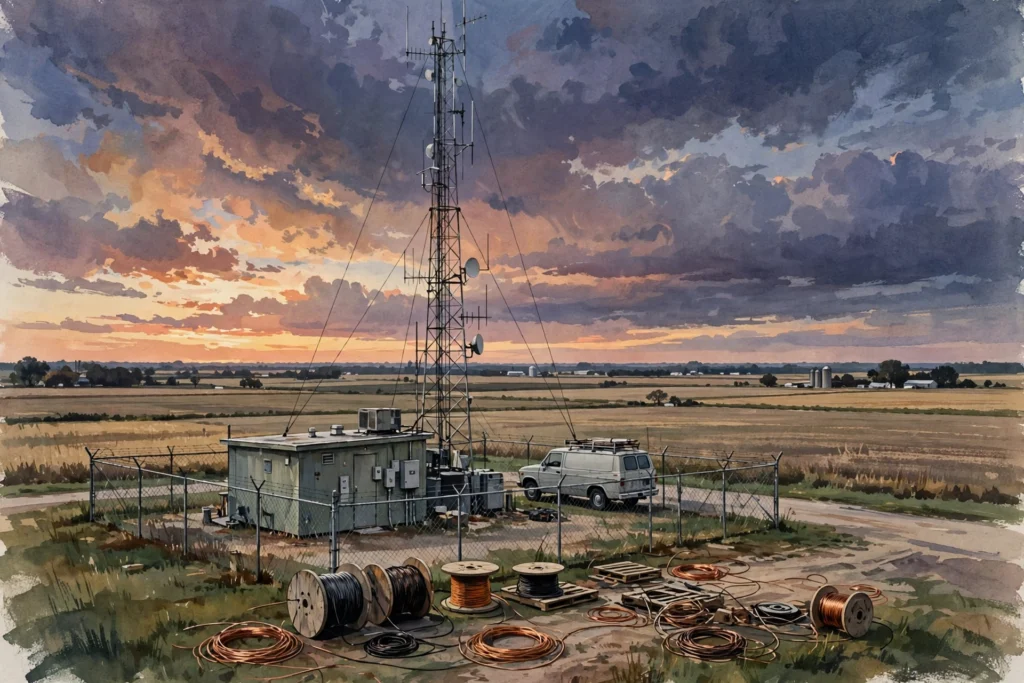
The work at the centre of the dispute was one small piece of a much larger effort to drag the nation's air traffic control communications out of the copper-wire era. The job in Arkansas was part of the programme to replace the ancient copper lines that carry voice and data between air traffic control centres with modern fibre-optic cable, and L3Harris is the main contractor on that job. FAA officials have said the modernisation effort is now 70 percent complete and could be finished late next year. The work at the remote communications site in Arkansas began in October and followed the standard procedure for L3Harris's modernisation efforts, the person close to the investigation said, and the FAA approved all of it.
On Friday, the L3Harris contractor and an FAA official returned to the site to carry out the next step: switching the communications lines over and replacing a router, a device known as a Juniper router that directs traffic across the network. The question of why the work was allowed to start ahead of a busy aviation weekend was put to the person close to the investigation, who said the FAA had performed an operational risk assessment and given the green light. The official watched the work, tested the finished product, and signed off on it. Eight minutes later, the network began to fail.
What followed was a cascading failure that spread far beyond Arkansas. Federal investigators have traced abnormal network activity to facilities in El Dorado and in Amarillo, Texas, where telecommunications equipment was involved in the breakdown. Duffy said on Sunday that replacing the router at the Arkansas facility triggered problems with another router that had recently been replaced in Texas, which started broadcasting and overloading routers at other air traffic control centres across the country. The installation by L3Harris of at least one new router at the remote facility led to a situation in which other centres were flooded with data that hampered their communications systems, according to officials. Two people familiar with the investigation told Reuters that the router installation itself went smoothly, and that problems developed only after the replacement was successfully completed under FAA oversight. Friday's problems were triggered "sometime shortly" after service at the facility was turned back over to the FAA, which had signed off on the work performed.
Officials said 17 of the FAA's 22 Air Route Traffic Control Centres experienced network instability during the incident. The FAA said on Sunday that it had disabled the broadcasting function of the routers believed to be involved and taken similar precautions with approximately 60 other routers across the air traffic control system. The routers that experienced issues were purchased in 2001 and were obsolete by 2006, Duffy said. As of 7 a.m. Eastern time on Monday, 284 flights within, into or out of the United States had been cancelled and another 954 delayed, according to flight-tracking website FlightAware, and Duffy predicted that air travel would return to normal on Monday. The disruption was, by the government's own account, the product of maintenance work that had been done thousands of times before without issue, and the FAA still does not know what ultimately caused the problem.
The Trump Administration's Blame Game
The new account of the FAA's role sits awkwardly with the version of events the trump administration has been giving in public since Friday. Duffy has been the face of the response, and his language has been blunt. He has said repeatedly that the ground stop was caused by L3Harris's work at the El Dorado facility, and on Saturday he framed the question as whether the cause was "incompetence" by the contractor or a faulty router. At a news conference on Tuesday at the Capitol, given alongside Bedford, Duffy said he wanted L3Harris to "hire better minds" for the work and is looking at bringing in other companies to help with the remaining contract. When the Post asked the FAA for comment on its new reporting, the agency pointed to that news conference rather than addressing the account directly.
The person close to the investigation did not dispute that L3Harris performed the work, or that the router was at the centre of the failure. What they disputed was the suggestion that the contractor had acted alone or without supervision. The FAA official was present for the work, tested it, and signed off on it, and the agency had approved the procedure in advance and cleared it through an operational risk assessment. On that telling, the failure is not a story about a contractor going rogue. It is a story about a system in which the government's own overseers approved a routine procedure that then went wrong in a way nobody yet understands, and about a cabinet secretary who moved quickly to assign blame before the investigation had established what happened.
That tension is not only a matter of public relations. It goes to the heart of how the investigation will be judged, and to who bears responsibility for a failure that stranded more than a million passengers. If the FAA signed off on the work, then the questions facing investigators widen considerably. They include whether the risk assessment was adequate, whether the testing the FAA official performed was sufficient to catch the fault, whether the procedure itself was flawed, and whether the agency's oversight of a contractor it depends on for a national modernisation programme is rigorous enough. The FAA and L3Harris are examining the router at a lab in Florida, and L3Harris is continuing its work on replacing and updating communications lines while the inquiry continues. Duffy has also said there was no evidence of a cyberattack or other malicious intent, and Homeland Security Secretary Markwayne Mullin said there were no indications of a cyberattack.
Congress and the $50 Billion Question
The dispute over blame is unfolding against a much larger fight in Congress over money. Duffy has called for $50 billion in additional funding to modernise the air traffic control system, up from an earlier request of $30 billion, after Congress approved $12.5 billion for upgrades last year. He has warned that the network runs on equipment decades old, saying, "I have systems that are from the '90s. I have radar that are from the '60s and '70s," and he has argued that companies including AT&T, Verizon and Lumen are ready to deploy a new architecture "tomorrow" if the money is there.
The size of the request has startled even members of the president's own party, and its history has become a problem for the administration. The ask has climbed steadily: the administration first described the $12.5 billion Congress approved in 2025 as a down payment, then sought about $20 billion more, raised the figure to $30 billion in late September, and then to $50 billion in the hours after the ground stop, each time without detailed breakdowns of how the money would be spent. Senate Majority Leader John Thune and other Republicans have demanded to know what happened to the money already provided, and Senator John Cornyn of Texas said it was "highly unlikely that Congress is just going to write a check for $50 billion just because he says so."
Democrats have pointed to the money already in hand. Congress approved $12.5 billion for air traffic modernisation in the president's sweeping spending bill in June 2025, but as of June of this year only $474.9 million of it had been spent, according to data from a congressional source shared with CNN. Thune said about $8 billion was still sitting unspent, and Representative Eric Larsen, the top Democrat on the House Transportation Committee, put the unspent figure at $11 billion. A September report by the Government Accountability Office added to the scepticism, finding that the administration had "not developed a comprehensive and well-documented lifecycle cost estimate" for its modernisation work. Trump weighed in for the first time on Monday, blaming the Biden administration and calling the breakdown "very, very old equipment that had a heart attack." Duffy was due to make his case to Senate Republicans at their weekly lunch on Tuesday, November 17, and the fight is now tangled up with the battle over government funding, which runs out on December 11.
The revelation that the FAA oversaw the Arkansas work is likely to sharpen that argument. Lawmakers who were already asking why billions in approved funding had not been spent will now also want to know why an agency that approved a procedure, supervised it, tested it and signed it off still saw the network collapse eight minutes later. The answer may be that the fault lay in a piece of equipment nobody could have foreseen failing, or in a software interaction that only appears at scale. But until the investigation produces a root cause, the administration's request for $50 billion will be judged against a record in which the government itself was in the room when the work that preceded the failure was done.
FBI News: The Investigation Widens
The investigation itself has widened in the days since the ground stop. The FBI said its cyber teams are working with the FAA, the Department of Transportation and L3Harris to provide technical assistance in the investigation, and stated that it has not taken possession of any equipment related to the incident. The bureau's involvement does not mean foul play is suspected. Officials have been consistent that there is no evidence of a cyberattack, and Duffy has said the same. The FBI's role appears to be technical support for an inquiry into a complex network failure, and its presence underlines how seriously the government is treating an outage that shut down the skies over the world's largest aviation market.
Meanwhile, the FAA has halted installation of new routers linked to Friday's ground stop until the root of the problem is found, according to a CBC report cited in coverage of the outage. That pause is a precaution, not a finding, and it reflects the uncertainty that still surrounds the cause. The routers at the centre of the failure are old, the network they serve is old, and the modernisation programme that is supposed to replace them is itself the project whose work preceded the collapse. L3Harris is continuing its work on replacing and updating communications lines while the inquiry continues, a decision that suggests the agency does not believe the programme itself is unsafe, even as it pauses the specific router installations connected to the incident.
The central question remains unanswered. The precise cause of the communications outage is still a mystery, the person close to the investigation said, and the FAA has not yet produced a root-cause analysis. Bedford said a root-cause analysis would be shared when available, but no date has been given. The examination of the router at the Florida lab is one strand of that work. The review of the risk assessment, the testing and the sign-off in Arkansas is another. And the question of whether the same failure could happen again, at another facility, on another Friday afternoon, is the one that matters most to the travelling public, and the one the investigation has not yet been able to answer.
What Happens Next
The immediate future belongs to the investigation and to Congress. The FAA and L3Harris will continue their examination of the router in Florida, and the agency has promised a root-cause analysis when one is available. Duffy's case for $50 billion will be tested in the Senate, where Republicans as well as Democrats want to know what happened to the money already approved and why a system that received $12.5 billion last year still depends on routers bought in 2001. The funding fight runs out on December 11, and the modernisation argument is now tangled up with it.
For travellers, the more pressing question is whether the system will hold through Thanksgiving. The ground stop was the most serious disruption to American air travel in a quarter of a century, and it came at the start of the busiest travel period of the year. The FAA has taken precautions with dozens of routers and paused new installations, and officials said on Monday that the system was returning to normal. But the cause of the failure is still unknown, and until it is found, the reassurance rests on precautions rather than on an explanation. The latest trump news from Washington suggests the blame game is far from over, and the next chapter will be written not by a cabinet secretary's remarks but by the lab in Florida and the report that follows. Whether the $50 billion request survives contact with lawmakers who now know the FAA signed off on the work that preceded the failure is an open question, and the answer will shape the system that carries Americans through the holidays and beyond.
Source: The Washington Post