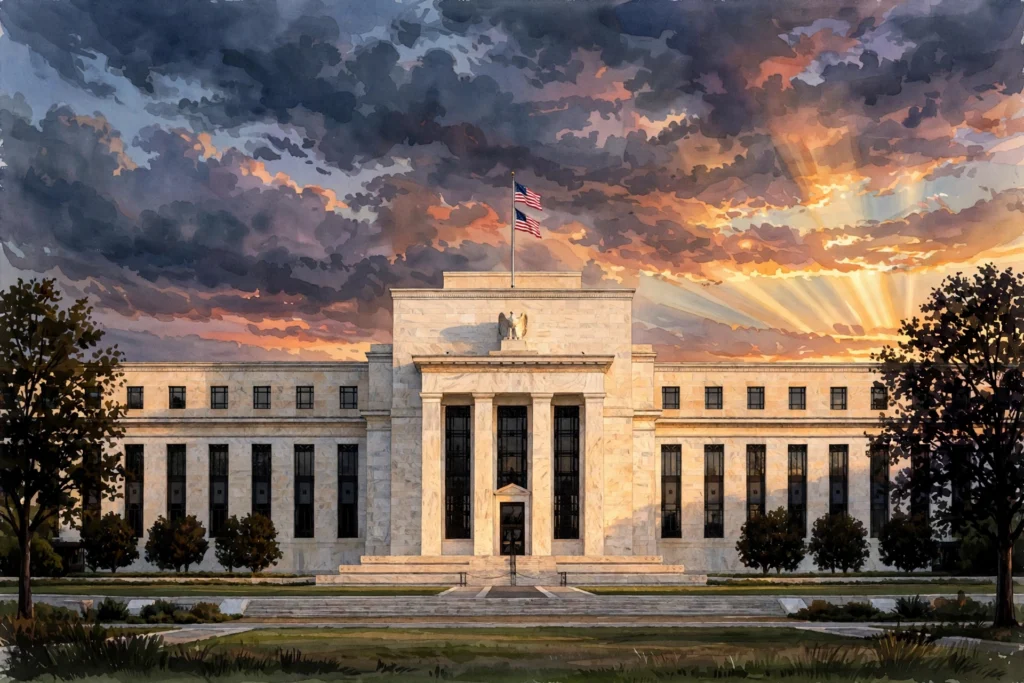
Federal Reserve News: Minutes to Test Rate-Hike Bets
Federal Reserve news takes centre stage on Wednesday, when the central bank releases the minutes of its October 27 to 28 meeting, and traders will read every line for clues about whether the Fed will raise interest rates again at its December 8 to 9 meeting. The minutes arrive at a moment when the direction of policy has flipped from the assumption that dominated most of the year. The market is no longer debating a rate cut. It is pricing a rate hike, with futures traders putting the odds of a quarter-point increase in December at roughly 88 to 91 percent, and a smaller but real chance of a half-point move, after a run of inflation data that came in hotter than expected and a 10-year Treasury yield that has pushed above 5 percent and stayed there. The minutes will not reveal the December decision, because that decision has not been made. What they can reveal is how broad the support for another increase was inside the room in October, and that breadth is what the market is waiting to measure.
The October meeting itself ended in a hold, but it was not a comfortable one. The Federal Open Market Committee kept its target range for the federal funds rate at 3.75 to 4.00 percent on a 10 to 2 vote, with Governor Lisa Cook and Cleveland Fed President Beth Hammack dissenting in favor of another quarter-point increase. The statement said plainly that inflation remains elevated, and the two dissents were the visible sign of a committee that was closer to moving than the headline suggested. The December committee has twelve participants: the seven governors, New York Fed President John Williams, and the rotating presidents Hammack, Kashkari, Logan and Paulson. What the minutes can establish is whether the two dissenters were outliers or the leading edge of a majority, and whether the officials who voted to hold did so because they were convinced rates were high enough, or because they wanted one more round of data before moving. If the record shows most participants expecting another increase soon, December is effectively settled and the argument moves to January.
The data since the meeting has pushed in one direction. On November 10, the Bureau of Labor Statistics reported that consumer prices rose 0.4 percent in October from September, against a consensus forecast of 0.3 percent, and that core prices, which exclude food and energy, rose 0.3 percent for a third straight month, against a forecast of 0.2 percent. On November 13, producer prices rose 0.3 percent on the month, below the 0.4 percent expected, but the annual rate climbed to 6.5 percent, the highest since November 2022. The annual inflation picture is complicated by a gap in the data: the Bureau collected no prices in October 2025 during the 43-day lapse in appropriations, so there is no year-ago comparison for October, and the last published annual core rate is September's 2.6 percent, with headline inflation at 3.7 percent. But the monthly numbers are clear enough. Prices are rising faster than the Fed wants, and they have been doing so for three months in a row.
What the Market Is Pricing for December
The market's response to the inflation data has been swift and decisive. After the October consumer price report, CME FedWatch showed a 91 percent chance of a quarter-point hike in December and a 9 percent chance of a half-point hike. A week earlier, traders had put the odds of a quarter-point hike at 77 percent and the odds of the Fed holding rates steady at 23 percent. By Friday, November 13, markets were pricing a 100 percent chance of a 25-basis-point hike at the December 8 to 9 meeting, according to one reading of the futures, with the odds of a 50-basis-point hike at 11.5 percent. A Reuters poll of economists conducted November 6 to 10 found that all 101 economists surveyed expected a quarter-point increase in December, a unanimity that is rare in such surveys and that reflects how thoroughly the inflation data has settled the debate. The question is no longer whether the Fed moves in December, but by how much, and what it signals about January.
The most hawkish voice in the debate belongs to Fed Governor Chris Waller, who said in London on the same day as the consumer price report that he would consider backing a 50-basis-point hike at the December meeting if core inflation keeps coming in at 0.3 percent or higher. Waller's condition has now been met three months in a row, which gives his warning real weight. Other officials have been more measured. Speaking in San Francisco, Federal Reserve Chair Kevin Warsh suggested that the economic boost from artificial intelligence might disappoint, while steering clear of the inflation risk, and Kansas City Fed President Jeff Schmid said policymakers still have work to do on inflation. The contrast between those messages is the reason the minutes matter: the public remarks give the market fragments, and the minutes assemble them into a picture of where the committee as a whole stands.
The bond market has already delivered its verdict on the direction of policy. The 10-year Treasury yield closed at 5.31 percent on October 5, its highest close since May 2002, then fell to 4.84 percent on November 5, its lowest close since September 9, before pushing back above 5 percent and reaching 5.17 percent by Friday, November 13, a four-week high. On Tuesday, November 17, the yield eased 2.0 basis points to 5.133 percent, with the two-year yield down 3.8 basis points to 4.836 percent, as Treasuries caught only a small haven bid during the equity sell-off. The two-year yield has climbed more than 1.2 percentage points in 2026, to over 4.7 percent as of November 11. The 10-year breakeven inflation rate, the market's implied average consumer inflation over the next decade, was 2.20 percent, essentially at the Fed's target, which means the rise in yields is not primarily a story about inflation expectations. It is a story about real yields: subtract the breakeven rate from the nominal yield and the real yield is about 2.8 percent, what a lender earns on a ten-year Treasury after expected inflation. That is a high real return, and it is the price the market is charging for lending to the government for a decade.
Why High Yields Matter for Stocks and Borrowing
The level of yields is the thread that connects the Fed's decision to the rest of the economy, and it is the reason the minutes will be read far beyond the bond market. The 10-year Treasury yield is the benchmark for mortgage rates, and it is the reason the average 30-year fixed mortgage stood at 7.33 percent in October, the highest since 2000 apart from a single month in 2023, and the reason existing-home sales fell to their slowest pace since August 2010. It is also the reason the artificial intelligence investment cycle, which is being financed with debt, is getting more expensive to fund. The companies building data centers are borrowing heavily, and when the yield on the safest asset in the world sits above 5 percent, the cost of that borrowing rises with it. The stock market felt the effect on Monday, when the Nasdaq fell 2.5 percent and the S&P 500 lost 1.9 percent in a sell-off centred on technology stocks, and the selling was not confined to the United States: Asian chip stocks fell sharply, European chip stocks were lower, and the bond market barely moved, a sign that investors were worried about more than just technology.
The minutes arrive in the middle of a crowded week for the market, and their timing amplifies their importance. Nvidia reports its quarterly results after the close on Tuesday, the first since the departure of its former chief executive, and the options market is pricing a move of nearly 8 percent in either direction. Retail sales and industrial production for October are due on Tuesday, November 17, and they will show whether the consumer, who has kept spending through a year of high prices, is starting to pull back. On Wednesday, alongside the minutes, the market will also be digesting the Nvidia results and the pending home sales data. And on Thursday, Anthropic is expected to price its initial public offering, with the shares set to list under the ticker ANT, a test of investor appetite for artificial intelligence companies that are not yet profitable at the scale of their ambitions. The minutes are one event among many, but they are the one that speaks directly to the cost of money, and the cost of money is the thread that runs through all the others.
The labour market is the other half of the Fed's mandate, and it is the reason the decision is not straightforward. The Fed is charged with both stable prices and maximum employment, and the two goals are pulling in opposite directions. Inflation is too high, which argues for higher rates, but the labour market is cooling, which argues against them. The minutes should show how the committee weighed that trade-off in October, and whether the officials who voted to hold did so because they were worried about jobs, or because they wanted more evidence on prices, or because they believed the September rate increase, the first since 2023, needed time to work through the economy. The Fed raised rates in September for the first time since 2023, and the October hold was the first chance to assess the effect. The December decision will be the second chance, and the minutes are the best available guide to how the committee is thinking about it.
The September Hike and a Central Bank Under Pressure
The October meeting did not happen in isolation. The Fed raised rates in September for the first time since 2023, lifting the target range to 3.75 to 4.00 percent, and the October hold was the committee's first chance to assess the effect of that move. The September increase came after a long stretch in which rates had been steady, and it marked a turn in policy that surprised a market which had spent much of the year expecting cuts. The October decision to hold, on a 10 to 2 vote, was therefore a pause inside a tightening cycle rather than the end of one, and the two dissents in favor of a further increase were the clearest signal that the committee's centre of gravity had shifted. The minutes should show whether the officials who voted to hold regarded the September hike as sufficient for now, or whether they simply wanted another month of data before moving again.
The leadership of the Fed is also part of the story. The chair is Kevin Warsh, and his public remarks have been watched closely for signs of how he reads the economy. Speaking in San Francisco, he suggested that the economic boost from artificial intelligence might disappoint, a cautious note about a technology that the market has treated as a near-certain source of growth. He steered clear of the inflation risk in those remarks, which left the market to infer his position from the committee's actions rather than his words. The minutes, which record the discussion rather than the speeches, are a better guide to the chair's thinking than any single appearance, because they show what was said in the room and by whom, and how the arguments were weighed.
The data the committee works with has itself been under strain. The 43-day lapse in appropriations meant the Bureau of Labor Statistics collected no prices in October 2025, which is why there is no year-over-year inflation comparison for October 2026, and why the last published annual core rate is September's 2.6 percent. The gap is a reminder that the Fed is making decisions with incomplete information, and that the monthly figures, which are complete, carry more weight than usual. The monthly core reading of 0.3 percent for three consecutive months is the number that matters most, because it shows underlying price pressure running at a pace that, annualised, sits well above the Fed's 2 percent target. A central bank that targets 2 percent cannot ignore three straight months of 0.3 percent, and the market's pricing reflects that arithmetic.
The market's reaction to the prospect of higher rates has been visible beyond bonds and stocks. Gold fell to a one-year low of 3,855 dollars as the dollar firmed, and silver fell 4.46 percent to 46.93 dollars, a reminder that higher real yields raise the cost of holding assets that pay no income. The pattern is the textbook response to a hawkish turn: when the yield on a ten-year Treasury rises above 5 percent, the opportunity cost of holding gold rises with it, and the metal falls. The same logic applies to the growth stocks that led Monday's sell-off. When the risk-free return is above 5 percent, the future earnings of a fast-growing company are worth less in the present, and the market reprices them accordingly. The minutes will not change that arithmetic, but they will tell the market whether the Fed intends to keep the pressure on, or whether it regards the current level of rates as enough.
What Happens Next
The December meeting, on December 8 and 9, is the decision point, and it brings more than a rate decision. It also brings fresh projections from Fed officials, including the dot plot, which shows where each member thinks rates are headed, and a press conference at which the chair will be asked to explain the choice. If the minutes show a committee leaning toward more than one additional move, the argument after December will be about January and about how high rates go. If they show a committee that was divided and cautious, the market will read December as a single step rather than the start of a sequence, and the focus will shift to whether the inflation data in the new year justifies another move. A half-point hike in December, a minutes transcript showing a majority leaning toward more than one additional move, or a breakeven inflation rate climbing decisively above roughly 2.5 percent would each break the current pattern, and each would push yields higher and stocks lower.
For households, the consequences are concrete. A higher federal funds rate does not set mortgage rates directly, but it nudges them, and mortgage rates track the 10-year Treasury yield, which has already risen above 5 percent. A December hike would keep borrowing costs high for homebuyers, for small businesses, and for the companies building the data centers that have powered the stock market's gains. For savers, higher rates are a benefit, and for borrowers they are a cost, and the balance between the two is the reason the Fed's decision is watched so closely. The minutes on Wednesday will not settle the question, but they will narrow it, and in a week when the market is already on edge, narrowing the question is enough. The traders who price a quarter-point hike at 90 percent and a larger hike at 6 percent are betting that the minutes will confirm what the inflation data has already told them: that the Fed is not done, and that December is when it proves it.
Source: Reuters