Trump News: Philippine Protests Grow as Trump Visits
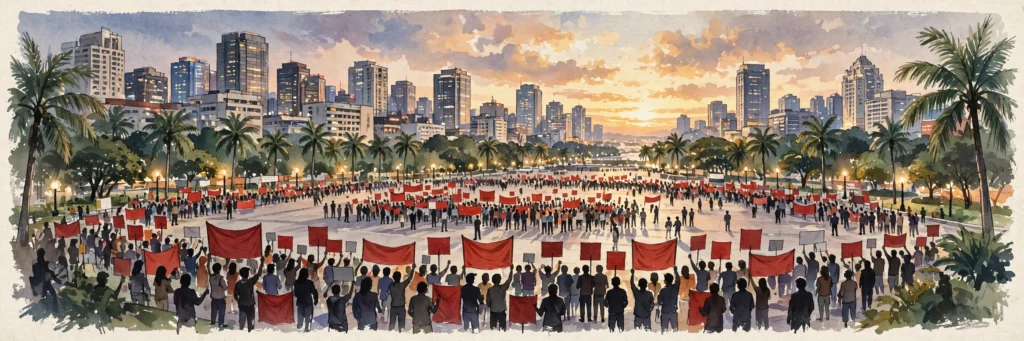
The trump news out of Manila on Tuesday came in two sharply different registers. Inside the summit venues, President Donald Trump was welcomed with a marching band, a flag-waving child and a gala dinner as the guest of honour. Outside, in a downtown square a short distance away, about 1,500 protesters waved red flags, held up a streamer reading Resist U.S. war and plunder, and prepared to burn an effigy of the American president. The demonstrations, now in their fifth day, have grown into the most visible opposition of the trip, and they have turned a flying diplomatic visit into a contest over how the Philippines should deal with the United States.
The protests are not a sideshow to the summit. They have been building since the weekend, they have already produced clashes with police, injuries and arrests, and the groups behind them have refused a government request to hold off until the world leaders leave. Their demands reach well beyond the visit itself: an end to the war in the Middle East, the scrapping of an American-led initiative on artificial intelligence and critical minerals, and a Philippine foreign policy that does not take its cues from Washington. As Trump arrived for the ASEAN-U.S. summit on Tuesday, the protest camp at Liwasang Bonifacio Plaza was still standing, and its organisers were calling on the public to join them.
The contrast is the story of the visit. The Philippine government has rolled out the full ceremonial welcome for a president it regards as its oldest treaty ally, while a significant current of public opinion regards the same visit as a reminder of a relationship that has never been equal. Both things are true at once, and the week in Manila has made that tension impossible to ignore.
Trump News: Fifth Day of Protests in Manila
The rally on Tuesday was the largest of the week so far. About 1,500 left-wing protesters gathered in a downtown Manila square ahead of Trump's arrival, according to the Associated Press, calling on Philippine leaders not to take their foreign policy cues from the United States. They waved red flags and held up a large streamer that read Resist U.S. war and plunder. They planned to burn an effigy of Trump, a traditional centrepiece of Philippine street protest, while riot police with shields and wooden truncheons stood nearby.
The protest leader on the ground, Teddy Casino, put the demand in plain terms. Speaking to the Associated Press at Liwasang Bonifacio square, he said the Philippine government should not deal with what he called a loser, and that the call to the Marcos administration was to stop being a puppet of Donald Trump and to uphold an independent foreign policy for the Philippines. The reference was to President Ferdinand Marcos Jr., whose government has spent the week hosting the summit and welcoming the American delegation.
Tuesday's rally was the fifth day of demonstrations, and the protests have grown steadily since they began. On Sunday, November 15, hundreds of demonstrators marched toward the summit venue and clashed with police, who blocked their path. The demonstrators included members of the New Patriotic Alliance, a network of activist groups that campaigns for democracy and social justice. According to Anadolu Agency, citing local media, at least two people were injured and several others were arrested after police blocked protesters near the Philippine International Convention Center.
The grievances the protesters name are specific. They oppose the war in the Middle East, which they say has driven up prices and deepened the economic crisis for ordinary Filipinos. They oppose the Pax Silica initiative, the American-led project on artificial intelligence and critical mineral supply chains, which they say will displace thousands of indigenous people and cause environmental destruction. And they oppose the visit itself, which they regard as an endorsement of a Philippine government they accuse of failing to address the concerns of its own people while welcoming foreign leaders.
One protest leader summed up the message in terms that left no room for ambiguity: to Donald Trump, the message was that he was not welcome in the Philippines. The slogan has appeared on placards and banners throughout the week, and it has been repeated in the statements of the groups organising the demonstrations.
White House News: A Red-Carpet Welcome Awaits
The government the protesters are criticising has taken a very different view of the visit. Trump arrived in the Philippines on Tuesday as the first stop on a three-day trip that will later take him to China, and the welcome was choreographed to the smallest detail. As he descended the stairs from Air Force One, he pumped his fist. A child handed him small American and Philippine flags, which he waved and then swept in big circular motions as he smiled. A marching band played YMCA as he walked to a waiting helicopter.
On Wednesday, the ceremonial welcome reaches its peak. Trump is set to receive a red-carpet welcome and full military honours from Marcos Jr., followed by a state banquet as part of his visit to the Malacanang presidential palace. The two leaders are expected to affirm their commitment to their countries' longstanding treaty alliance, and Trump is also expected to announce a series of commercial deals and investments in the aviation, defence, energy and technology sectors before heading to Shenzhen in China for the Asia-Pacific Economic Cooperation summit.
There is also a personal note to the visit that the White House has not hidden. Officials are arranging a possible brief reunion in Malacanang with Imelda Marcos, the 97-year-old former first lady and mother of the incumbent president, if she is well enough and gets her doctors' approval. Now using a wheelchair, she was the jet-setting wife of the strongman leader who was ousted in the pro-democracy People Power uprising of 1986. But the friendship with Trump endured: he often asks Marcos Jr. and other Philippine officials how she is doing. When the Philippine leader met Trump in the White House last year, he carried a note from his mother thanking the American president for his strong backing of the Philippines, and Trump told him to please say hello to her.
The formal programme is a reminder of why the visit matters to both governments. The Philippines is Washington's oldest treaty ally in Asia, and the two countries are bound by a defence treaty under which Washington has repeatedly stated that it is obligated to defend the Philippines if Filipino forces come under armed attack. The ASEAN leaders have been working on a non-aggression pact with China in the contested waters of the South China Sea, a key global trade route, and confrontations there have escalated in recent years, particularly between Chinese and Philippine coast guard and naval forces in disputed shoals.
Trump Administration: The ASEAN and Quad Agenda
The business of the visit began within hours of Trump's arrival. First on the agenda on Tuesday was a meeting of the leaders of the Quad nations, the grouping of the United States, Australia, India and Japan that aims to counter China's influence in the Asia Pacific. It is their first meeting since Trump returned to the White House last year, and the first Quad leaders' gathering in two years. Trump was then scheduled to sign a trade deal with Thailand, the kind of agreement he has relished striking since launching a trade war last year buttressed by steep tariff threats.
The Thailand agreement illustrates how much of the week's diplomacy is about trade. The United States announced a trade framework last October under which Thailand would remove tariffs on most American goods, as well as barriers for importing American cars, food products and pharmaceutical drugs, according to the Office of the United States Trade Representative. At the time, the administration said Thailand would also spend more than 18 billion dollars on American aircraft and buy American farm goods and liquefied natural gas. The picture has since been complicated by the courts: the Supreme Court overturned in February the 19 percent tariff that Trump placed on goods from Thailand, and the administration sought replacement tariffs in July by levying a 12.5 percent tax on imports from Thailand for not taking steps to oppose the use of forced labour.
Before the gala dinner on Tuesday night, Trump was due to take part in what was billed as a special summit with the ASEAN leaders, where they were expected to discuss efforts to deepen trade and security ties as well as the region's longstanding conflicts, including years of violence in Myanmar and escalating disputes in the South China Sea, which Beijing claims virtually in its entirety. Washington rejects China's expansive claim in the waterway. He was being feted at the gala as the guest of honour at the annual summit of the Association of Southeast Asian Nations, a cocktail reception and dinner with other world leaders that offered an intermission from some of the thorniest issues at home.
The visit is Trump's first travel abroad since his party suffered deep losses in the midterm elections, and the first time he has travelled overseas as a president facing a Congress controlled by the opposition party. It is also, by his own account, the opening leg of a week that will take him to China for three-way nuclear talks with Chinese President Xi Jinping and Russian President Vladimir Putin, and potentially for a meeting with North Korea's leader Kim Jong Un. The Manila stop is brief, barely more than a day, but it sets the tone for everything that follows.
The Protest Movement That Refused to Wait
The groups behind the protests have been organising for weeks, and the government knew it. The progressive group Bagong Alyansang Makabayan, known as Bayan, rejected a request from the presidential palace to defer the demonstrations during the 49th ASEAN Summit, choosing instead to stage them while world leaders gathered in Manila from November 14 to 17. Bayan argued that the presence of international delegates provided a necessary platform to criticise the administration of President Ferdinand Marcos Jr. and American policies, and that the right time to mobilise was during Trump's visit, so that the world could see the broad and massive resistance against what the group called his imperialist agenda.
Bayan's statement also accused the palace of using the summit to discourage scrutiny of government spending, describing the appeal to hold off the protests as a pretentious ploy to avoid accountability. The group claimed that the palace and the police had effectively left no room for dissent, treating protests as threats to national security and branding demonstrators as enemies of the state. It called on the public to maintain the protest camp at Liwasang Bonifacio and to take part in planned actions during the visit.
Women's rights and labour groups had announced their opposition earlier, at a press conference in Manila on Friday, November 13. The groups, organised under the World March of Women-Pilipinas, argued that the president's presence contradicted ASEAN's commitments to eliminating violence against women and human trafficking, and pointed to the accusations of sexual misconduct made against Trump over the years. Their intervention widened the protest beyond the left-wing groups that have traditionally led demonstrations against visiting American presidents, and it gave the movement a broader base.
The logistics of the summit have themselves become part of the argument. The Philippines adjusted the summit schedule to accommodate a 24-hour layover for Trump, who landed on November 17, and invitations sent months earlier to leaders from China, Japan and India had to be updated to reflect the change. The government also declared an ASEAN break from November 15 to 18, during which the authorities have conducted random inspections of public utility vehicles. For the protesters, these measures are evidence that the summit was rearranged around one man, and that ordinary Filipinos are paying the price in disruption and scrutiny.
The demonstrations are part of a long tradition in the Philippines, a country where the United States has a deep and complicated history as a former colonial power, a treaty ally, and the operator of military bases that were closed in the early 1990s but whose presence is still felt through a series of defence agreements. Protests have greeted American presidents before, sometimes in much larger numbers than this week's crowds. What is different this time is the timing: the protests are taking place days after the Republicans suffered major setbacks in the November 3 midterm elections in the United States, and the demonstrators have seized on that result, arguing that Trump arrives in Manila weakened at home and unwelcome abroad.
What Happens Next
The immediate timetable is set. On Wednesday, Trump takes part in the welcome ceremony with Marcos, followed by bilateral talks between the two leaders, the only one-on-one meeting the president is due to hold in Manila. He then departs for Shenzhen, where the Asia-Pacific Economic Cooperation leaders' meeting opens the same day and runs through Thursday, November 19. There he is scheduled to hold bilateral talks with Xi Jinping and to take part in a three-way meeting with Xi and Putin, a combination of leaders that has not sat down together in this format before.
The protests, for their part, are not scheduled to end with the summit. The organisers have kept their camp in place and have called for continued actions during the remainder of the visit, and the fifth day of demonstrations suggests a movement that has found its footing rather than one that is running out of energy. The question for the coming days is whether the crowds grow as the state banquet and the military honours unfold, or whether the heavy police presence and the end of the summit drain the momentum.
What the week has already shown is that the welcome in Manila was never going to be unanimous. The government staged a red-carpet reception for its oldest ally, and the streets answered with an effigy, a streamer and a demand for an independent foreign policy. Both will be part of the record of the visit, and both will shape how it is remembered.
Source: Time Magazine