Trump News: Trump Arrives at ASEAN Summit
The trump news out of Manila on Tuesday was measured in minutes. President Donald Trump arrived in the Philippine capital on Tuesday afternoon, landing at Ninoy Aquino International Airport at 5:30 p.m. local time, the last head of state to reach the 49th ASEAN Summit — and only half an hour before the gathering's closing ceremony was due to begin. The late arrival set the tone for a tightly packed evening of diplomacy: a meeting of Quad leaders, a special summit with the United States and ASEAN, and a dinner with Southeast Asian leaders, all before the president flies on to China on Wednesday for the APEC summit in Shenzhen.
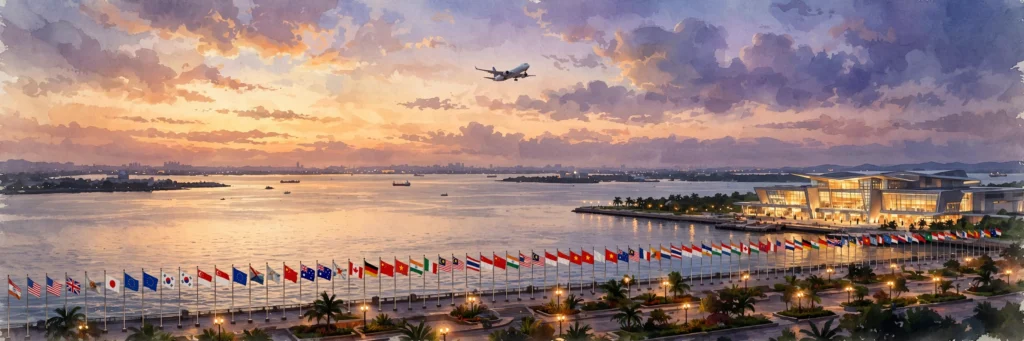
Trump's plane touched down in a city that had spent days preparing for him. The summit, hosted by the Philippines as this year's chair of the Association of Southeast Asian Nations, opened on Sunday at the Philippine International Convention Center in Manila, and by the time the American president arrived, most of the week's business was already done. The closing ceremony, led by President Ferdinand Marcos Jr., was scheduled for 5:00 p.m. — thirty minutes before Trump's scheduled landing — with the Philippines formally handing the ASEAN chairmanship to Singapore. According to the ASEAN National Organizing Council's media advisory, cited by the BusinessMirror, Trump was the last leader to arrive, and his only formal appearance at the summit itself would come in its final half hour.
The timing meant Trump would miss one of the week's set-piece gatherings altogether. The 21st East Asia Summit, which brings together the leaders of ASEAN member states and dialogue partners including Australia, China, India, Japan, New Zealand, Russia and South Korea, was scheduled to begin at 2:30 p.m. on Tuesday — three hours before the president's plane was due to land. Department of Foreign Affairs Undersecretary Leo Herrera-Lim told reporters the schedule would not change, and the Department of Foreign Affairs confirmed that the late arrival would not delay the summit's programme. Trump had been expected to take part in the East Asia Summit alongside the other leaders, but the arithmetic of the timetable made that impossible unless the schedule was rearranged at the last minute.
A Late Arrival on the Summit's Final Day
The White House schedule for the evening, published ahead of the trip, laid out a rapid sequence of engagements once the president was on the ground. At 6:20 p.m., Trump was to greet the leaders of the Quad — the grouping of the United States, Japan, Australia and India — and take part in a photograph opportunity at the Solaire Resort in Manila. Ten minutes later, at 6:30 p.m., he was scheduled to sit down with those leaders for a multilateral meeting. At 7:45 p.m., he was to take part in the ASEAN-U.S. Summit Special and a reception, and at 8:25 p.m., a U.S.-ASEAN dinner.
Wednesday brings a quieter but symbolically important engagement. At 11:05 a.m., Trump is scheduled to take part in a welcome ceremony with President Marcos, followed by bilateral talks between the two leaders. The meeting with Marcos is the only one-on-one the president is due to hold in Manila, and it comes at a moment when the Philippines is Washington's oldest treaty ally in Asia and one of the countries most directly affected by the rivalry between the United States and China in the South China Sea. Officials have not said publicly what the two presidents will discuss, and no new agreement or package has been confirmed for the visit.
The president's trip to Manila is the first stop on an Asia tour that will take him to Shenzhen in China on Wednesday for the Asia-Pacific Economic Cooperation leaders' meeting, which runs on November 18 and 19. There he is scheduled to hold bilateral talks with Chinese President Xi Jinping and to take part in a three-way meeting with Xi and Russian President Vladimir Putin. Trump has also said a meeting with North Korean leader Kim Jong Un might happen in China this week, although no such meeting has been confirmed by any of the governments involved.
The Manila stop is also Trump's first overseas trip since the November 3 midterm elections in the United States, in which Democrats won major victories and took control of both chambers of Congress. That result has changed the political landscape the president is operating in at home, and it has given the Asia trip an added significance: it is the first time he has travelled abroad as a president facing a Congress controlled by the opposition party. The trip is being watched in Washington as closely as it is being watched in Manila, for what it says about how the president intends to conduct foreign policy in the second half of his term.
The Quad Meeting: Four Leaders, First Time in Two Years
The first item on the evening's agenda is also one of the most closely watched. The leaders of the United States, Japan, Australia and India were expected to meet in Manila on Tuesday, shortly after Trump's arrival, for the first Quad leaders' meeting in two years, according to a Reuters report from Manila dated November 14. The meeting was not formally announced by any of the four governments, and it rests on the accounts of two people familiar with the planning who spoke to Reuters, but the White House schedule's inclusion of a multilateral meeting with the Quad leaders at 6:30 p.m. confirmed that the gathering was going ahead.
The Quad is the informal grouping of the four democracies that has become one of the central structures of Indo-Pacific diplomacy. It brings together the United States, Japan, Australia and India for cooperation on security, technology, infrastructure and supply chains, and its leaders' meetings have become a fixture of the regional calendar. That the four leaders have not met at this level for two years is itself a measure of how much has changed in the region — and of how much is riding on the conversation in Manila. The grouping's agenda in recent years has been shaped above all by the rise of China, and by the question of how the four countries coordinate their responses to Beijing's growing military and economic weight in the region.
For Trump, the Quad meeting is also a return to a format he helped to revive. The grouping was relaunched during his first term, and its leaders' summits became a regular feature of his administration's approach to the Indo-Pacific. The fact that the first leaders' meeting in two years is taking place on the margins of the ASEAN summit, in a city where the president arrived only minutes before it began, underlines how much of this trip has been improvised around a timetable that was never going to be generous.
The US-ASEAN Special Summit and Dinner
After the Quad meeting, the president moves on to the centrepiece of the evening: the ASEAN-U.S. Special Summit, scheduled for 7:45 p.m., followed by a reception and then a U.S.-ASEAN dinner at 8:25 p.m. The special summit was described by the Philippine Department of Foreign Affairs as the culmination of the day's proceedings, and it is the formal moment at which the United States engages with the Southeast Asian bloc as a group. The ASEAN-U.S. summit is a regular feature of the regional calendar, but this year's edition carries more weight than most, because it comes at a moment when the relationship between Washington and Southeast Asia is under visible strain.
The strain is, above all, about trade. Trump's tariffs have been one of the dominant themes of the summit in Manila, with leaders seeking common ground on how to respond to a trade war that has hit export-dependent Southeast Asian economies hard. The summit opened on Sunday with leaders looking for a shared position on the tariffs, and the question of what the United States is prepared to offer the region — in market access, in investment, or in reassurance — has hung over the entire week. According to one report from the summit, no new U.S.-ASEAN trade agreement or investment package has been confirmed for the Manila meeting, and the special summit is not expected to produce one.
The summit's broader backdrop has been unusually tense. The gathering takes place against an energy shock triggered by the closure of the Strait of Hormuz earlier this year, volatile global trade, and persistent tension in the South China Sea. The Philippines, as chair, chose to close out its year leading the bloc with a summit that was meant to demonstrate ASEAN's ability to hold together under pressure. The arrival of the American president on the final day, for a few hours of meetings, is a reminder of both the bloc's importance to Washington and the limits of what a flying visit can achieve.
Protests in Manila as Trump Arrives
Trump's arrival was not welcomed by everyone in Manila. Around 2,000 people had gathered to protest his visit, according to a report published on Tuesday, and hundreds of demonstrators had already taken to the streets on Sunday, November 15, to oppose his expected arrival and the role of the United States in regional security. The protests were the most visible sign of a current of opposition to the visit that had been building for days.
Women's rights and labour groups had announced their opposition on Friday, November 13, at a press conference in Manila. The groups, organised under the World March of Women-Pilipinas, argued that the president's presence contradicted ASEAN's commitments to eliminating violence against women and human trafficking. Jean Enriquez, the national coordinator of the World March of Women-Pilipinas and executive director of the Coalition Against Trafficking in Women-Asia Pacific, said at the press conference that at least 28 women had accused Trump of sexual misconduct, harassment, assault and rape. The groups said it was ironic that Trump was arriving in Southeast Asia only days before the start of the 18-day campaign to end violence against women.
The protests are part of a long tradition of demonstrations against visiting American presidents in the Philippines, a country where the United States has a deep and complicated history — as a former colonial power, as a treaty ally, and as the operator of military bases that were closed in the early 1990s but whose presence is still felt through a series of defence agreements. The demonstrations on Sunday and Tuesday were smaller than some of the protests that have greeted American presidents in the past, but they were a reminder that the welcome in Manila was not unanimous.
What the Manila Stop Means for the Trump Administration
The politics news value of the trip extends beyond the summit rooms. For the trump administration, the Asia tour is the first major foreign trip of the second half of the president's term, and it comes at a moment when the administration's foreign policy is being tested on several fronts at once: the trade war with China, the war in Ukraine, the confrontation with Iran, and the unresolved question of North Korea. The Manila stop, brief as it is, is the opening act of a week in which the president will sit down with Xi Jinping and Vladimir Putin — two leaders with whom his relationships have defined American foreign policy for a decade.
The president flew to Asia aboard the new Air Force One gifted to him by Qatar, a luxury Boeing 747 that has drawn scrutiny over whether it has received the full range of defensive upgrades the president promised it would get. Reports by the Washington Post and NBC News, citing American officials, have raised questions about whether the jet has been fitted with the security systems of the aircraft it replaced, and the White House has declined to discuss specific upgrades. The plane has been a subject of argument since the Gulf state presented it to the president last year, and the decision to fly it on a trip that takes in the Philippines and China has kept that argument alive.
From Manila to Shenzhen: APEC and the Xi-Putin Meeting
The Manila visit is, in the end, a prelude. The main event of the week is the APEC leaders' meeting in Shenzhen, which opens on Wednesday, November 18, and runs through Thursday, November 19. There, Trump is scheduled to hold bilateral talks with Xi Jinping, the Chinese president and the host of the gathering, and to take part in a three-way meeting with Xi and Putin — a combination of leaders that has not sat down together in this format before. The APEC meeting brings together the leaders of 21 economies around the Pacific, and this year's agenda is expected to feature trade, artificial intelligence and economic resilience.
For the countries of Southeast Asia, the question is what the week leaves behind. The ASEAN summit in Manila was the Philippines' chance to shape the region's agenda as chair, and the handover of the chairmanship to Singapore at Tuesday's closing ceremony marks the end of that year. The special summit with the United States, the Quad meeting, and the bilateral with Marcos are the last acts of a chairmanship that has had to navigate the trade war, the South China Sea, and the energy shock of the Hormuz closure. Whether the week's diplomacy produces anything durable — a trade understanding, a security commitment, a framework for managing the rivalry with China — will only become clear in the weeks that follow.
What Happens Next
The immediate timetable is set. President Marcos is scheduled to hold a press conference at 6 p.m. on Tuesday, following the closing ceremony. Trump's evening runs through the Quad meeting, the special summit and the dinner, and on Wednesday morning he takes part in the welcome ceremony with Marcos before departing for Shenzhen. The APEC leaders' meeting opens the same day, and the bilateral with Xi and the trilateral with Xi and Putin follow in the days after.
Source: South China Morning Post