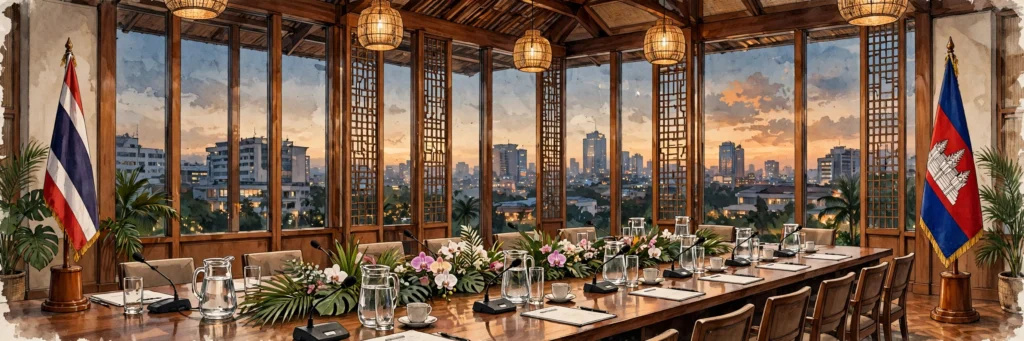
Trump News: Thailand, Cambodia Seek Backing at ASEAN
In the latest trump news from Asia, the 49th summit of the Association of Southeast Asian Nations has become the stage for a quiet contest between two of its own members. Thailand and Cambodia have arrived in Manila seeking the backing of the region, and of the American president who flies in for the closing hours, over a border dispute that killed at least 150 people and forced nearly a million from their homes before a ceasefire took hold in December. The guns have been silent for almost a year, but the argument over where the border runs, and who owns the ancient temples that stand along it, has not been settled. For the leaders in Manila, the question is whether the summit can produce a durable peace between two of its members.
The summit opened on Sunday, November 15, at the Philippine International Convention Center in Manila, and runs until Tuesday, November 17. It is hosted by Philippine President Ferdinand Marcos Jr., who holds the bloc's rotating chair for 2026, and it is the final gathering of the year for a group that now counts 11 members, after Timor-Leste joined in October 2025. Together the members represent nearly 694 million people, about 8.4 percent of the world's population. But it is the arrival of President Donald Trump, due on the final day, that has given the border dispute its sharpest edge, because both Bangkok and Phnom Penh see his brief presence as a chance to win the most powerful backer in the room.
A Ceasefire Holding, a Border Still Disputed
The dispute at the heart of the summit is older than the bloc itself, but it turned violent again late last year. Armed clashes broke out along an 800-kilometre contested border, and around competing claims to sacred sites, above all the Preah Vihear Shiva temple, a centuries-old Hindu sanctuary on the frontier. At least 150 people were reported killed, and nearly one million were displaced from their homes on both sides of the line. The scale of the displacement shocked the bloc and forced it to confront a conflict inside its own family.
The fighting was stopped only after intervention from outside the two countries. ASEAN members pressed both governments to talk, and China and the United States both weighed in, before a ceasefire was agreed in December. That truce has held ever since. But a ceasefire is not a settlement. The underlying territorial disagreement remains unresolved, and the bloc has been pushing for more dialogue and for third-party observers who could watch the frontier and report on whether the truce is being kept. Along the frontier, the fighting emptied villages and towns on both sides and disrupted farming and trade across the border.
The roots of the quarrel go back to maps drawn in the colonial era, when the boundary between French Indochina and Siam was surveyed with lines that the two sides have read differently ever since. The International Court of Justice awarded the Preah Vihear temple itself to Cambodia in 1962, and clarified the land around it in a further ruling in 2013, but the wider border has never been fully agreed. That history matters in Manila: neither government can concede ground without facing anger at home, because each claim is tied to national pride and to sacred ground.
What Each Side Wants in Manila
Cambodia comes to Manila with one overriding concern: keeping the ceasefire in place and reaching a peaceful resolution. Prime Minister Hun Manet is due to arrive shortly after midnight on Tuesday, November 17, in time for the final day of meetings, while Cambodia is represented in the opening sessions by Deputy Prime Minister Hang Chuon Naron. The timing underlines how much of the Cambodian effort is aimed at the summit's closing hours, when Trump is in the room and the final communique is being settled.
Thailand's prime minister, Anutin Charnvirakul, was among the leaders who arrived in Manila on Saturday, ahead of the opening meetings on Sunday. His early arrival gave Bangkok a full weekend of bilateral conversations before the formal sessions began. The White House has also signalled that Trump will sign a trade agreement with Thailand during the visit, which gives Bangkok a separate channel to the American president beyond the border question.
Both governments want the same thing from the summit: international support for their position, and guarantees that the peace will hold. For Cambodia, the priority is a settlement that preserves the ceasefire and brings in outside eyes, through the third-party observers ASEAN has been calling for. For Thailand, the priority is a process that respects its own claims. Neither side can get what it wants from the other alone, which is why both are courting the room: the ASEAN members who must live with the consequences, the great powers whose trade and security ties give them leverage, and the American president whose intervention helped stop the fighting.
Trump News: A Flying Visit With a Crowded Agenda
Trump's own part in the summit is brief to the point of being symbolic. According to the media advisory issued by the ASEAN National Organizing Council, he is scheduled to arrive in Manila at 5.30pm on Tuesday, November 17, just 30 minutes before the formal closing. That means he is likely to miss the East Asia Summit, which begins at 2.30pm the same day. If the schedule holds, his only official appearance would be during the final half hour of the closing ceremony and the handover of the ASEAN chairmanship from the Philippines to Singapore. President Marcos is scheduled to hold a press conference at 6pm, after the ceremony ends.
The centrepiece of Trump's visit is the ASEAN-US Special Summit on Tuesday, the closing event of the gathering. He is also expected to meet Marcos one on one, and to join the leaders of India, Japan and Australia for a meeting of the Quad, the four-nation grouping, on Tuesday evening. It will be his first ASEAN gathering in the Philippines since 2017, and his first major overseas trip since the midterm elections of November 3, when his party lost control of both houses of Congress. In US politics, the trip is being watched as a test of whether a president weakened at home can still command the stage abroad.
The shortness of the visit has not gone unnoticed in Manila. Diplomats had expected Trump to take part in the East Asia Summit alongside the leaders of ASEAN and its dialogue partners. Instead, the schedule leaves him arriving after most of the substantive business is done. That does not make his presence meaningless: a presidential visit, however brief, carries weight, and the leaders who want his backing will have their chance in the margins. From Manila, Donald Trump travels on to Shenzhen for the Asia-Pacific Economic Cooperation leaders' meeting, where a bilateral session with Chinese President Xi Jinping is expected. Xi is not expected in Manila, so the two leaders will not cross paths in the Philippine capital.
Pax Silica and the Contest for Southeast Asia
Beyond the border dispute, the summit is also a stage for the wider contest between the United States and China for influence in Southeast Asia. An analysis published by the Council on Foreign Relations on November 15, by Joshua Kurlantzick, said the president's visit carries ambitious goals but may deliver limited results, a judgement that captures the gap between what Washington hopes to achieve in Manila and what a flying visit can realistically produce. The Trump administration is expected to promote Pax Silica, an initiative focused on artificial intelligence, semiconductors and critical mineral supply chains, which aims to draw Southeast Asian countries into a trusted network for the technologies that will define the next decade.
Potential trade arrangements with Vietnam and Thailand are also on the agenda, according to the same analysis, although uncertainty over American tariffs could complicate progress. That uncertainty has been the shadow over the whole summit: the region's economies depend on exports to the United States, and the tariff policies of the past year have left governments unsure where they stand. China, meanwhile, has been expanding its own artificial intelligence cooperation with ASEAN countries, and its premier used his appearance in Manila to press Beijing's case. The competition is not only about technology. It is about which great power the region's governments see as the more reliable partner, and whether Southeast Asia can keep its options open rather than being forced to choose.
The Wider Agenda: Seas, Myanmar and Energy
The border dispute is far from the only problem on the summit's agenda. The South China Sea remains the region's most persistent flashpoint, with China, Taiwan and four ASEAN members, Brunei, Malaysia, the Philippines and Vietnam, tangled in long-running territorial standoffs. Negotiations on a code of conduct with Beijing, meant to prevent clashes at sea, began in 2005 and have still not produced a final agreement. The summit is also expected to advance the ASEAN Digital Economy Framework Agreement, which aims to double the region's digital economy to two trillion dollars by 2030.
Myanmar remains another unresolved challenge. Its military authorities have been excluded from full political representation at high-level ASEAN meetings since the coup of February 2021, which removed the elected government and set off a continuing civil war. The bloc's five-point peace plan, introduced in April 2021, has failed to produce meaningful progress. On November 15, the leaders agreed to keep Myanmar's representation at a non-political level until meaningful progress is made, a decision that preserves the status quo rather than resolving it.
Energy security has also forced its way onto the agenda, driven by the conflict involving the United States, Israel and Iran, which has disrupted energy markets and raised concerns about fuel supplies and prices across a region that imports much of its oil. The war in the Middle East is far from Southeast Asia, but its effects on shipping, fuel prices and supply chains reach directly into the region's economies.
What Happens Next
The test of the summit comes on Tuesday, when the leaders issue their final communique and the chairmanship passes to Singapore. The document will show whether the bloc has found language on the Thailand-Cambodia dispute that both sides can accept, and whether it commits to the dialogue and third-party observers ASEAN has been calling for. A clear statement, with a mechanism behind it, would be a genuine step forward. The other things to watch are the announcements around Trump's visit: whether the trade agreement with Thailand is signed, and what is said about Pax Silica. Then attention shifts to Shenzhen, where Trump meets Xi. For Thailand and Cambodia, the summit's end is not the end of the story. The ceasefire has held for almost a year, but it will hold only as long as both sides believe the peace is worth more than the dispute, and only as long as the region keeps paying attention.
Source: South China Morning Post