Trump News: Quad Summit Set for Manila on Nov. 17
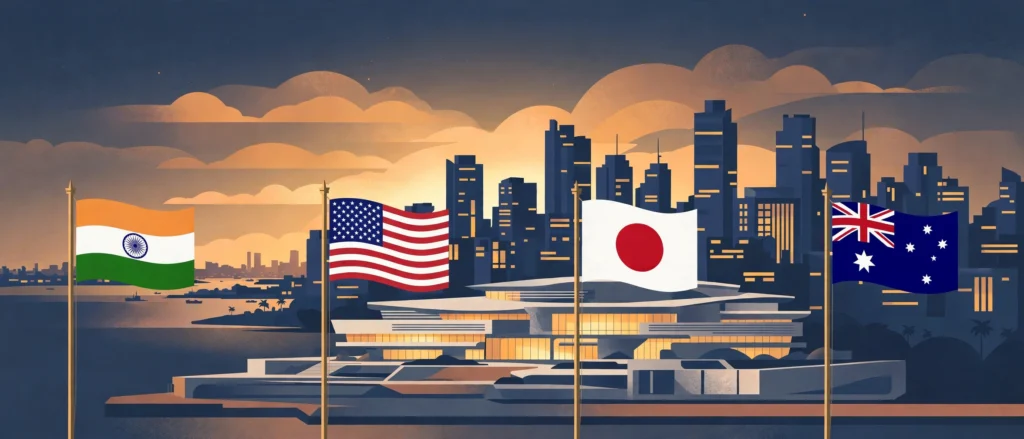
In the latest Trump news from Asia, President Donald Trump is set to sit down with the leaders of India, Japan and Australia in Manila on Tuesday evening, November 17, for the first Quad leaders' summit in more than two years. The meeting of the Quadrilateral Security Dialogue, the four-nation grouping of the United States, India, Japan and Australia, will be the first since September 2024 and the first ever held in a country that is not a member. It comes on the sidelines of the ASEAN summits in the Philippines, where Prime Minister Narendra Modi is attending a three-day programme. The agenda, according to officials briefed on the preparations, is dominated by two practical questions: securing the supply chains for the critical minerals that power modern industry, and keeping the commercial shipping lanes carrying the region's energy supplies safe from attack.
The four leaders expected around the table are Modi, Trump, Japanese Prime Minister Sanae Takaichi and Australian Prime Minister Anthony Albanese. Sources in New Delhi confirmed the plan to The Hindu on Saturday, November 14, saying the meeting was expected on Tuesday evening. In Washington, US officials confirmed that Trump will take part in a multilateral meeting with the Quad leaders, Reuters reported. India's foreign ministry has been more cautious: spokesperson Randhir Jaiswal said on Friday, November 13, only that the ministry would keep reporters updated, and officials confirming the summit on Saturday evening were still awaiting formal intimation of its timing.
Trump Administration: The Manila Stop on a Packed Asia Trip
For the Trump administration, the Manila meeting is the first stop on a crowded itinerary that carries the president from Southeast Asia to China within four days. Trump is due to arrive in Manila on Tuesday, where he will also meet Philippine President Ferdinand Marcos Jr. and attend the ASEAN-US Special Summit, a plan the Department of Foreign Affairs confirmed on November 11. It is his first ASEAN gathering in the Philippines since 2017, and his first major overseas trip since the midterm elections of November 3, when his party lost control of both houses of Congress. From Manila he travels to Shenzhen, China, for the APEC summit, where he is scheduled to meet Chinese President Xi Jinping for a bilateral meeting and working lunch on Thursday, November 19, then join the first-ever three-way meeting with Xi and Russian President Vladimir Putin.
The sequencing matters: the Quad session comes first, giving Trump a meeting with three close partners before he faces the two leaders with whom Washington's relationships are most strained. The ASEAN summit opened in Manila on Sunday with tariff tensions dominating the first day, and a Quad meeting focused on minerals and shipping lanes is a chance for the administration to talk about what it is building in Asia, rather than only about the barriers it has raised.
White House News: What Washington Has Confirmed
The White House news out of Washington so far has been measured rather than triumphant. Officials confirmed the president's participation in the multilateral meeting with the Quad leaders and outlined the issues expected to feature, but promised no concrete outcomes. According to Reuters, the officials said supply chains for critical minerals and the security of commercial shipping lanes for energy supplies would be a key part of the agenda. One official added that attacks on commercial ships were very likely to be taken up, pointing at the dangers facing merchant vessels in the waterways around the Middle East and the Black Sea. A Quad Business Forum mechanism, bringing companies from the four countries into the grouping's work, may also be announced, according to reporting on the preparations.
The caution is deliberate: the White House has described the week's later meeting with Xi and Putin as the start of a conversation, not a negotiation expected to produce an agreement, and the same applies to Manila. The meeting is a restart at the top level, not a deadline for decisions.
Marco Rubio News: How Manila Became the Venue
The choice of Manila has its own backstory, and the Marco Rubio news around it explains why the summit is happening on borrowed ground. The US Secretary of State had earlier indicated that Manila would host the next Quad leaders' summit, and the Philippines, which is not a member, is hosting it on the sidelines of the ASEAN summits it is chairing this year. India chairs the Quad and was due to host in 2025, but the meeting never happened, mainly because of the US President's unavailability, according to sources cited by The Hindu. India may yet host in Delhi next year, but for now the grouping has taken the pragmatic route of meeting where the leaders already are.
The arrangement underlines how unusual this summit is: the first Quad leaders' meeting held in a country that is not a member, and the first since the fourth leaders' summit in Wilmington, Delaware, in September 2024, hosted by then President Joe Biden. The gap has fed speculation about the grouping's health, which Washington has pushed back on. The formal host had not been clarified as of the weekend, but the plan was confirmed by sources in both New Delhi and Washington.
Iran War News: Why Shipping Lanes Top the Agenda
The most urgent item on the Manila agenda is the safety of commercial shipping, and the Iran war news behind it explains why the issue is personal for India. At least 30 Indian seafarers aboard ships in the Strait of Hormuz, the Sea of Oman and the Black Sea have been killed in attacks during the conflicts in Iran and Ukraine, according to The Hindu. The leaders are expected to consider the security of the shipping lanes carrying energy supplies through those chokepoints, and the attacks on merchant vessels are very likely to be raised directly, according to the US official who briefed reporters.
The shipping discussion sits alongside the other big economic item: critical minerals. The leaders are expected to consider supply-chain security for the minerals used in batteries, electronics and defence equipment, where processing capacity matters as much as the raw deposits. The Quad's foreign ministers adopted a Critical Minerals Initiative Framework in New Delhi on May 26, 2026, and the leaders' discussion builds on that work. Any discussion of minerals in Manila should not be treated as a binding agreement, but the direction is clear: the four countries want supply chains for the materials of the energy transition to run through friendly ports, and they want the ships carrying them to arrive safely.
Trump Tariffs: The Trade Backdrop in Manila
Trade runs through everything in Manila this week, and the Trump tariffs dominating the ASEAN summit's opening days form the backdrop to the Quad meeting as well. Modi arrived in the Philippines with maritime security, trade and regional defence cooperation high on India's agenda, according to Bloomberg, and his programme runs from November 16 to 18 for the ASEAN-India Summit and the East Asia Summit. India-ASEAN bilateral trade reached 128.38 billion dollars in the financial year 2025-26, and the ASEAN trade agreement review, the Act East policy, defence sales including the BrahMos missile system to the Philippines, and Myanmar are all part of the wider programme he is carrying into the week.
The Quad's own economic agenda fits into that picture. Critical minerals and shipping lanes are trade issues as much as security issues, and the leaders' discussion will touch the same questions the ASEAN summit has debated all week: who controls the supply chains, and who bears the cost when they are disrupted. For India, the stakes are concrete: its economy depends on crude oil imported through vulnerable sea routes, and its manufacturers need reliable access to the minerals in everything from phones to fighter jets. The Manila meeting will not settle the tariff arguments hanging over the ASEAN summit, but it gives the four Quad leaders a forum to talk about the economics of the Indo-Pacific on their own terms.
US Politics: Why the First Quad Summit Since 2024 Matters
In US politics, the Quad is an unusual creature: an informal grouping, not a treaty alliance, that has survived changes of government in all four member countries. It was revived in 2017 and upgraded to leader level in 2021, and its work spans maritime security, regional stability, critical technologies, infrastructure and the shared goal of a free and open Indo-Pacific. The leaders last met in September 2024, and the foreign ministers have kept the machinery turning since then, including the May 2026 meeting in New Delhi that produced the minerals framework. The Manila summit is the first leaders' meeting of Trump's second term, and a test of whether the grouping still commands four busy heads of government's attention.
The test matters because the Quad's value has always been in what its leaders choose to do with it. At its best, it coordinates the four countries on the practical problems of the region: keeping sea lanes open, building infrastructure without political strings, and making sure the supply chains for critical technologies do not depend on a single source. At its weakest, it is a photo opportunity that produces a statement and little else. The two-year gap since Wilmington has left both readings available. A joint statement naming concrete steps on minerals and shipping, a Business Forum that gives companies a role, and a commitment to meet again would point to a grouping that is working; a vague communique and no follow-up would point the other way.
What Happens Next
All eyes now turn to Tuesday evening. The first things to watch for are the simplest: a joint statement, any Quad Business Forum announcement, and progress on the critical minerals framework the foreign ministers adopted in May. The second is whether Modi and Trump hold a separate bilateral meeting alongside the Quad session, a possibility that has attracted attention but whose scheduling remains to be confirmed. The third is the tone the leaders strike in public, which will signal whether the grouping intends to meet at leader level regularly again after its two-year pause.
From Manila, Trump travels to Shenzhen for the APEC summit and the first-ever three-way meeting with Xi and Putin on Thursday, which the White House has said will focus on nuclear arms reduction and the war in Iran. What happens in Manila will shape that encounter: agreement on minerals and shipping would send the president into Shenzhen with three partners behind him, while a thin outcome would leave the trilateral as the week's defining event. Either way, the Manila summit is the moment the Quad returns to the top table after two years away, and Tuesday evening will show whether the grouping still has the momentum its founders claimed.
Source: The Hindu