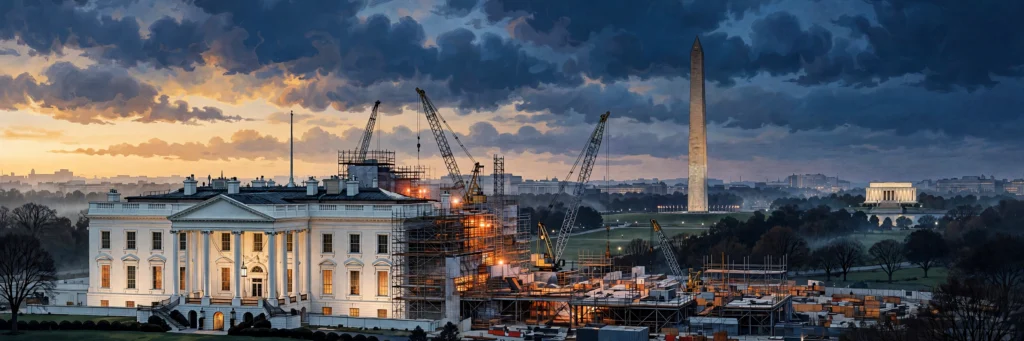
Trump Approval Rating: Poll Finds Majority Oppose Projects
The latest trump approval rating news is a rebuke delivered in bricks, marble and steel. A new Washington Post poll finds that a majority of Americans disapprove of President Donald Trump’s construction projects in Washington, his programme of building and remodelling across the capital. The survey, published on Saturday, found opposition that runs across party lines, with the president’s efforts to remake Washington facing significant resistance even among Republicans, the voters who form the core of his support. It is the latest in a run of surveys delivering the same message for more than a year: the American public likes the idea of a grander capital far less than the president does.
The finding matters because the building programme is not a side project for this White House. Trump has described the beautification of Washington as one of the strongest legacies of his second term, and he has told advisers that it inspires pride in the country. Aides have privately encouraged him to focus on other things, but the president has largely rejected that advice. On the Monday before the midterm elections, he spent nearly an hour at the Lincoln Memorial Reflecting Pool talking about the work: rusty pipes, graffiti, fountains and monuments, and the resodding of the National Mall. “The president’s a builder. You can’t keep him away,” Interior Secretary Doug Burgum said at the event. The polls suggest the voters he is trying to impress see the building as a symbol of misplaced priorities at a moment when most Americans say the cost of living is their dominant concern.
Trump approval rating: what the new poll found
The Washington Post poll is the freshest entry in a long polling record on the president’s building plans, and the earlier surveys explain why the new finding lands as confirmation rather than surprise. In July, a Washington Post-Ipsos poll of more than 2,600 adults found that nearly two in three Americans felt negatively about the three projects at the centre of the programme: the White House ballroom, the 250-foot triumphal arch and the redesign of the Lincoln Memorial Reflecting Pool. Sixty-five percent of respondents said they were dissatisfied or upset, with 27 percent choosing dissatisfied and 38 percent choosing upset, while only 32 percent said they were enthusiastic or satisfied. The July 8–13 survey found that about nine in ten Democrats viewed the proposals negatively, and that disapproval among independent voters reached 73 percent. Nearly seven in ten Republican respondents took a positive view, but that still left a substantial minority of the president’s own party unconvinced.
The same pattern showed up when voters were asked about the projects one by one. An ABC News/Washington Post/Ipsos poll conducted in late April found that 56 percent of Americans opposed tearing down the East Wing of the White House to make way for the ballroom, against 28 percent who supported it and 15 percent who were unsure. Strong opposition outweighed strong support by about three to one, 47 percent to 16 percent. The results were nearly identical to an October 2025 survey by the same pollsters, suggesting that months of debate and construction had not moved public opinion at all. The arch drew even less support: 52 percent opposed the plan and 21 percent supported it, with 26 percent unsure. The addition of Trump’s signature to paper currency was the least popular proposal of all, opposed by 68 percent and supported by just 12 percent.
The polling also captures a president whose standing has fallen to record lows across the board. An ABC News/Washington Post/Ipsos poll conducted in the run-up to the midterm elections found Trump’s approval rating at 33 percent, a record low for him, with 66 percent of Americans disapproving and 52 percent disapproving strongly. Majorities disapproved of his handling of every issue measured, and on the economy, 28 percent approved while 70 percent disapproved, also a record. About seven in ten Americans said petrol was unaffordable and that the country was headed in the wrong direction. In the same survey, 59 percent said Trump was focused too much on building projects in Washington, against 11 percent who said too little and 27 percent who said the right amount. A separate Economist/YouGov survey conducted from November 9 to 11 put his approval at 32 percent, with 63 percent disapproving. In that survey, 57 percent of respondents opposed the proposed arch, and half said Congress should not allow construction of the White House ballroom to continue.
Election polls: the ballroom, the arch and the Reflecting Pool
The ballroom is the centrepiece of the programme and the project voters know best. The administration announced the construction of a 90,000-square-foot ballroom in July 2025, with Trump promising that it would not interfere with the current building. Demolition of the East Wing began in late October 2025, and the new hall, designed to seat 650 people for state occasions, is rendered in the administration’s plans as a gilded space with coffered ceilings, chandeliers and floor-to-ceiling arched windows. The price has climbed steadily: presented at first as a 300 million dollar undertaking paid for by private donations, then described as a 400 million dollar project, it had reached 600 million dollars by July 2026, with taxpayers on the hook for more than half of the cost. The ballroom is being built under a no-bid contract, as is the work on the Reflecting Pool. A Financial Times investigation estimated that the combined cost of the president’s Washington projects would exceed one billion dollars.
The arch has become the most contested of the three projects. The plan calls for a 250-foot structure at Memorial Circle, between the Lincoln Memorial and Arlington National Cemetery, more than twice as tall as the Lincoln Memorial itself. Public reaction has been overwhelming: more than 99 percent of the comments submitted to the National Capital Planning Commission about the arch criticised the project, according to an analysis by USA Today. The opposition sharpened into a legal fight in November, when nine members of the Kennedy family filed a lawsuit seeking to stop the arch, arguing that the project was unlawful and violated the laws established by Congress to protect the national memorial. The family members, including Edward Kennedy Jr. and former congressman Joe Kennedy, pointed to an analysis showing that the arch would cast a shadow over the John F. Kennedy Eternal Flame grave site in Arlington National Cemetery for up to nine minutes on 18 days of the year. A federal judge ordered construction halted temporarily, and the White House publicly criticised the judge’s order.
Midterm elections 2026: the politics behind the numbers
The poll numbers help explain the result of the midterm elections on November 3, when Democrats won control of both the House of Representatives and the Senate. The building programme became a campaign issue in its own right, a visible shorthand for the argument that the president was spending his political capital on monuments while voters worried about prices. The new Congress does not convene until January 3, but the election has already changed what happens to the projects, because the Democrats who will take the gavels have put the construction programme on their list of investigations.
That shift is already visible. On November 5, Senator Richard Blumenthal of Connecticut, the ranking Democrat on the Senate Permanent Subcommittee on Investigations, renewed requests for records from donors to the White House ballroom, including defence contractors Palantir and Lockheed Martin. He asked recipients to begin producing records by November 30 and said the subcommittee would look for other ways to obtain them if the donors failed to comply voluntarily by January 4. Democrats have said they intend to examine the ballroom’s financing, the use of no-bid contracts, and the financial dealings of the president’s associates, alongside inquiries into immigration enforcement, government spending and the Iran war. The White House, anticipating the scrutiny, has hired fifteen new lawyers for its counsel’s office and warned Democrats that their planned investigations could amount to blatant criminality, a claim that has itself become a flashpoint.
The partisan shape of the polling also tells a story about the president’s coalition. The ballroom is opposed by nearly nine in ten Democrats and about six in ten independents, but it also divides Republicans: 22 percent of Republicans opposed the project in the October 2025 survey, and only 51 percent of Republicans supported the arch in the April poll, with support falling to 23 percent among non-MAGA Republicans even as it reached 59 percent among MAGA Republicans. That is the significant Republican opposition the new Washington Post poll highlights, and it matters because the projects are the president’s personal initiative rather than a party platform. When a president’s signature undertaking loses a fifth or more of his own party in the polls, it becomes a problem that no amount of rallies can fix.
White House news: what happens next
What happens next will be decided in three places at once. In the courts, the Kennedy family’s lawsuit will test whether the arch can proceed at all, and the temporary halt ordered by the federal judge is the first time any of the projects has been stopped by a court rather than by public opinion. In Congress, the new Democratic majorities take their seats on January 3 with subpoena power in both chambers, and the ballroom’s donors face a November 30 deadline to begin producing records voluntarily, with January 4 as the point at which the subcommittee says it will look for other ways to obtain them. The White House’s legal preparations, including the fifteen new lawyers in the counsel’s office and an August opinion from the Justice Department’s Office of Legal Counsel on the scope of executive privilege, suggest a fight that could run for years.
In Washington itself, construction continues. The ballroom is rising on the site of the demolished East Wing, the Reflecting Pool work goes on, and the arch remains in dispute. The president has shown no sign of reconsidering the programme, and his election-eve speech suggested the opposite: that he regards the building as a legacy worth defending in public, even in the final hours of a campaign. The polls, however, have been consistent for more than a year, from October 2025 through the November surveys, and they point in one direction. A majority of Americans disapprove of the construction projects, a majority say the president is focused too much on building, and half of the public says Congress should not allow the ballroom to continue. Whether the new Congress acts on that sentiment, and whether the courts halt the arch for good, will determine whether the president’s building programme survives its own unpopularity.
Source: The Washington Post