US News Today: 2,000 Flights Canceled After FAA Stop
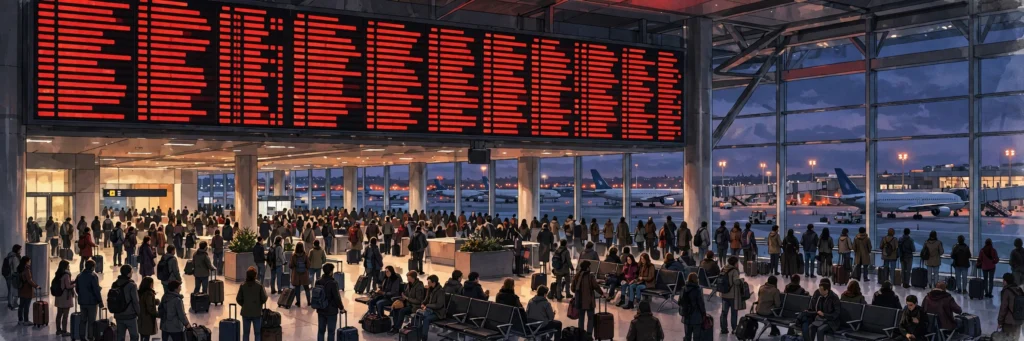
The top story in us news today is not the ground stop itself, but what came after it. More than 2,000 flights were canceled across the US on Saturday, November 14, as airlines worked to dig out from the longest nationwide ground stop in 25 years, which stranded passengers and forced professional and college sports teams to scramble for alternate transportation. FlightAware’s tally put it at more than 2,500 canceled Saturday, with hundreds more delayed. The difference between the two figures, more than 2,000 canceled and more than 2,500 in FlightAware’s tally, reflects the scale of a disruption that was still growing as Saturday unfolded, and it shows how a stop that lasted a little over four hours on Friday could still be canceling thousands of flights the next day. The cancellations on Saturday are the aftermath, and they are the story now: planes out of place, crews out of place, passengers stranded, and sports teams scrambling to reach Saturday games.
The ground stop was issued Friday, November 13, at about 3:54 p.m. ET and lifted around 8:15 p.m. ET after lasting more than four hours. It was the first nationwide stop since January 2023, when a key FAA computer system malfunctioned, and only the second since the September 11, 2001 attacks. Those two comparisons place Friday’s stop in a narrow and serious category. A nationwide ground stop is rare. The last one was in January 2023, and before that, the only other one since September 11, 2001, was the stop that followed the attacks themselves. Friday’s stop, lasting more than four hours, from about 3:54 p.m. ET to around 8:15 p.m. ET, was the longest nationwide ground stop in 25 years. The length matters because a stop of that duration, in the middle of a Friday afternoon and evening, does not end when the stop is lifted. It leaves behind a backlog of flights, crews, and passengers that takes days to clear, and Saturday’s cancellations are the first full measure of that backlog.
The reason given for the stop was technical. Trump administration officials said new technology being added to the nation’s air traffic control system overloaded antiquated equipment and caused “intermittent” communications and radar gaps. That explanation, that new technology overloaded old equipment, is the account offered by officials for why the system faltered on Friday afternoon. The communications and radar gaps were described as “intermittent,” which means they came and went rather than failing all at once, and that intermittency is part of why a nationwide stop was issued: when communications and radar cannot be relied on consistently, the safest course is to stop departures nationwide until the gaps are resolved. The stop was lifted around 8:15 p.m. ET, after lasting more than four hours, and the airspace was then reopened. But the reopening did not undo the disruption. It only allowed the work of clearing it to begin, and Saturday’s more than 2,000 cancellations, more than 2,500 by FlightAware’s tally, with hundreds more delayed, show how much work remained.
US news today: Saturday’s cancellations and delays
More than 2,000 flights were canceled across the US on Saturday, November 14, and FlightAware’s tally put it at more than 2,500 canceled Saturday, with hundreds more delayed. Those numbers are the headline of the Saturday aftermath, and they need to be read together. The figure of more than 2,000 canceled is the broad count of cancellations across the US on Saturday. FlightAware’s tally of more than 2,500 canceled Saturday is a specific count from the flight-tracking service, and it is higher than the broader figure, which suggests the total was still rising as the day went on. Hundreds more flights were delayed, which means the disruption on Saturday was not only cancellations but also delays, with passengers waiting for flights that were still operating but behind schedule. The combination of cancellations and delays is the shape of a system digging out: some flights are removed from the schedule entirely, others are kept but pushed back, and passengers are left to wait, rebook, or find another way to travel.
The effect on professional and college sports teams is a concrete example of how the disruption spread beyond ordinary passengers. The ground stop stranded passengers and forced professional and college sports teams to scramble for alternate transportation. Sports teams travel on tight schedules, with games on Saturday that cannot easily be moved, and a nationwide stop on Friday afternoon left them looking for other ways to get to their games. The scramble for alternate transportation is not a detail. It is a sign of how a stop that affects the whole country at once reaches into parts of life that are not usually thought of as aviation stories. A team that cannot fly to a Saturday game has to find another route, another flight, or another mode of travel, and the fact that teams were scrambling shows that the disruption was felt immediately, on Friday evening, before Saturday’s cancellations even began.
Secretary of Transportation Sean Duffy said the airspace was now “opened up” and blamed “old hardware” for the travel chaos. He encouraged NCAA football teams to reach out to the FAA so the agency could prioritize flights for Saturday games. That encouragement is a direct response to the problem facing sports teams. By asking NCAA football teams to reach out to the FAA, Duffy was offering a way for the agency to prioritize flights for Saturday games, so that teams could get to where they needed to be. The prioritization is a practical measure for a specific problem: Saturday games that depend on Friday and Saturday travel, and teams that were stranded by the stop. Duffy’s description of the airspace as now “opened up” is the official account of the current state of the system: the stop has been lifted, the airspace is open, and the work now is to clear the backlog. His blame for “old hardware” points to the equipment at the centre of the official explanation, the antiquated equipment that officials said was overloaded by new technology being added to the air traffic control system.
Secretary of Homeland Security Markwayne Mullin told reporters at the White House that no one was in any danger and that more than 3,000 flights were safely landed on Friday. That statement addresses the safety question directly. More than 3,000 flights were safely landed on Friday, even as the ground stop was in effect, and no one was in any danger, according to Mullin. The safe landing of more than 3,000 flights on Friday is a measure of how the system handled the stop: departures were halted nationwide, but flights already in the air were brought down safely. The number, more than 3,000 safely landed, is a reassurance, and it is also a measure of scale. Thousands of flights were in the air when the stop was issued at about 3:54 p.m. ET, and all of them had to be landed safely before the system could be reopened around 8:15 p.m. ET. Mullin’s statement, made to reporters at the White House, was part of the administration’s effort to explain what happened on Friday and to reassure the public that the stop itself did not put passengers in danger.
Breaking news: why the stop happened
Trump administration officials said new technology being added to the nation’s air traffic control system overloaded antiquated equipment and caused “intermittent” communications and radar gaps. That is the explanation offered for the stop, and it has two parts: new technology being added, and antiquated equipment that was overloaded by it. The new technology is being added to the nation’s air traffic control system as part of an overhaul, and the antiquated equipment is the older hardware that the system still relies on. When the new technology overloaded the old equipment, the result was “intermittent” communications and radar gaps, gaps that came and went and could not be relied on. The word “intermittent” matters, because it describes a problem that is not a single failure but a series of gaps, and a series of gaps in communications and radar is enough to justify a nationwide stop. The FAA’s decision to issue a ground stop at about 3:54 p.m. ET on Friday, November 13, and to lift it around 8:15 p.m. ET after more than four hours, was the response to those gaps.
The FAA has already replaced thousands of old copper wires with fiber optic lines and upgraded hundreds of radio systems as part of an overhaul that began last year after Congress approved $12.5 billion of funding. That overhaul is the context for the new technology being added, and it is also the context for the old hardware that Duffy blamed. Thousands of old copper wires have already been replaced with fiber optic lines, and hundreds of radio systems have already been upgraded, as part of an overhaul that began last year. Congress approved $12.5 billion of funding for that overhaul. The scale of the funding, $12.5 billion, and the scale of the work already done, thousands of wires and hundreds of radio systems, show that the modernization is well under way. But the stop on Friday shows that the work is not complete, and that the antiquated equipment still in place can be overloaded when new technology is added. The overhaul began last year, and it is continuing, but Friday’s stop is a reminder that the transition from old to new is itself a period of risk, when new and old systems have to work together and can interfere with each other.
Duffy’s blame for “old hardware” and the officials’ account of new technology overloading antiquated equipment point to the same cause. The hardware is old, the technology is new, and the combination produced gaps in communications and radar. The overhaul, with $12.5 billion in funding from Congress, is meant to replace that old hardware, and thousands of copper wires have already been replaced with fiber optic lines, with hundreds of radio systems upgraded. But the replacement is not finished, and Friday’s stop happened in the middle of that process. The question for the days ahead is not only how quickly Saturday’s cancellations can be cleared, but how the overhaul proceeds, and whether the addition of new technology can be managed without overloading the equipment that remains.
Live news updates: how long the effects will last
Officials said the effects could be felt for days, but the system is likely to be operating normally in time to handle the Thanksgiving travel rush. That is the official forecast for the recovery, and it has two parts. The first part is that the effects could be felt for days, which means Saturday’s cancellations are not the end of the disruption. The backlog from a stop lasting more than four hours, from about 3:54 p.m. ET to around 8:15 p.m. ET on Friday, does not clear in a single day. Airlines have to reposition planes and crews, rebook passengers, and restore their schedules, and that work takes time. The second part is that the system is likely to be operating normally in time to handle the Thanksgiving travel rush, which is the next major test for the system. Thanksgiving is one of the busiest travel periods of the year, and the official expectation is that the system will be back to normal by then. The forecast is therefore both a warning and a reassurance: expect effects for days, but expect normal operations by Thanksgiving.
The Thanksgiving travel rush is the horizon against which the recovery will be measured. If the system is operating normally by then, the disruption will have been contained to the days after Friday’s stop. If it is not, the consequences would be far larger, because Thanksgiving travel involves many more passengers and many more flights than a normal weekend. Officials said the system is likely to be operating normally in time, which is a prediction, not a guarantee, but it is the prediction the administration is offering. The days between Saturday, November 14, and Thanksgiving will show whether that prediction holds, and Saturday’s cancellations, more than 2,000 across the US, more than 2,500 by FlightAware’s tally, with hundreds more delayed, are the starting point for that recovery.
All US-bound traffic departing from Eurocontrol member states was suspended at the FAA’s request because of the technical issues. That suspension is a measure of how far the stop reached. Eurocontrol member states are the European countries whose air traffic is coordinated through Eurocontrol, and US-bound traffic departing from those states was suspended at the FAA’s request. The suspension was not limited to flights within the US. It extended to flights departing from Europe for the US, because those flights would have arrived in US airspace affected by the technical issues. The FAA’s request to suspend that traffic shows that the stop was treated as a nationwide and international matter, not only a domestic one, and it shows that the technical issues, the “intermittent” communications and radar gaps, were considered serious enough to halt incoming traffic from Europe as well as departures within the US.
Top news stories today: a stop with rare precedent
The ground stop was the first nationwide stop since January 2023, when a key FAA computer system malfunctioned, and only the second since the September 11, 2001 attacks. That history is what makes Friday’s stop so notable, and it is what makes Saturday’s cancellations so significant. A nationwide stop has happened only twice since September 11, 2001: once in January 2023, when a key FAA computer system malfunctioned, and now on Friday, November 13, 2026. The January 2023 stop was caused by a malfunction in a key FAA computer system. Friday’s stop was caused, according to officials, by new technology overloading antiquated equipment and causing “intermittent” communications and radar gaps. The causes are different, but the rarity is the same. A nationwide stop is an exceptional measure, taken only when the system cannot be relied on, and it has now been taken twice in less than four years, after not being taken at all in the years between September 11, 2001, and January 2023.
The stop was also the longest nationwide ground stop in 25 years. Lasting more than four hours, from about 3:54 p.m. ET to around 8:15 p.m. ET, it exceeded the duration of the January 2023 stop and any other nationwide stop in the last 25 years. The length is part of why the aftermath has been so large. A stop of more than four hours, in the middle of a Friday afternoon and evening, removes a large block of departures from the schedule, and it leaves behind a backlog that cannot be cleared quickly. Saturday’s cancellations, more than 2,000 across the US, more than 2,500 by FlightAware’s tally, with hundreds more delayed, are the direct consequence of that length. The longer the stop, the larger the backlog, and the more days it takes to clear.
The site already published “US News Today: FAA Lifts Nationwide Ground Stop” on November 13, and this article is the Saturday aftermath, led by the cancellations, not a re-telling of the ground stop itself. That distinction matters, because the ground stop has already been covered, and the new story is what happened after it was lifted. The stop was lifted around 8:15 p.m. ET on Friday, after lasting more than four hours. The airspace was then “opened up,” in Duffy’s words. But the opening of the airspace did not end the story. It began the recovery, and Saturday’s cancellations are the first full day of that recovery. The focus of this article is therefore on Saturday: the more than 2,000 flights canceled, the more than 2,500 in FlightAware’s tally, the hundreds more delayed, the sports teams scrambling for alternate transportation, and the officials’ forecast that effects could be felt for days but the system is likely to be operating normally in time for Thanksgiving.
What happens next for passengers and airlines
For passengers, the days ahead will be shaped by the backlog. Officials said the effects could be felt for days, which means that Saturday’s cancellations may not be the last. Airlines are working to dig out from the longest nationwide ground stop in 25 years, and digging out takes time. Planes need to be repositioned, crews need to be rested and reassigned, and passengers need to be rebooked. The more than 2,000 cancellations on Saturday, and the hundreds more delays, are the visible part of that work, and they will be followed by further cancellations and delays as the system clears. The forecast that the system is likely to be operating normally in time to handle the Thanksgiving travel rush is the horizon for that work, and it will be tested in the days leading up to Thanksgiving.
For the FAA and the administration, the days ahead will be shaped by the overhaul. The FAA has already replaced thousands of old copper wires with fiber optic lines and upgraded hundreds of radio systems as part of an overhaul that began last year after Congress approved $12.5 billion of funding. That overhaul will continue, and the question is how it proceeds after Friday’s stop. The stop was caused, according to officials, by new technology overloading antiquated equipment, and Duffy blamed “old hardware” for the travel chaos. The overhaul is meant to replace that old hardware, but the stop shows that the process of replacing it can itself cause disruption. The work of the overhaul, and the work of clearing Saturday’s backlog, will proceed in parallel, and both will be watched closely in the days ahead.
For sports teams, the immediate problem was Saturday’s games. Duffy encouraged NCAA football teams to reach out to the FAA so the agency could prioritize flights for Saturday games, and that prioritization was a direct response to the scramble for alternate transportation that followed the stop. Professional and college sports teams were forced to scramble, and the FAA’s willingness to prioritize flights for Saturday games was a way to help them reach their destinations. Whether that prioritization was enough, and how many teams were affected, will be part of the fuller picture of Saturday’s disruption, alongside the cancellations and delays that affected ordinary passengers.
The Saturday aftermath, in the end, is a story of a rare event and its consequences. A nationwide ground stop, the first since January 2023 and only the second since September 11, 2001, the longest in 25 years, lasting more than four hours from about 3:54 p.m. ET to around 8:15 p.m. ET on Friday, November 13, caused by new technology overloading antiquated equipment and creating “intermittent” communications and radar gaps, led to more than 2,000 flights canceled on Saturday, November 14, more than 2,500 by FlightAware’s tally, with hundreds more delayed. More than 3,000 flights were safely landed on Friday, no one was in any danger, according to Mullin, and the airspace was “opened up,” according to Duffy. All US-bound traffic from Eurocontrol member states was suspended at the FAA’s request. The effects could be felt for days, but the system is likely to be operating normally in time for Thanksgiving. Those are the facts of the Saturday aftermath, and they are the facts that will shape the days ahead.
Source: AP